

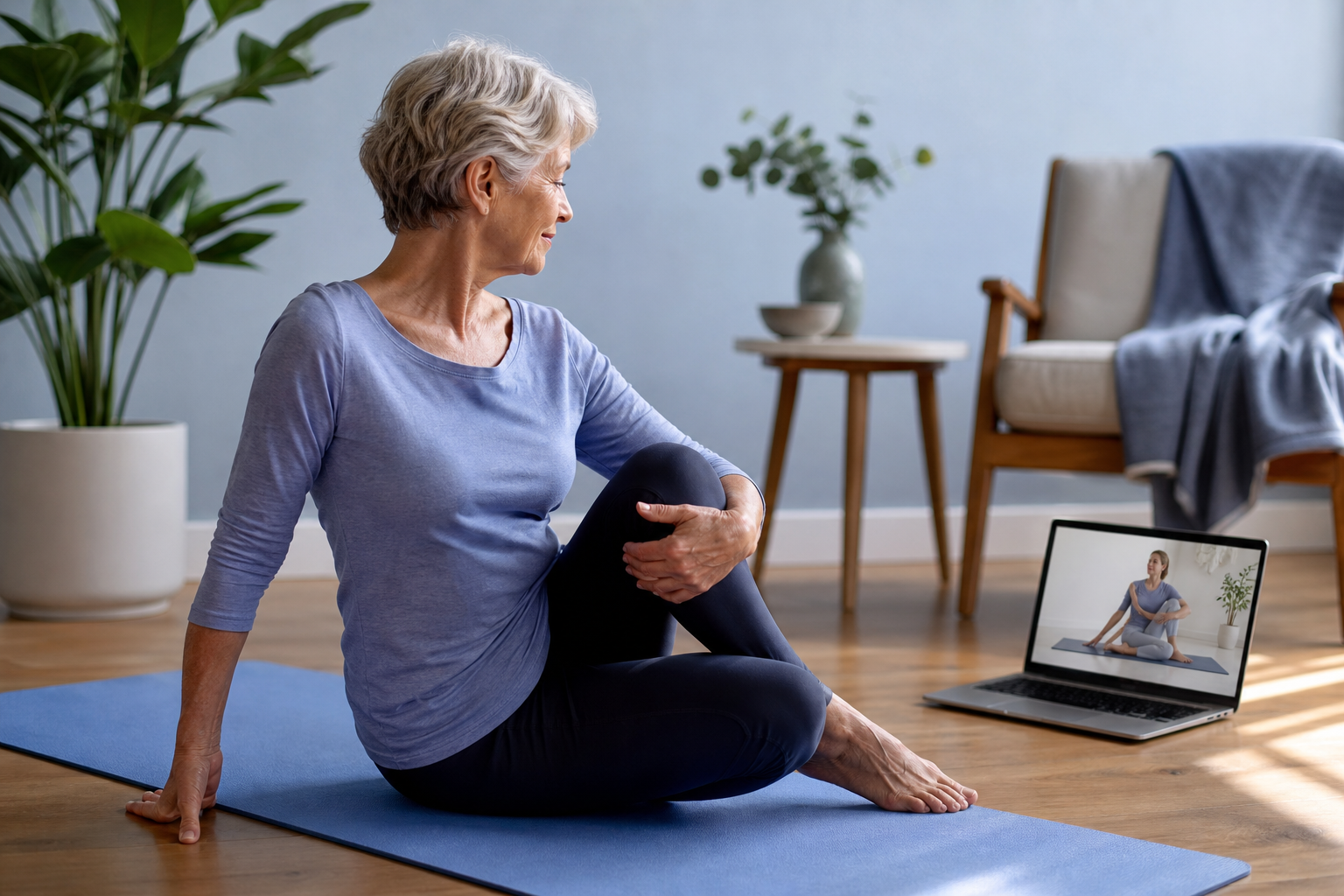
A good online yoga program for seniors goes beyond gentle poses. It pairs instructors with verified geriatric or clinical credentials, offers pose modifications and chair support, runs in a format that matches the student's schedule and tech comfort, and provides clear safety guidance for common conditions like arthritis and balance issues. Knowing what to look for matters, because the market is flooded with programs that simply label a standard class "gentle" and call it senior-friendly.
More options have made the choice harder, not easier. Platforms compete for attention with polished thumbnails and low prices, but very few are designed with older bodies in mind. This guide gives seniors and caregivers a concrete framework to evaluate any program on credentials, format, safety design, and technical access.
Why More Seniors Are Turning to Online Yoga
Online yoga has grown well beyond a pandemic habit. According to Yoga Earth's 2026 report, 8.0% of adults aged 65 and older practiced yoga in 2022, against an overall adult participation rate of 16.9%. That gap suggests significant room for growth among older adults, and online delivery is one reason participation is rising. ZipDo's 2026 report puts online yoga platforms at more than 52 million monthly active users in 2023.
For seniors specifically, the appeal is practical. Driving to a studio, managing parking, and keeping a fixed class schedule can be real barriers, especially for those with mobility limitations or who live in rural areas. Online classes remove those obstacles entirely.
Social connection is another factor: many live online programs include a community component, which can help counter isolation. The key is finding a program that actually delivers these benefits safely, rather than one that markets to seniors without designing for them.
What Type of Yoga Is Best for Seniors?
Not all yoga styles suit older bodies equally. Filter by style before you evaluate credentials or pricing. Three styles consistently appear in clinically oriented senior programs, and each serves a different need.
Chair Yoga
Chair yoga adapts standing and floor poses to be performed seated or with a chair for support. It is the most accessible starting point for beginner yoga for seniors online, particularly for anyone with significant balance concerns, recent joint replacement, or limited floor mobility. Poses like seated cat-cow, chair warrior, and supported forward folds provide range-of-motion work without the risk of falling.
Gentle Yoga
Gentle yoga uses slower pacing, longer holds, and reduced intensity compared to styles like Vinyasa or Ashtanga. It typically includes standing poses, light balancing work, and basic pranayama (yogic breathing techniques). A well-designed gentle class for seniors will include verbal cues for modifications throughout, not just at the start of a session.
Restorative Yoga
Restorative yoga uses props such as bolsters, blankets, and blocks to support the body in passive poses held for several minutes. It targets the nervous system more than the muscular system, making it appropriate for seniors managing chronic stress, fatigue, or pain conditions.
What to Watch For
Check that the style matches your current physical capacity, not where you hope to be in six months. A class labeled "gentle" that opens with a standing balance sequence and offers no chair modifications is not designed for seniors; it is a standard class with a softer name. Look for programs that explicitly name chair options, offer multiple difficulty levels within a single class, and address conditions like arthritis, osteoporosis, or limited hip mobility in their program descriptions.
Live Classes vs. On-Demand Videos: Which Format Works Better for Older Adults?
Both formats have real advantages. The right choice depends on your schedule, motivation style, and how much real-time feedback matters to you. One important note: ZipDo's 2026 data shows that 70% of online yoga course users complete less than two weeks of a course that typically runs eight to twelve weeks. Accountability structures, like live sessions with a set time, can help counter that pattern.
| Format | Best for | Engagement level | Tech needed | Instructor correction |
|---|---|---|---|---|
| Live (Zoom-style) | Seniors who want real-time feedback and social contact | High: fixed schedule creates routine | Stable internet, camera, microphone | Possible: instructor can see you and cue adjustments |
| On-demand video | Seniors who need schedule flexibility or practice at their own pace | Moderate: requires self-motivation | Basic internet or Wi-Fi, any device | None: corrections are pre-recorded and general |
| YouTube free videos | Seniors exploring styles before committing to a paid program | Low to moderate: no accountability structure | Basic internet, any device | None |
Live Zoom-style classes offer one feature on-demand video cannot: the instructor can see you. That matters for safety. An instructor who notices a student compensating with their lower back or locking their knees can cue a correction before it becomes an injury. For seniors new to yoga, this real-time feedback loop is worth prioritizing.
On-demand platforms give you full control over timing, which suits seniors managing unpredictable energy levels or caregiving responsibilities. The trade-off is that corrections are baked into the recording and may not address your specific pattern of movement.
Free YouTube content offers a wide range of senior yoga videos, but quality varies enormously and the platform does not vet instructor credentials. Many popular channels are run by fitness instructors without clinical or geriatric training. YouTube works well as a way to sample styles before committing to a structured program, not as a long-term safety-conscious practice on its own.
How to Evaluate Instructor Credentials for a Senior Yoga Program
Credentials are the single most important filter when choosing an online yoga program for seniors. A well-meaning instructor without relevant training can design sequences that are genuinely risky for older bodies, particularly those with osteoporosis, balance disorders, or post-surgical limitations.
Here is what to look for, in order of importance:
-
Geriatric or clinical specialization. A general Yoga Alliance RYT-200 or RYT-500 certification means an instructor completed a foundational teacher training. It does not mean they have studied aging physiology, fall prevention, or contraindications for common senior health conditions. Look specifically for credentials in geriatric yoga, adaptive yoga, or therapeutic yoga for older adults. These programs cover anatomy as it changes with age, safe sequencing for osteoporosis and arthritis, and how to modify for common medications that affect balance or blood pressure.
-
Medical or Ayurvedic background on the design team. The best senior programs are not built by instructors alone. Look for programs where the curriculum was reviewed or co-designed by physicians, physical therapists, or trained practitioners in systems like Ayurveda. This is especially relevant for programs targeting specific conditions rather than general wellness.
-
Transparent credential listing. Any credible program will display instructor qualifications on its website, not just a bio photo and a short paragraph about a personal yoga journey. If you cannot find where an instructor trained, for how long, and in what specialty, treat that as a gap.
-
Continuing education in senior health. Instructors who pursue ongoing training in fall prevention, chronic pain management, or breath-based practices for cardiovascular health are more likely to keep their teaching current.
-
Experience specifically with older populations. Years of teaching general adult classes do not automatically transfer to senior instruction. Ask or check whether the instructor has taught seniors in clinical, community, or rehabilitation settings, not just in a general wellness studio.
When evaluating the best yoga for seniors online, apply this checklist to any program before you look at pricing, class length, or platform features. Credentials are the foundation everything else rests on.
Safety Features Every Good Senior Yoga Program Should Include
A program can have credentialed instructors and still fall short on safety design. The way a class is structured, cued, and supported matters as much as who is teaching it.
Check for these features before enrolling:
-
Chair modifications offered throughout, not just mentioned once. A chair option named in the program description but absent from actual class cues is not a real modification. Every standing balance pose, every floor transition, and every inversion-adjacent movement should come with a seated or supported alternative.
-
Explicit contraindication guidance. Good programs name conditions, such as osteoporosis, glaucoma, recent hip replacement, or uncontrolled hypertension, and explain which poses to avoid or adapt. This information should appear in the class itself, not buried in a terms-of-service document.
-
Instructor visibility and clear demonstration. In a live class, you need to see the instructor's full body during demonstrations. In recorded content, camera angles should show alignment cues clearly, not just a close-up of a face. Poor production quality is a safety issue, not just an aesthetic one.
-
Pacing that allows time to settle into poses. Sequences designed for seniors should move more slowly than a standard adult class, with time built in for students to find their footing before the next cue arrives.
-
Community and check-in structures. Isolated practice carries its own risks. Programs that include a community forum or check-in feature give students a way to flag discomfort, ask questions between sessions, and stay connected. Seniors Yoga Online, for example, includes an interactive community tool specifically aimed at addressing isolation among seniors in remote areas, per einpresswire.com.
-
Clear emergency guidance. Any responsible online program should state at the start of each class that students should stop and rest if they feel pain, dizziness, or shortness of breath, and that the class is not a substitute for medical advice.
Technical Requirements for Joining Online Yoga Classes as a Senior
The technology barrier is real, but the actual requirements are modest. What you need depends on whether you are joining a live class or watching pre-recorded videos.
For live Zoom-style classes:
- A device with a camera and microphone: a laptop, tablet, or smartphone all work. A tablet propped on a stand is often the most practical option because the screen is large enough to see the instructor clearly without being tethered to a desk.
- A stable internet connection. A basic broadband connection handles video calls without interruption. If your connection is unreliable, position yourself closer to your router or use a wired connection if your device allows it.
- A clear, open space roughly six feet by four feet. You need room to extend your arms and step to the side without hitting furniture.
- A Zoom account, which is free to create. Most live senior yoga programs run on Zoom or a similar platform and will send you a link when you register.
For on-demand video and YouTube:
Steps one and three above still apply, but you do not need a camera or microphone. Any device with a browser or the YouTube app works. You can pause, rewind, and replay at any point, which is a genuine advantage when learning a new pose sequence.
If screen size is a concern, casting from a phone or tablet to a television using a streaming device makes the instructor much easier to see during a session.
Free and Low-Cost Options: YouTube, Trials, and Medicare-Supported Programs
Free options exist, and they are worth knowing about before you commit to a paid program.
YouTube carries a large volume of senior yoga content at no cost. Channels vary widely in quality, but searching for chair yoga or gentle yoga for seniors will surface instructors who post full-length classes regularly. Use YouTube to sample styles and identify what pacing and format suit you, rather than as a permanent practice home. Credential vetting is your responsibility there, since the platform does not screen instructors.
Many paid programs offer free trials, typically ranging from seven to fourteen days. A trial is the most useful evaluation tool available to you: it lets you assess instructor visibility, pacing, modification quality, and community features before spending anything.
Medicare-adjacent fitness programs, such as SilverSneakers, may cover access to certain online wellness classes depending on your health plan. Coverage details vary by plan and change periodically, so check directly with your insurer rather than relying on any third-party description. Haute Bodhi Yoga publishes free online guides covering gentle poses like chair pose and tree pose, per hautebodhi.com, which can supplement a structured program, though its primary focus is in-person hot yoga rather than senior-specific programming.
Free resources work best as entry points. A program designed specifically for older adults, with credentialed instructors and structured safety features, typically carries a cost.
When a Clinically Specialized Program Is the Better Choice
General senior yoga classes suit most older adults exploring movement and stress reduction. But some situations call for something more specific.
Managing a condition like osteoporosis, recovering from joint replacement, or living with a progressive neurological condition means a standard gentle class may not address your actual needs safely. The same applies if you are a yoga instructor or caregiver who wants to teach older adults: foundational teacher training does not cover aging physiology or clinical contraindications in enough depth.
hellomyyoga is an online wellness education platform built for yoga practitioners and instructors seeking that clinical depth. Its Geriatric Yoga Care teacher training is designed by doctors, vaidyas, and yoga chikitsa acharyas (clinical yoga specialists), covering the anatomy of aging, condition-specific sequencing, and safe practice design for older populations. This is the level of training that separates an instructor qualified to work with seniors from one who has simply attended a general teacher training.
Prices and plan limits verified as of October 2026.
FAQs
What is the best free yoga app for seniors?
No single app suits every senior. The most practical free starting point is YouTube, where instructors like Yoga with Adriene and several chair yoga specialists post full-length classes. For structured guidance, look for apps that offer a free trial so you can assess pacing, modifications, and instructor credentials before paying. The best free option is the one whose instructor has visible geriatric or adaptive training and whose class includes chair modifications throughout.
Is chair yoga effective for seniors with severe arthritis?
Chair yoga can support joint mobility, reduce stiffness, and improve circulation in people with arthritis, including severe cases. Seated poses remove the weight-bearing demands of standing sequences, which makes movement more accessible on high-pain days. Look for a program where the instructor explicitly addresses arthritis in the class description and offers modifications for hand, wrist, and knee involvement. Chair yoga is not a medical treatment, but many practitioners with arthritis report meaningful improvement in daily range of motion.
Can seniors with osteoporosis safely practice yoga online without in-person supervision?
With the right program, yes, though with important caveats. Osteoporosis requires avoiding deep forward folds, spinal twists past a safe range, and any pose that loads the spine under flexion. A program designed for osteoporosis will name these contraindications explicitly and offer alternatives. If your bone density loss is significant or you have had a recent fracture, consult your physician before starting any online program, and prioritize live classes where an instructor can see your alignment rather than pre-recorded video.
How long should a yoga session be for someone over 70?
A session of 20 to 45 minutes suits most adults over 70, particularly those new to yoga or returning after a long break. Shorter sessions practiced consistently three to four times a week tend to produce better results than longer sessions done infrequently. Programs designed for seniors typically structure classes in this range. If energy or concentration fades before the session ends, stopping early is always the right choice.
Do online yoga programs for seniors count toward Medicare fitness benefits?
Some do, depending on your specific Medicare Advantage plan. Programs affiliated with Medicare-supported fitness initiatives may be covered, but eligibility rules, covered platforms, and plan availability change regularly. The most reliable way to check is to call your plan directly and ask which online wellness programs are currently included. Do not assume coverage based on a program's marketing language alone.
Conclusion
A good online yoga program for seniors is built around three things: instructors with verifiable geriatric or clinical credentials, class design that includes real modifications for common conditions, and a format that fits how you actually live. Price and production quality are secondary to those foundations.
Before enrolling in anything, check the instructor's specific training background and confirm that chair modifications appear throughout the class rather than just in the description. If you are an instructor or caregiver seeking to work safely with older adults, look for programs that go beyond general teacher training and cover aging physiology and condition-specific sequencing directly.