

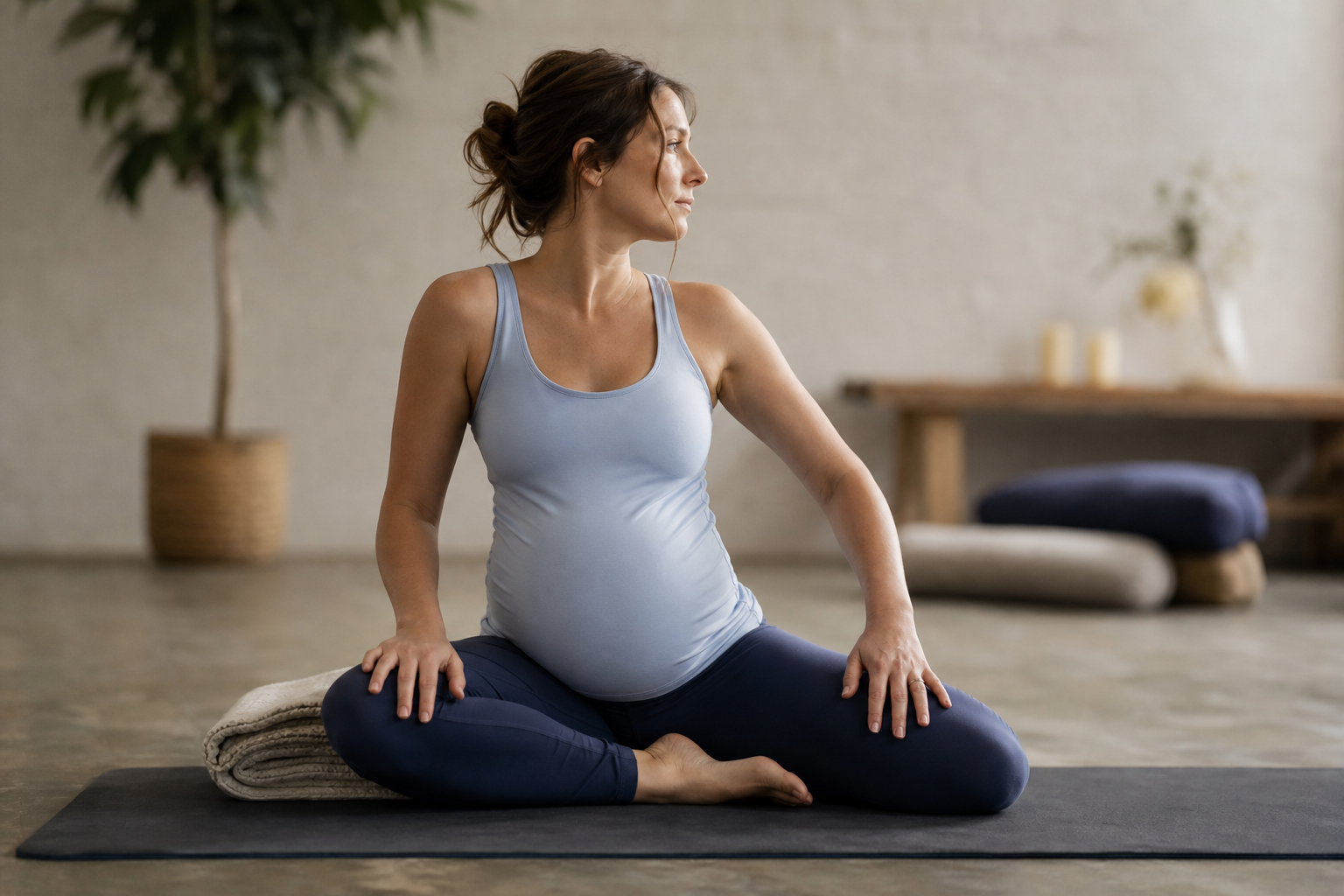
Teaching prenatal yoga safely means adapting every phase of a class, from check-in to closing rest, to the trimester in front of you. Prioritize pelvic stability, avoid supine lying after 20 weeks, replace closed twists with open ones, and always verify each student's health status before class begins.
Most guides stop at listing poses to avoid. What they skip is the sequencing logic that holds a safe prenatal class together, the order of decisions an instructor makes from the moment students walk in to the moment they rest in Savasana. This article covers that logic: the physiological reasoning behind each phase, the modifications that matter by trimester, and the contraindications every instructor needs to know. It does not provide a complete ready-to-teach pose list; it explains the structure and decisions that make any sequence safe.
Why Teaching Prenatal Yoga Is Different from a General Class
Prenatal yoga is a distinct practice with its own physiological rules, and the stakes of getting it wrong are higher than in most yoga settings.
Pregnancy changes the body in ways that affect every pose. Relaxin loosens ligaments throughout the body, not just in the pelvis, which means joints that feel stable may be more vulnerable to strain than usual. The growing uterus shifts the center of gravity forward, alters spinal mechanics, and places new demands on the pelvic floor. These changes compound across trimesters, so a sequence that works at 14 weeks may need significant adjustment at 28 weeks.
The benefits of getting it right are well documented. A meta-analysis published in BMC Pregnancy and Childbirth found that yoga interventions reduced the duration of labor by − 117.75 minutes. Research in the American Journal of Obstetrics and Gynecology found that stress-reducing interventions including yoga were associated with a 0.50 relative risk of preterm birth. A systematic review also found that prenatal yoga interventions produced a significant reduction in anxiety, with a mean difference of -4.20. These outcomes depend on instruction that is both skilled and trimester-appropriate.
Balance is one of the most underestimated risks. According to research published on PMC, the estimated rate of falls during pregnancy is 27%, comparable to the fall rate of women over 70. That single figure explains why every standing pose in a prenatal class needs a widened stance, wall support, or both.
For instructors who want a structured path to teaching these classes with confidence, hellomyyoga's prenatal yoga courses offer a curriculum designed by doctors, vaidyas, and yoga chikitsa acharyas specifically for this population. The full range of courses and training options is available at hellomyyoga.
How Do Trimester-Specific Needs Shape Your Sequence?
The same core sequence structure applies across all three trimesters, but the modifications shift meaningfully at each stage. Understanding what is happening physiologically in each trimester tells you why the adjustments matter, not just what they are.
| Trimester | Key Physiological Changes | Sequencing Focus | Primary Modifications |
|---|---|---|---|
| First (weeks 1–13) | Fatigue, nausea, early hormonal shifts; uterus still small | Gentle grounding; build body awareness | Shorter holds; avoid inversions; reduce intensity if nausea is present; prioritize breathwork |
| Second (weeks 14–27) | Uterus expands above the pelvis; center of gravity shifts; energy often returns | Stability and strength; pelvic girdle support | Widen all stances; introduce block between thighs in standing poses; begin modifying supine work |
| Third (weeks 28–40) | Maximum abdominal expansion; increased lumbar curve; vena cava compression risk in supine | Comfort, space, and preparation for birth | Avoid all flat supine poses; use angled bolsters; emphasize side-lying rest; focus on hip opening and breath |
In the first trimester, many students feel uncertain about what is safe. Your role is to reassure through structure: keep the class predictable, avoid anything that raises core temperature sharply, and give students permission to rest whenever they need to.
The second trimester is often the most active phase. Students may feel stronger and want to do more. This is the right time to build pelvic stability work into the sequence, because the pelvis is under increasing load and the ligaments are at peak laxity. Research estimates the fall rate during pregnancy at 27%, comparable to the fall rate of women over 70, which is reason enough to prioritize stability over depth. Chair pose with a block between the inner thighs is more useful here than a deep squat.
By the third trimester, the sequence becomes about creating space rather than building strength. Hip openers, supported forward folds, and breathwork take priority. Any pose that requires lying flat on the back should be removed entirely after 20 weeks, because the weight of the uterus can compress the inferior vena cava and reduce blood return to the heart.
One practical note: students in a single class may span all three trimesters. Build your base sequence around third-trimester needs and then offer first- and second-trimester students the option to go deeper where appropriate. This approach keeps the whole room safe.
Step-by-Step: Building a Safe Prenatal Yoga Sequence
A safe prenatal class follows a specific order. Each step below corresponds to a phase of the class, and the sequence is not interchangeable. Skipping the check-in to save time, for example, removes the only moment you have to catch a new complication before it becomes a problem on the mat.
-
Verify each student's current health status and trimester. Ask directly at the start of every class, not just at enrollment. Pregnancy develops quickly, and a student who had no restrictions last week may have been advised to avoid certain movements this week. This step is the foundation of safe instruction.
-
Run a brief circle time. Ask each student to share their name, how many weeks along they are, and any specific physical requests for that session. This takes three to five minutes and gives you the information you need to adjust cues in real time. It also builds the sense of community that makes prenatal classes distinct.
-
Open with centering and breathwork, using props from the start. Seat students on bolsters or folded blankets to support the pelvis in a neutral position. Begin with slow, intentional breathing to settle the nervous system before any movement begins. Breathwork is not a warm-up formality; it is an active part of the practice and sets the pace for everything that follows.
-
Move into standing work with a shortened, widened stance. As pregnancy progresses, the center of gravity shifts forward. A standard yoga stance is no longer stable for most pregnant students. Cue students to step their feet wider than hip-width and to soften the knees. Offer the wall or a chair back as support for any balance-dependent pose.
-
Replace closed twists with open twists throughout the standing and seated sequence. A closed twist compresses the abdomen. An open twist, where the body rotates away from the front leg or the belly has room to move freely, creates space rather than compression. This applies to seated poses as well as standing ones.
-
Stabilize the pelvic girdle with targeted modifications. Deep squats place significant load on already-lax sacroiliac joints. Replace them with Chair pose (Utkatasana) and place a block between the inner thighs. Squeezing the block activates the adductors and stabilizes the pelvis without the deep hip flexion that can aggravate pelvic girdle pain.
-
Modify all supine poses after 20 weeks. Place a bolster or folded blankets under the right side of the torso to create a 15 to 20 degree angle, or move the student into a side-lying position entirely. Flat supine lying after 20 weeks risks compressing the inferior vena cava, which can reduce blood flow to both the mother and the baby.
-
Close with side-lying Savasana or supported restorative poses. Never end a prenatal class with students lying flat on their backs. Side-lying Savasana with a bolster between the knees is comfortable, safe, and deeply restoring. Allow at least five to seven minutes for this closing rest.
Key Contraindications: What to Avoid When Teaching Prenatal Yoga
A few specific movements carry enough risk in pregnancy that they belong on every instructor's checklist before class. Knowing these is not about limiting what students can do; it is about understanding why certain poses create physiological problems and choosing safer alternatives.
Flat supine lying after 20 weeks. The weight of the uterus in a flat supine position presses on the inferior vena cava, the large vein that returns blood from the lower body to the heart. Reduced blood return can cause dizziness, nausea, and decreased circulation to the baby. Use an angled bolster or move students to a side-lying position instead.
Closed twists. Any twist that compresses the front of the abdomen, such as a seated spinal twist where the torso rotates toward a bent knee, places direct pressure on the uterus. Replace these with open twists that rotate away from the belly and create space rather than compression.
Deep abdominal engagement and core work that loads the linea alba. Exercises that create visible doming or coning along the midline of the abdomen can strain the linea alba, the connective tissue that runs vertically between the two sides of the rectus abdominis. Avoid crunches, boat pose, and any movement that produces that ridge.
Deep unsupported squats. Pregnancy-related ligament laxity affects the sacroiliac joints throughout all three trimesters. Deep squats without support can aggravate pelvic girdle pain. Chair pose with a block between the inner thighs is a stable, effective substitute.
Strong inversions and balance-dependent poses without support. Any pose that risks a fall needs a wall, chair, or prop as a standard requirement, not an optional modification.
Breath retention and forceful breathing techniques. Breath holds reduce oxygen availability. Rapid forceful exhalation techniques are contraindicated during pregnancy. Keep all breathwork slow, voluntary, and gentle.
Can Teaching Prenatal Yoga Online Work as Well as In Person?
The sequencing principles, contraindications, and trimester-specific modifications covered in this article apply equally in an online setting. The main practical differences are prop communication and the health check-in: describe prop setups in detail before each pose, ask students to position their camera so you can see their full body, and make the verbal check-in more structured since you cannot read body language as easily. The format changes; the physiology does not.
What Certification Do You Need to Become a Certified Prenatal Yoga Instructor?
Becoming a certified prenatal yoga instructor means completing training that goes beyond a general yoga teacher certification. Pregnancy involves specific physiological changes, contraindications, and clinical considerations that standard 200-hour programs do not cover in depth.
Most specialized prenatal yoga instructor training programs build on an existing yoga teaching foundation. Some are offered as standalone specialty certifications, others as add-on modules. When evaluating a program, look for curriculum that covers trimester-specific sequencing, pelvic floor anatomy, common pregnancy complications and when to refer out, and hands-on or supervised practice with pregnant students.
Some programs emphasize particular philosophies or methodologies for working with pregnant and postnatal students.
When choosing any pregnancy yoga training, ask whether the program addresses postnatal care as well as prenatal, since the postpartum period carries its own physiological demands. A training that covers both gives you a more complete scope of practice and a wider range of students you can safely support. For a structured path that includes both, hellomyyoga's yoga teacher training offers a Prenatal and Postnatal Yoga certification designed by doctors, vaidyas, and yoga chikitsa acharyas, combining self-paced coursework with live Zoom sessions.
FAQs
Is prenatal yoga safe in the first trimester?
Yes, prenatal yoga can be safe in the first trimester, but the approach matters. Keep intensity low, avoid anything that sharply raises core temperature, and give students permission to rest freely. Many first-trimester students experience fatigue and nausea, so shorter holds and a predictable, gentle sequence work best. Always ask students whether their care provider has cleared them for physical activity before the first class.
How long does it take to complete a prenatal yoga instructor training?
Program length varies. Short specialty certifications can be completed in a few weeks of self-paced study, while more comprehensive programs that include live sessions, supervised practice, and postnatal content may take several months. The right length depends on how much clinical depth the curriculum covers, not just the total contact hours. Review the syllabus carefully to confirm it includes trimester-specific sequencing, anatomy, and contraindications.
What props are essential for a prenatal yoga class?
Bolsters, blankets, blocks, and a sturdy chair or wall access cover most needs. Bolsters support the pelvis in seated work and replace flat supine lying after 20 weeks. Blocks go between the inner thighs in Chair pose for pelvic stability. Blankets fold under the hips or knees for comfort in restorative poses. For online classes, communicate the full prop list at the start of every session so students have everything ready before class begins.
Can a yoga teacher without a 200-hour base certification teach prenatal yoga?
A general 200-hour certification is a common starting point before specializing, because it builds the foundational anatomy and sequencing knowledge that prenatal training builds on. Some specialized prenatal programs do accept students without a prior teaching certification, but the depth of learning will be different. If you plan to teach professionally, a recognized base certification alongside a prenatal specialty gives you a more complete and credible scope of practice.
What breathing techniques are safe to teach during pregnancy?
Slow, voluntary breathwork is generally safe and beneficial during pregnancy. Techniques that involve breath retention or rapid, forceful exhalation are contraindicated, as they can reduce oxygen availability. Gentle rhythmic breathing, slow diaphragmatic breathing, and awareness-based practices that encourage students to breathe without strain are all appropriate. When in doubt, keep the instruction simple: breathe in a way that feels easy and unforced, and never hold the breath.
Conclusion
Teaching prenatal yoga safely comes down to one core principle: the physiology of pregnancy shapes every decision you make, from how wide you cue a stance to how you end the class. Trimester-specific modifications, a structured check-in, and a clear list of contraindications are not optional refinements. They are the difference between a class that supports a pregnant student and one that puts her at risk.
If you are ready to move from understanding these principles to teaching with them confidently, start by reviewing what your current training covers. If prenatal and postnatal anatomy, pelvic floor considerations, and clinical contraindications are not already in your curriculum, a dedicated pregnancy yoga training is the practical next step.