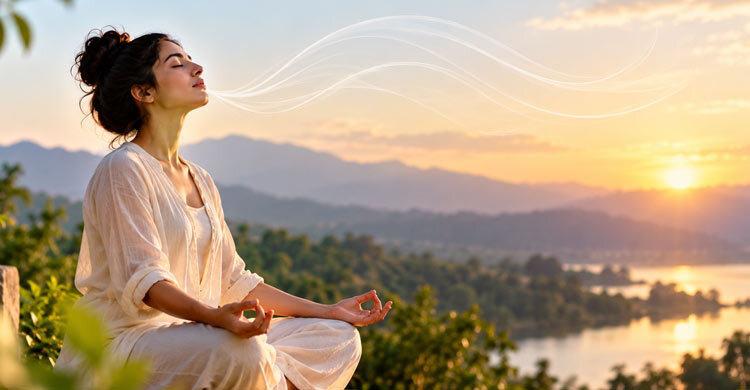
Stop for a moment and notice how you are breathing. Not how you should be breathing, just how you are. Is it high in the chest or low in the belly? Quick or slow? Is there a pause at the end of the exhale, or does the next breath start before the last one has finished?
Most people have never asked this question. That is the first reason pranayama matters. It begins by making the unnoticed visible.
The heartbeat, digestion and blood flow run without instruction. Breathing runs on its own too, but unlike the others, you can take over. You can slow it, lengthen it, pause it, or pass it through one nostril. Few functions sit so close to both the body and the will.
The one automatic function you can also steer
Yoga noticed this long before laboratories did. The breath is where voluntary and involuntary meet, and that makes it a handle on states that are otherwise hard to reach directly. You cannot order a restless mind to be still. You can, however, change the pace and length of your breath, and watch what the mind does in response.
What the classical texts say
Patanjali places pranayama as the fourth limb of yoga, after posture and before withdrawal of the senses. Yoga Sutra 2.49 describes it as the regulation of the flow of inhalation and exhalation, and it follows from a seat that is already steady and comfortable. The order matters. Breath work is not offered as a way around the body. It rests on it.
The next sutras describe the breath as external, internal or held, and as something refined by place, time and number until it becomes long and subtle (2.50). The fruit is described in two short lines. Sutra 2.52 says the covering over the light is thinned, and 2.53 says the mind becomes fit for concentration. Notice the modest claim. Pranayama does not hand you insight. It makes the mind more usable for the practices that follow.
The Hatha Yoga Pradipika, a later and more practical text, states the link between breath and mind in one verse (2.2): when the breath moves, the mind moves, and when the breath is still, the mind is still. The verse then advises restraint of the breath. Read alongside the Yoga Sutra, the message is consistent. The breath is treated as a lever for attention, not as an end in itself.
A fair reading keeps two things apart. These texts are a tradition’s account of practice and its inner purpose. They are not clinical trials, and they do not claim to be.
What modern research shows, and what it does not
Researchers have mostly studied slow, voluntary breathing rather than pranayama as a whole tradition, so the evidence is real but indirect. Three pieces are worth knowing.
A 2018 systematic review in Frontiers in Human Neuroscience looked at slow breathing, fewer than ten breaths a minute, in healthy people. From 15 eligible studies it reported higher heart rate variability and changes in brain rhythms, along with greater relaxation and lower arousal, anxiety and anger. Only 15 studies met the criteria, and the authors describe mechanisms as still under debate.
A 2023 meta-analysis in Scientific Reports pooled 12 randomised trials with 785 adults. Breathwork was linked to lower self-reported stress than control conditions, with a small-to-medium effect (g = -0.35). The authors rated most studies at moderate risk of bias and urged caution about the gap between hype and evidence. That is a useful sentence to keep in mind when reading claims online.
A 2023 randomised study from Stanford in Cell Reports Medicine compared five minutes a day of three breathing exercises with mindfulness meditation over one month. Breathwork, especially an exhale-focused pattern called cyclic sighing, improved mood and lowered respiratory rate more than mindfulness did. Five minutes is a small commitment, which is part of the finding’s appeal. It is one study, and it does not show that breathing replaces meditation or treatment.
So the honest summary is this. Slow, steady breathing appears to help many healthy people feel calmer, and the effects are modest rather than miraculous. The research does not support promises that a technique cures disease, and it says little about the more forceful or breath-holding practices.
Pace, exhale and attention
If the evidence points anywhere, it points at qualities rather than named techniques: a slower rate, an unhurried exhale, and attention that stays with the breath. These are also the qualities the tradition prizes. Patanjali’s long and subtle breath, and the Pradipika’s stillness, describe the same direction of travel.
This is a useful corrective for students who collect techniques. A beginner who breathes gently and attentively for a few minutes is practising pranayama in a real sense. A student who forces a ratio is not necessarily practising it better.
Practising safely
Pranayama is generally gentle, but it is a physical practice, and the more forceful or retention-based methods deserve respect. The US National Center for Complementary and Integrative Health advises learning yoga from a qualified instructor. The medical literature also includes a published case report of a healthy 29-year-old woman who developed a collapsed lung after practising kapalabhati, the rapid breath of fire. A single case does not mean the practice is dangerous for most people, but it is a reminder that force is not a virtue.
Sensible ground rules follow from this. Keep the breath comfortable. Stop if you feel dizzy, light-headed, breathless or anxious. Leave retention and rapid breathing to a teacher who can see you. People with heart or lung conditions, high or low blood pressure, or pregnancy should speak to their doctor before starting.
A simple place to begin
Sit comfortably with the spine upright and the eyes soft. Breathe through the nose in your usual way for a minute and simply watch. Then let each exhale become a little longer than the inhale, without strain, and without counting hard. Continue for three to five minutes. When the mind wanders, return to the breath. That is the whole practice.
It will probably feel too simple. That is the point. The skill is not in the pattern. It is in learning to stay with what is happening, breath by breath, and to notice what changes.
The breath as a daily teacher
In a day full of notifications, the breath is one of the few things that is always with you and always honest. It shortens under pressure and lengthens when you settle. Pranayama asks you to listen to it, then to guide it, gently, towards steadiness. The classical texts say that steadiness of breath prepares the mind for deeper practice. The modern studies, with appropriate caution, suggest that slowing down helps many people feel better. Both are good reasons to begin.
Sources
Yoga Sutra 2.49 (text and translation): https://scriptures.ru/yoga/yoga_sutra_eng/yoga_sutra_2.49.1.htm
Yoga Sutra 2.52, Centre for Yoga Studies: https://yogastudies.org/sutra/yoga-sutra-chapter-2-verse-52/
Yoga Sutra 2.53, Centre for Yoga Studies: https://yogastudies.org/sutra/yoga-sutra-chapter-2-verse-53/
Hatha Yoga Pradipika 2.2, Centre for Yoga Studies: https://yogastudies.org/hyp/hyp-chapter-2-verse-2/
Zaccaro et al. 2018, slow breathing systematic review, Frontiers in Human Neuroscience: https://pmc.ncbi.nlm.nih.gov/articles/PMC6137615/
Fincham et al. 2023, breathwork meta-analysis, Scientific Reports: https://www.nature.com/articles/s41598-022-27247-y ·
Balban et al. 2023, brief structured respiration practices, Cell Reports Medicine: https://pubmed.ncbi.nlm.nih.gov/36630953/