

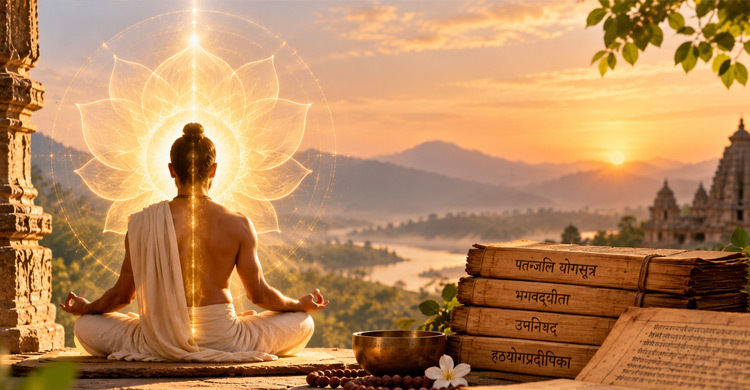
- The Word Itself
- Samadhi as the Eighth Limb of Ashtanga Yoga
- Samprajnata and Asamprajnata: The Two Broad Categories
- The Yoga Sutras on the Conditions for Samadhi
- What the Hatha Yoga Pradipika Adds
- Samadhi in the Mandukya Upanishad and Advaita Context
- Sahaja Samadhi: The Natural State
- Samadhi and Transcendental Meditation
- Common Misreadings Worth Correcting
- The Role of Purification in Preparing for Samadhi
- What This Means for Practice
- Deepening Your Understanding Through Structured Study
- Conclusion
- Frequently Asked Questions
Samadhi in yoga is one of the most discussed and least understood concepts in the entire tradition. You'll find the word in wellness articles, retreat brochures, and social media captions — usually described as "bliss," "enlightenment," or "pure consciousness." But when you return to the classical texts, a more precise and far more interesting picture emerges. Samadhi is not a feeling. It is a specific state of consciousness with distinct stages, prerequisites, and structural conditions that the ancient teachers mapped with remarkable care.
What follows is what those texts actually say — without flattening the teaching into a motivational summary.
The Word Itself
Samadhi comes from the Sanskrit roots sam (together, completely), a (towards), and dhi (to place, to hold). A reasonable translation is "to place completely" or "to hold together." Some commentators render it as "integration" or "absorption." None of these English words fully carry the meaning, which is why the tradition tends to keep the Sanskrit term.
What the word points to is a state in which the mind's usual fragmentation — the constant movement between object, thought, memory, and self-narration — comes to rest. The mind is not blank. It is unified and directed.
Samadhi as the Eighth Limb of Ashtanga Yoga
Patanjali's Yoga Sutras is the primary classical source for understanding samadhi in yoga. In this text, Patanjali describes eight limbs (ashtanga): yama (ethical restraints), niyama (personal disciplines), asana (posture), pranayama (breath regulation), pratyahara (withdrawal of the senses), dharana (concentration), dhyana (sustained meditation), and finally samadhi.
This sequence is not arbitrary. Each limb prepares the ground for the next, and samadhi is not accessible by skipping what comes before. A practitioner who has not stabilised dharana and dhyana has not yet created the conditions in which samadhi can arise.
The relationship between the final three limbs is so close that Patanjali groups them together under the term samyama — the combined practice of concentration, meditation, and absorption directed at a single object. Understanding dharana and dhyana as distinct but connected stages is essential before samadhi can be meaningfully approached.
Samprajnata and Asamprajnata: The Two Broad Categories
Patanjali distinguishes two fundamental types of samadhi.
Samprajnata samadhi (also called sabija, meaning "with seed") is samadhi that still involves a cognitive object. The mind is absorbed in something, and a trace of subject-object relationship remains. Within this category, Patanjali describes four progressively subtler forms:
- Savitarka (with deliberation): the mind holds a gross object — such as a physical form — along with its name and associated knowledge. The object, its name, and its conceptual content are mixed together in awareness.
- Nirvitarka (without deliberation): the same gross object is held, but the name and conceptual overlay fall away. The object is known directly, without the filter of language or memory.
- Savichara (with reflection): the mind moves to subtle objects, such as the tanmatras (subtle elements) or the indriyas (sense faculties), with name and concept still present.
- Nirvichara (without reflection): the subtle object is held without conceptual overlay. The mind becomes prasanna — clear and tranquil.
These four stages are sometimes described as forming samapatti, or "coincidence" of the mind with its object. The mind takes on the form of what it contemplates.
Asamprajnata samadhi (also called nirbija, meaning "without seed") is the state beyond all cognitive content. There is no object, no deliberation, no reflection. Even the samskara (latent impressions) that fuel ordinary mental activity are stilled. This is the state Patanjali points to when he describes chitta vritti nirodha — the cessation of the fluctuations of the mind-field.
This distinction matters because it prevents a common misreading: that any quiet or pleasant meditative experience is samadhi. Samprajnata samadhi still involves a relationship between a knowing subject and a known object. Asamprajnata samadhi dissolves even that.
The Yoga Sutras on the Conditions for Samadhi
Patanjali is specific about what enables samadhi and what obstructs it. The kleshas (afflictions) — avidya (ignorance), asmita (ego-sense), raga (attachment), dvesha (aversion), and abhinivesha (clinging to life) — are named as the root obstructions. These are not moral failings to be judged; they are structural features of conditioned consciousness that must be understood and gradually thinned.
Vairagya (non-attachment) and abhyasa (sustained practice) are the two pillars Patanjali identifies as the means. Neither alone is sufficient. Practice without non-attachment refines technique but does not liberate the practitioner from the kleshas. Non-attachment without practice produces a kind of passive withdrawal that is not samadhi.
The Yoga Sutras also describe ishvara pranidhana — surrender to the divine or to pure consciousness — as a direct path. Patanjali acknowledges that for some practitioners, this devotional orientation accelerates the conditions for samadhi in ways that purely technical practice does not.
What the Hatha Yoga Pradipika Adds
The Hatha Yoga Pradipika, compiled in the fifteenth century and attributed to Swami Svatmarama, approaches samadhi from the perspective of hatha practice rather than the raja yoga framework of Patanjali. Here, samadhi is described as manonmani — the state in which the mind becomes unmani, absorbed and without its ordinary function.
The text describes samadhi as the union of the individual self (jivatma) with the universal self (paramatma), and uses the term laya (dissolution) to describe the process. Rather than being forcibly restrained, the mind dissolves into its source.
The Hatha Yoga Pradipika also links samadhi to the awakening of kundalini shakti and the movement of prana through the sushumna nadi (the central energy channel). When prana is no longer dispersed through the ida and pingala channels but moves through the sushumna, the conditions for samadhi become available.
The technical vocabulary differs from Patanjali's, but both texts point to the same destination: a state in which the ordinary dualistic operation of the mind is suspended.
Samadhi in the Mandukya Upanishad and Advaita Context
The Mandukya Upanishad does not use the word samadhi explicitly, but its analysis of the four states of consciousness — jagrat (waking), svapna (dreaming), sushupti (deep sleep), and turiya (the fourth) — provides the philosophical ground on which samadhi is understood in the Advaita Vedanta tradition.
Turiya is not a fourth state alongside the other three. It is the witnessing awareness that pervades and underlies all states. In this reading, samadhi is not an experience that comes and goes — it is the recognition of what was always already present.
Adi Shankaracharya's commentaries on the Upanishads develop this further. Viveka (discrimination) between the permanent and the impermanent, and vairagya (dispassion) toward what is impermanent, are the essential preparations. Samadhi is not the goal of effort; it is what remains when the misidentification with mind and body is seen through.
This perspective is worth holding alongside Patanjali's more graduated technical map. The two are not contradictory. Patanjali describes the path; Advaita describes the nature of the destination.
Sahaja Samadhi: The Natural State
Several later texts and teachers in the Indian tradition — particularly within the Shaiva and Tantric streams — describe sahaja samadhi (natural or spontaneous samadhi). This is distinguished from kevala samadhi, which requires deliberate withdrawal from sensory engagement.
In sahaja samadhi, the recognition of one's true nature is not interrupted by activity. The practitioner moves through ordinary life — speaking, working, relating — without losing the ground of awareness. This is often described as the mature fruit of sustained practice, where samadhi is no longer a special state entered and exited but the natural condition of a mind that has been thoroughly clarified.
The Tripura Rahasya, a text in the Shakta Advaita tradition, describes this at length. Awareness does not need to withdraw from its objects to remain free. Objects arise within awareness, and awareness is not disturbed by them.
Samadhi and Transcendental Meditation
The mechanics of how the mind settles toward its source — and what that settling actually involves — is a subject serious practitioners often explore. For a grounded discussion of how one classical technique approaches this process, the conversation on the mechanics of Transcendental Meditation with Anand Shrivastava on hellomyyoga offers a useful perspective from an experienced teacher.
Common Misreadings Worth Correcting
Samadhi is not unconsciousness. Deep sleep (sushupti) is also a state of mental quiet, but it is characterised by tamas (inertia) and an absence of awareness. Samadhi — particularly asamprajnata samadhi — is described as prajnaloka, luminous with awareness. The distinction matters.
Samadhi is not the same as bliss. Ananda (bliss) may arise as a quality within certain stages of samadhi, but it is not the definition. Treating bliss as the marker of samadhi leads practitioners to chase pleasant states rather than the underlying condition of unified awareness.
Samadhi is not permanent for most practitioners. The texts describe vyutthana — the "rising out" of samadhi back into ordinary awareness. Repeated practice deepens the samskara of samadhi until, in the advanced stages, the state becomes stable. But for most practitioners, samadhi is initially a temporary condition.
Samadhi is not a reward for good behaviour. It is a specific state of consciousness that arises when the conditions Patanjali describes are met. Ethics matter because the kleshas are obstacles — not because virtue is being exchanged for a spiritual prize.
The Role of Purification in Preparing for Samadhi
The classical texts are consistent on this point: the mind that enters samadhi must be shuddha (pure) and sthira (stable). This is not metaphorical. The texts describe the mind as a chitta (mind-field) that accumulates samskara (impressions) from every experience. These impressions create vasanas (tendencies) that pull the mind toward habitual patterns.
The practices of yama and niyama, asana, pranayama, and pratyahara are all understood as purification processes. They thin the samskara layer and reduce the kleshas. The mind becomes progressively more sattvic — clear and luminous — and less dominated by rajas (restlessness) and tamas (inertia).
The Shravan month in the Hindu calendar is traditionally associated with this kind of purification work, including practices of svadhyaya (self-study), tapas (disciplined effort), and satsang (association with wisdom). The connection between seasonal practice and the preparation of consciousness is explored in the hellomyyoga discussion on Shravan month, purity, and consciousness.
What This Means for Practice
Reading the classical texts on samadhi carefully changes how you approach practice. A few things become clear.
The earlier limbs are not preliminary formalities. Dharana and dhyana are the immediate predecessors of samadhi, and they require real cultivation. If your concentration practice is inconsistent, samadhi is not the next thing to work toward — it is the natural outcome of what comes before.
The object of concentration matters in the early stages. Patanjali allows for a wide range of objects: the breath, a sound, a flame, a concept, or the nature of the self. What matters is that the object is held with consistency and that the mind's relationship to it progressively deepens.
The texts do not promise samadhi as an outcome of any particular number of hours of practice. They describe it as arising when the conditions are met. That is not discouraging — it is precise. The work is to understand the conditions and create them.
For practitioners and teachers who want to go deeper into the philosophical architecture of yoga, the conversation with Dr. Deepak Sachdeva on decoding yoga offers a grounded exploration of how classical yoga philosophy applies to contemporary practice.
Deepening Your Understanding Through Structured Study
Understanding samadhi at the level the classical texts describe it requires more than reading. It requires a framework for practice and a teacher or community that can hold the inquiry with you.
hellomyyoga's programs are built by doctors, vaidyas (Ayurvedic practitioners), and yoga chikitsa acharyas (yoga therapy specialists) who bring both textual depth and clinical grounding to the teaching. The platform's blog, hmyTV interview series, and self-study courses are designed for practitioners who take this seriously. You can explore what is available at hellomyyoga.com.
Conclusion
Samadhi in yoga, as the classical texts describe it, is not a mystical reward or an altered state to be chased. It is a specific condition of consciousness — mapped in detail by Patanjali and elaborated across multiple traditions — that arises when the mind has been sufficiently purified, stabilised, and directed. The texts give you the map. The practice gives you the ground. What the classical sources ask of you is not belief, but sustained, intelligent attention to the conditions they describe.
Frequently Asked Questions
What does samadhi mean in yoga?
Samadhi is the eighth and final limb of Patanjali's Ashtanga yoga. The word comes from Sanskrit roots meaning "to place completely" or "to hold together." It describes a state of unified, absorbed awareness in which the ordinary fragmentation of the mind is stilled. It is not a feeling of bliss but a specific condition of consciousness with distinct stages described in classical texts.
What are the types of samadhi according to Patanjali?
Patanjali describes two broad categories: samprajnata samadhi (with cognitive content, also called sabija or "with seed") and asamprajnata samadhi (without cognitive content, also called nirbija or "without seed"). Within samprajnata samadhi, he identifies four progressively subtler stages — savitarka, nirvitarka, savichara, and nirvichara — moving from gross objects to subtle ones and from conceptual engagement to direct knowing.
Is samadhi the same as enlightenment?
The relationship depends on the tradition. In Patanjali's framework, asamprajnata samadhi is associated with kaivalya (liberation or aloneness of pure consciousness). In Advaita Vedanta, samadhi points toward the recognition of one's true nature as pure awareness. Most teachers distinguish between temporary samadhi states and the stable, irreversible recognition described as liberation or moksha.
Can samadhi be experienced without years of practice?
The classical texts describe samadhi as arising when specific conditions are met — including purification of the mind, stability of concentration, and the thinning of the kleshas (afflictions). These conditions typically require sustained practice over time. Some traditions describe grace or devotion as accelerating this process, but the texts do not suggest samadhi is available without genuine preparation.
What is the difference between dhyana and samadhi?
Dhyana (meditation) is the seventh limb of Ashtanga yoga and involves a sustained, unbroken flow of attention toward a single object. Samadhi is what arises when that flow deepens to the point where the distinction between the meditator, the act of meditating, and the object of meditation dissolves. Dhyana still involves a subject-object relationship; samadhi, particularly in its deeper forms, moves beyond it.
What is sahaja samadhi?
Sahaja samadhi, described in Tantric and Shaiva traditions, refers to a natural or spontaneous samadhi that is not interrupted by ordinary activity. Unlike kevala samadhi, which requires withdrawal from sensory engagement, sahaja samadhi is the condition of a mind so thoroughly clarified that awareness remains undisturbed even while moving through daily life. It is often described as the mature expression of sustained practice.
How does the Hatha Yoga Pradipika describe samadhi differently from Patanjali?
While Patanjali describes samadhi through the framework of chitta vritti nirodha (cessation of mental fluctuations) and a graduated path of eight limbs, the Hatha Yoga Pradipika approaches it through the language of laya (dissolution), kundalini awakening, and the movement of prana through the sushumna nadi. The technical vocabularies differ, but both texts point to a state in which the ordinary dualistic operation of the mind is suspended and awareness rests in its own nature.