

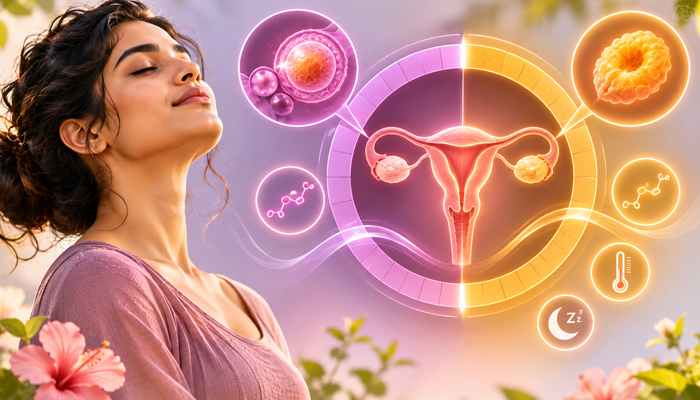
Some weeks you feel sharp and social. Other weeks the same life feels heavier: your jeans fit differently, your patience runs shorter, small problems sit larger than they should. Many women notice a rhythm like this, though not everyone does, and not every month. If you have ever wondered whether you imagined the difference, the biology below suggests it is worth taking your own experience seriously.
One honesty note before the science: not every cycle follows the script. Cycles vary from woman to woman and month to month. Some cycles pass without ovulation at all, and stress, illness, breastfeeding, perimenopause and hormonal contraception can each change or pause the pattern. What follows is the pattern as it typically runs. Your own version is the one worth learning.
First, a quick map of the cycle
A menstrual cycle is counted from the first day of one period to the first day of the next. According to the US Office on Women’s Health, a regular cycle can be anywhere from 24 to 38 days, and it can shift a little from month to month. Throughout it, the brain and ovaries trade chemical messages. The brain releases luteinizing hormone (LH) and follicle-stimulating hormone, and the ovaries respond with estrogen and progesterone. These hormones reach far beyond the uterus: they touch energy, sleep, skin and mood.
The cycle has two halves, and the dividing line between them is ovulation.
Ovulation: the main event, over in about a day
As estrogen rises in the first half of the cycle, it eventually triggers a surge of LH from the pituitary gland. The Office on Women’s Health notes that LH levels begin to surge about 36 hours before ovulation and peak about 12 hours before the egg is released. The surge causes the dominant follicle to rupture and release its egg, and the egg can be fertilised for only about 12 to 24 hours.
Your body does send signals, if you know to look for them. A few days before ovulation, vaginal discharge typically becomes clearer and more slippery, a change that helps sperm travel. Some women feel a mild, one-sided cramp in the pelvic area. And because sperm can live for three to five days in the reproductive tract, the fertile window covers the days leading up to ovulation and the day of ovulation itself.
A necessary word of caution here: if avoiding pregnancy is your goal, calendar and symptom awareness alone are not reliable contraception. That is a conversation to have with your doctor.
The luteal phase: your body prepares, quietly
Once the egg is released, the ruptured follicle transforms into a structure called the corpus luteum, which produces increasing amounts of progesterone. This second half of the cycle, the luteal phase, usually lasts about 14 days, though the Office on Women’s Health notes the gap between ovulation and the next period can range from about one week to nearly three.
The two halves of the cycle do different work on the uterine lining. In the first half, estrogen rebuilds and thickens it. After ovulation, progesterone changes its character: the lining becomes secretory, filled with fluids and nutrients, ready to support an embryo if one arrives. Progesterone also thickens the mucus in the cervix, making it harder for sperm or bacteria to pass, and it raises basal body temperature slightly, which is why some women track their morning temperature to confirm that ovulation happened. Many women also notice their breasts feel fuller or tender in the days before a period.
If there is no pregnancy, the corpus luteum degenerates after about 14 days. Estrogen and progesterone levels fall, the lining is shed, and a new cycle begins.
What research can, and cannot, say about mood
The luteal phase is when many women report feeling more anxious, low or irritable. Researchers have found group-level patterns that point in the same direction, though the details are still being worked out. In one small 2010 study of 13 healthy women, lower blood serotonin levels in the premenstrual phase went together with higher tension, anxiety and fatigue scores. Reviews of the wider evidence describe altered activity of the serotonin system in women with severe premenstrual mood symptoms, including premenstrual dysphoric disorder (PMDD), a recognised condition that is far more intense than ordinary premenstrual changes.
Two cautions belong with that research. These are findings about groups of women, often in small studies; they cannot explain why you, personally, feel low on a given Tuesday. And correlation is not destiny: plenty of women feel few mood changes at all. What the evidence does support is the basic point many women have been told to doubt. Premenstrual changes are biological, not imagined. If mood symptoms are severe enough to disrupt your life, that is a medical matter, and treatments exist.
The world is finally talking about this
For generations, menstruation was treated as private embarrassment rather than public health. That is shifting, and you can see it in newspapers around the world. In 2025, The Guardian reported on a University College London study arguing that boys and girls should be taught about menstruation together, after finding that many women had received just two lessons about periods in their entire schooling, focused narrowly on biology and silent on wellbeing. In 2026, the BBC described Gen Z women teaching their own mothers about periods and hormones, closing a knowledge gap that earlier generations carried quietly.
This matters because knowledge changes behaviour. Understanding what your body may be doing in the luteal phase will not make a harder week disappear, but it can stop that week from looking like a personal failure.
What this means in daily life
Track your cycle for a few months, even with a simple calendar. Note your energy, sleep, mood and any pain. Tracking may reveal patterns, and those patterns are useful information for you and, if needed, for your doctor. The Office on Women’s Health is direct about one point: pain or bleeding severe enough to make you miss work or school is not normal, and it can be treated.
You may also find your cycle invites a gentler kind of self-management: noticing when you naturally have more to give, and when your body may be asking for quieter days. There is no single right way to respond. Some women adjust how they exercise or rest across the month; others simply find that naming the possibility of a pattern removes some self-blame.
If you would like to explore yoga and women’s wellness further, the programs at hellomyyoga are one place to begin.
Your cycle is yours to learn, whatever pattern it keeps. Understanding it will not make hard days vanish, but it can replace confusion with something kinder: information.
Sources and further reading
Research and clinical references
- Merck Manual, “Menstrual Cycle” (phases of the cycle, LH surge, corpus luteum and progesterone’s effects): https://www.merckmanuals.com/home/women-s-health-issues/biology-of-the-female-reproductive-system/menstrual-cycle
- Office on Women’s Health, US Department of Health and Human Services, “Your menstrual cycle” (cycle length of 24-38 days, LH surge timing, egg lifespan, fertile window, tracking guidance): https://womenshealth.gov/menstrual-cycle/your-menstrual-cycle
- Kikuchi H. et al., “Decreased blood serotonin in the premenstrual phase enhances negative mood in healthy women,” Journal of Psychosomatic Obstetrics and Gynaecology (2010; small study of 13 women): https://pubmed.ncbi.nlm.nih.gov/20384471/
- Halbreich U., Tworek H., “Altered serotonergic activity in women with dysphoric premenstrual syndromes,” International Journal of Psychiatry in Medicine (1993; review): https://pubmed.ncbi.nlm.nih.gov/8514462/
News reporting
- The Guardian (UK), “Teach boys and girls together about menstruation, UCL study argues” (2025): https://www.theguardian.com/education/2025/aug/20/teaching-boys-and-girls-mixed-classes-menstruation-periods-ucl-study
- BBC (UK), “Why Gen Z women know more about periods than their mums” (2026): https://www.bbc.com/news/articles/c5y0qp43zv0o