

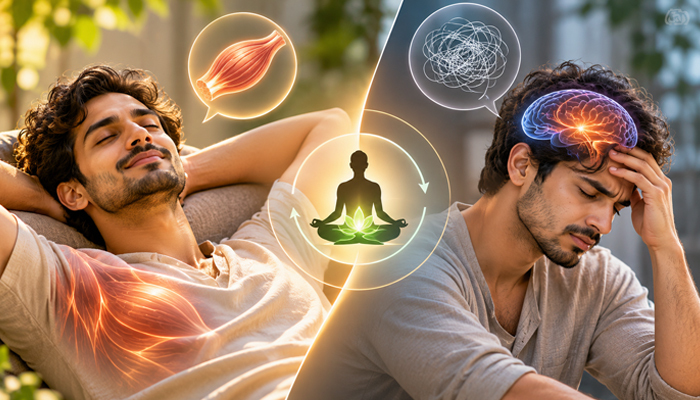
You clear a Sunday, sleep in, cancel plans, and spend the afternoon horizontal on the sofa. By evening you have “rested” for hours. So why do you feel no better? Why does Monday arrive with the same heaviness you carried into the weekend?
Part of the answer is that we treat all tiredness as one thing. It is not.
Physical tiredness and mental tiredness are different states
The distinction is older than modern science. A 2023 workshop summary in the journal SLEEP, drawing together fatigue researchers from across medicine and neuroscience, reaches back to the Italian physiologist Angelo Mosso, who observed more than a century ago that “fatigue” covers at least two phenomena: the measurable loss of muscular force, and the felt sensation of being tired. The two do not always travel together.
The same summary makes another useful point: fatigue can follow physical activity, mental activity or emotional activity, and it is worsened by disrupted sleep, pain, low mood and anxiety. That matches lived experience. Physical tiredness shows up as heavy limbs and an empty fuel tank. Mental tiredness shows up differently: racing thoughts, rereading the same sentence three times, an inability to focus on a conversation you care about. Emotional tiredness is quieter still, the flatness that comes from carrying other people’s needs for too long.
A body at rest can hold a mind still running at full speed. That is the mismatch behind the unrestful Sunday.
One popular lens: the seven kinds of rest
A framework many people find useful comes from Dr Saundra Dalton-Smith, whose book Sacred Rest describes seven types of rest. It is a reflective tool rather than a medical diagnosis, but it has travelled well: Harvard Health recently walked through it with Dr Eric Zhou, a sleep-medicine researcher at Harvard Medical School. The seven:
Physical rest. Your body feels heavy and slow. Sleep and naps count, but Zhou points out that gentle movement such as stretching, yoga and walking can also work as active physical rest, and can actually raise energy.
Mental rest. Your thoughts will not stop. Some people find that writing tomorrow’s tasks down before bed, or a few minutes of quiet meditation, gives the mind permission to stop problem-solving.
Sensory rest. You feel irritable and “fried”. Screens, notifications and background noise keep the nervous system on duty. Dimming the lights and putting the phone in another room is rest of this kind.
Emotional rest. You are carrying others and cannot say so. An honest conversation with someone you trust, or journalling, can begin to refill this.
Social rest. Some company drains and some restores. This kind of rest means fewer obligatory yeses and more time with people who fill you up.
Creative rest. You feel stuck and uninspired. Beauty and novelty help: music, art, a walk somewhere new.
Spiritual rest. You feel aimless or disconnected. Prayer, community, volunteering or time in nature, anything that reconnects you to something larger than your task list.
The framework’s real gift is the question it teaches you to ask: which kind of tired am I? It also corrects a common misunderstanding about sleep. Sleep does far more than rest the body; it supports memory, mood and emotional processing too. But as Zhou notes, if you already sleep seven to nine hours and still wake up drained, simply adding more sleep may not be the missing piece. The deficit may be somewhere else entirely.
Burnout is a different thing from a tiring week
It is worth separating everyday exhaustion from burnout, because the World Health Organization does. In 2019, the WHO included burnout in the International Classification of Diseases as an occupational phenomenon, defining it as a syndrome that results from chronic workplace stress that has not been successfully managed. Its three marks: feelings of energy depletion or exhaustion, growing mental distance from one’s job or cynicism about it, and reduced professional efficacy. The WHO is specific that burnout belongs to the work context and is classified as a phenomenon, not a medical condition.
The BBC’s reporting on extreme exhaustion adds a human layer to that definition. Burnout can be genuinely debilitating; recovery can take years. Researchers point to triggers like excessive workload, too little autonomy, unfairness and, above all, feeling unappreciated. None of those are fixed by a nap. That is the point of keeping the categories separate: a rest deficit asks for rest, while burnout asks for changes at work, support, and sometimes professional help.
Why your rest may not be working
Here is the mismatch most of us live in. We feel mentally or emotionally exhausted, and we respond with physical stillness plus a phone. But an hour of scrolling is not mental rest; it is more sensory input. Collapsing in front of a screen soothes the body while the mind keeps spinning, which may be why it so often fails to refresh.
The practical shift is small and forgiving. Before you rest, take ten seconds to notice which kind of tired you are. If it is your body, lying down may be just what you need. If your mind is racing, some people find that writing things down or sitting quietly with the breath helps more than another episode of anything. If your senses are overloaded, quiet and dim light. If it is your heart, the friend rather than the feed. There is no formula here; the point is simply to match the rest to the depletion, and to experiment kindly until something actually restores you.
One more thing, said gently. If you are sleeping well, resting deliberately, and still exhausted week after week, see a doctor. Persistent fatigue can sit behind medical conditions that have nothing to do with your schedule, and it deserves more than another early night.
Yoga enters this picture modestly. The Harvard physicians describe stretching and yoga as active physical rest, and meditation as a practice that can serve mental, sensory and even spiritual rest. If you would like to explore gentle yoga and meditation as part of how you rest, the programs at hellomyyoga are one place to begin.
Real rest is not the absence of activity. It is the presence of the right kind.
Sources and further reading
Research and clinical references
- Harvard Health, “The 7 types of rest and why we need them all” (interview with Harvard Medical School sleep-medicine researcher Dr Eric Zhou on Dr Saundra Dalton-Smith’s framework): https://www.health.harvard.edu/preventive-care/the-7-types-of-rest-and-why-we-need-them-all
- Raizen D. et al., “Beyond the symptom: the biology of fatigue,” SLEEP, Oxford Academic (2023; summary of an NIH/Sleep Research Society workshop): https://academic.oup.com/sleep/article/46/9/zsad069/7177603
- World Health Organization, “Burn-out an ‘occupational phenomenon’: International Classification of Diseases” (2019): https://www.who.int/news/item/28-05-2019-burn-out-an-occupational-phenomenon-international-classification-of-diseases
News reporting
- BBC Future (UK), “Extreme exhaustion and burnout: How it happens and what to do about it” (2024; interview with exhaustion researcher Anna Katharina Schaffner): https://www.bbc.com/future/article/20240117-extreme-exhaustion-the-truth-about-burnout