

You are in the middle of a conversation. The other person is speaking, and you are looking at them, nodding at the right moments. And then it happens. A yawn rises up before you can stop it. You cover your mouth, a little embarrassed, and say, "Sorry, I did not sleep well last night."
But what if the yawn is not about last night at all? What if it is about what your mind was doing in that exact moment? Somewhere between their second sentence and their fifth, you had already left the conversation. You were composing your reply, or you were somewhere else entirely, and your body simply announced it before you noticed.
A yawn is not just about being tired
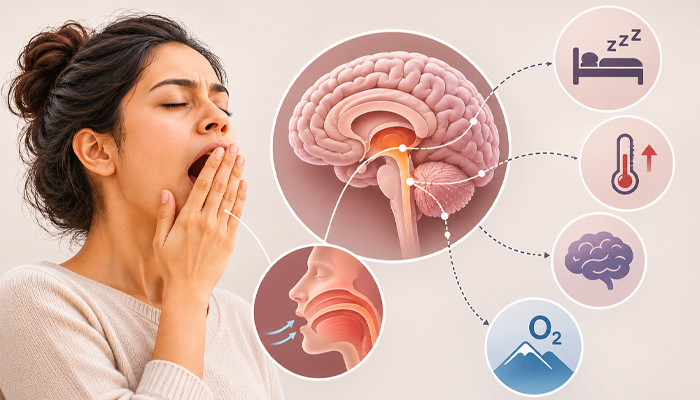
For a long time we treated yawning as a simple sign of sleepiness or boredom. Research over the last two decades tells a more interesting story. Studies by psychologist Andrew Gallup and colleagues suggest that yawning helps cool the brain. When the brain runs a little too warm, its performance drops, and a yawn acts like a reset, drawing in cool air and boosting blood flow so the brain can stay alert. In one study, people were less likely to catch a contagious yawn when they were breathing through their nose, because nasal breathing already cools the blood going to the brain.
So a yawn is not your body shutting down. It is your body trying to bring your attention back online. The question worth asking is: why did your attention need rescuing in the first place?
There is another clue. Yawning is contagious, and research links that contagion to empathy. We are more likely to catch a yawn from people we are close to, and catching it depends on the same social wiring that lets us sense what another person feels. Yawning, it turns out, sits right at the border between attention and connection, the two things a real conversation needs most.
The mind that is never fully here
Harvard psychologists Matthew Killingsworth and Daniel Gilbert used a phone app to ping thousands of people at random moments and ask what they were doing, what they were thinking about, and how happy they felt. The result: people spend about 47 percent of their waking hours thinking about something other than what they are doing. And a wandering mind, they found, is generally a less happy mind, even when it wanders to pleasant things.
Now bring that into a conversation. Research on how dialogue works shows that listeners start planning their reply long before the speaker has finished. We think we are listening, but a part of the mind is already rehearsing its own lines. When we are not rehearsing, we are drifting, to the grocery list, the unread emails, the thing someone said yesterday. And when the mind has drifted far enough, the body steps in. We lose interest. We yawn.
The yawn in the meeting, on the call, across the dinner table is often just the visible tip of a mind that left the room a while ago.
A mind overstimulated is a mind undernourished
This is not entirely our fault. We live inside an attention economy built to pull us away from the present. Research tracked over years shows the average time a person can focus on one screen has dropped from about two and a half minutes in 2004 to under a minute today. A recent review of 71 studies covering nearly 100,000 people found that heavy consumption of short-form video was associated with poorer attention and weaker impulse control.
A hyperstimulated mind is not a rested mind, and it is not an attentive one either. When the nervous system is fed a constant stream of novelty, an ordinary unhurried conversation starts to feel slow. The mind keeps reaching for the next stimulus. Yawning in such moments may be the brain's honest signal: this input is not enough, or I have nothing left to give it.
The breath is the way back
Here is where the story turns practical. The same breathing pathway that cools the brain also calms it. A systematic review published in Frontiers in Human Neuroscience looked at studies on slow breathing and found consistent evidence that slowing the breath increases parasympathetic activity, the rest-and-digest branch of the nervous system, improves heart rate variability, and reduces anxiety. In yoga, this has been known for centuries. Pranayama is not mystical. It is a way of speaking directly to the nervous system through the one function that is both automatic and voluntary.
And this is also where mindfulness stops being an idea and becomes a practice you can use mid-sentence:
Notice the yawn instead of hiding it. Treat it as a notification, not an embarrassment. It is your body telling you that your attention has slipped. That noticing is itself mindfulness.
Take one conscious breath before you reply. One slow inhale through the nose, one slow exhale, while the other person finishes. You will be surprised how often the reply you were rehearsing was not worth interrupting for.
Let listening be the practice. When you catch yourself building an answer, come back to the speaker's words the way you come back to the breath in meditation. You will drift again. Come back again. That returning is the whole exercise.
Give the mind real rest, not more input. Scrolling is not rest. A few minutes of slow breathing, an actual pause in the day, a short practice that empties the nervous system instead of filling it, this is what lets you show up to the next conversation fully.
Where learning helps
Awareness of the problem is the first step, but attention is a trainable skill, and training is easier with guidance and structure. On hellomyyoga, you will find programs that work with exactly these foundations: breath, pranayama, mindfulness, and the yogic understanding of the mind, taught systematically by experienced teachers. Whether you want to deepen your own practice or learn to guide others, the programs on the hellomyyoga website are built to take you from knowing about attention to actually working with it, one breath at a time.
The next time a yawn rises in the middle of a conversation, do not just apologise for it. Ask what it is telling you. Your body may not be asking for sleep. It may be asking you to come back.
Sources
Research
- Gallup, A.C. and Gallup, G.G. (2007). Yawning as a Brain Cooling Mechanism: Nasal Breathing and Forehead Cooling Diminish the Incidence of Contagious Yawning. Evolutionary Psychology. https://journals.sagepub.com/doi/full/10.1177/147470490700500109
- Gallup, A.C. and Eldakar, O.T. (2011). Contagious yawning and seasonal climate variation (thermoregulatory theory review). Frontiers in Neuroscience. https://www.frontiersin.org/journals/neuroscience/articles/10.3389/fnins.2012.00188/full
- Norscia, I. and Palagi, E. (2011). Yawn Contagion and Empathy in Homo sapiens. PLOS ONE. https://journals.plos.org/plosone/article?id=10.1371%2Fjournal.pone.0028472
- Platek, S.M. et al. (2003). Contagious yawning: the role of self-awareness and mental state attribution. Cognitive Brain Research. https://pubmed.ncbi.nlm.nih.gov/12880893/
- Killingsworth, M.A. and Gilbert, D.T. (2010). A Wandering Mind Is an Unhappy Mind. Science. https://www.science.org/doi/10.1126/science.1192439
- Corps, R.E. et al. (2018). Early preparation during turn-taking: Listeners use content predictions to determine what to say but not when to say it. Cognition. https://doi.org/10.1016/j.cognition.2018.01.015
- Zaccaro, A. et al. (2018). How Breath-Control Can Change Your Life: A Systematic Review on Psycho-Physiological Correlates of Slow Breathing. Frontiers in Human Neuroscience. https://www.frontiersin.org/journals/human-neuroscience/articles/10.3389/fnhum.2018.00353/full
In the news
- Wandering mind not a happy mind. Harvard Gazette (2010). https://news.harvard.edu/gazette/story/2010/11/wandering-mind-not-a-happy-mind/
- More than a sign of sleepiness, yawning may cool the brain. Princeton University news (2011). https://www.princeton.edu/news/2011/09/19/more-sign-sleepiness-yawning-may-cool-brain
- Yawning may boost brain's alertness. New Scientist. https://www.newscientist.com/article/1888725-yawning-may-boost-brains-alertness/
- Tips for improving your focus: average attention on a screen down to 47 seconds. AP News. https://apnews.com/article/attention-span-improve-focus-social-media-2334290ba5d8206c18aeca0090be2f3f
- Is brain rot real? Researchers warn of risks of short-form video (review of 71 studies, Psychological Bulletin). NBC News. https://www.nbcnewyork.com/news/national-international/brain-rot-researchers-warn-risks-short-form-video/6425637/