

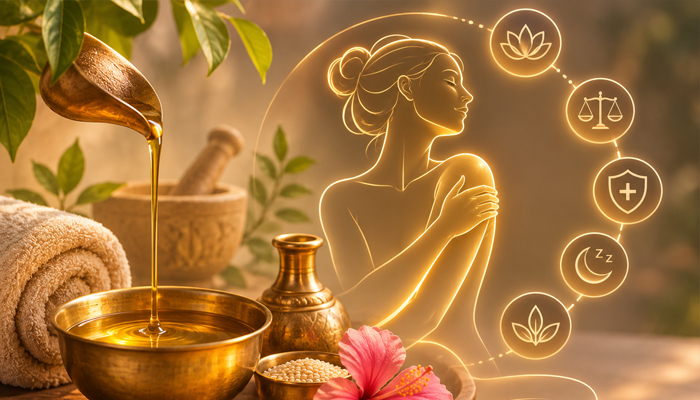
Think about your hands at the end of a normal day. They have stirred the dal, buttoned a child's shirt, typed a hundred messages, packed a lunchbox, held a phone through a difficult call, rubbed a parent's back, folded laundry that was not yours. By the time the house is quiet, your hands have touched everyone and everything.
Now ask a harder question: when was the last time someone touched you, simply to care for you? Not a hurried hug at the door, not a pat on the shoulder. Unhurried, caring touch, the kind that says: you matter, you can put the weight down now.
For many women, the honest answer is: I cannot remember. We give touch all day and receive almost none. And slowly, without naming it, we go hungry.
Touch hunger is real
Researchers have a name for this: touch deprivation, or skin hunger. During the pandemic years it made headlines around the world, as psychologists warned that millions of people were starving for physical contact, and that the symptoms looked a lot like depression: hopelessness, stress, anger, low motivation, a sense that something is missing.
But touch hunger did not begin with the pandemic, and it did not end with it. It lives quietly in the lives of people who care for others for a living and at home – and that describes most women.
The science says touch is not a luxury. In 2024, researchers published one of the largest analyses ever done on touch: a systematic review and meta-analysis of 212 studies covering nearly 13,000 people, in the journal Nature Human Behaviour. The conclusion was striking. Touch interventions reliably reduced pain, anxiety and feelings of depression in adults, and the benefits were just as strong for mental health as for physical health. Two details from that study deserve attention. First, for adults, it did not matter whether the touch came from a familiar person or a professional – the body received it the same way. Second, it did not need to be long. Frequent, shorter touch worked at least as well as long sessions.
In other words, the body is not asking for a spa day once a year. It is asking for small, regular doses of caring touch. Which raises a hopeful question: what if the hands that give it could be your own?
Ayurveda answered this centuries ago
Ayurveda has a practice for exactly this, and its name carries the whole philosophy. In Sanskrit, the word sneha means two things at once: oil, and love. Abhyanga, the practice of anointing the body with warm oil, is therefore not described as a beauty treatment or a therapy you book. It is self-love, applied with the hands.
The classical texts are unambiguous. The Ashtanga Hridayam, one of the three great foundational works of Ayurveda, instructs: abhyangam acharet nityam – practice oil massage daily. The verse goes on to say it wards off aging, fatigue and aggravated Vata, and brings nourishment, sound sleep and firm, healthy skin. The Charaka Samhita places abhyanga inside dinacharya, the daily routine, alongside waking early and eating properly – not as an occasional indulgence but as maintenance, the way you maintain anything you intend to keep for a long time.
Notice what the tradition is really prescribing: daily, unhurried, caring touch, given to yourself, before the day's demands begin.
What research says about oil on your own skin
Modern studies are beginning to test these old claims, and the early results are encouraging.
In a controlled pilot study run with Stanford's Center for Asian Health Research and Education, healthy adults were randomly assigned to daily self-abhyanga with an Ayurvedic herbal oil, professional massage, or a control group. After two weeks, the self-abhyanga group reported a 16 percent drop in perceived stress and a 28 percent improvement in sleep disturbance scores – results comparable to the group receiving professional massage, and clearly ahead of the control group.
An earlier pilot study published in the Journal of Alternative and Complementary Medicine found that even a single one-hour Abhyanga session significantly reduced subjective stress and lowered heart rate in healthy adults, with blood pressure falling in participants who started out prehypertensive.
The findings extend beyond Ayurveda. A 2026 study in Scientific Reports followed women aged 25 to 45 with sleep problems who added a ten-minute self-massage to their evening routine. After a month, they were sleeping about 22 minutes longer, with more deep sleep and lower anxiety scores, while the control group saw no such change. And a randomized trial of career women – perhaps the population that needs this most – found that massage-based self-care over four weeks significantly improved both sleep quality and overall quality of life.
The pattern across studies is consistent: the nervous system does not much care whose hands are doing the touching. It cares that the touch is slow, warm and regular.
Why a ritual, not a remedy
This is where abhyanga quietly outperforms most wellness advice. A remedy is something you take when you are already unwell. A ritual is something you keep, so that you are harder to knock down.
Abhyanga asks for ten to fifteen minutes before your bath. Warm a little oil – sesame is the classic choice, coconut in hot weather. Sit or stand on an old towel. Start at the scalp and face, move down the body with long strokes on the limbs and gentle circles around the joints, and never skip the feet, which carry you through every single day and are thanked the least. Let the oil sit a few minutes, then bathe.
That is all. No appointment, no equipment, no dependence on anyone else's schedule or goodwill. On the busiest mornings, even five minutes on the head, ears and feet keeps the thread unbroken – because the point was never perfection. The point is that for a few minutes each day, a woman who spends her life reaching outward places her own hands on her own body, and the message finally arrives: I am also someone worth caring for.
For women moving through their 30s, 40s and beyond, this matters even more. These are the years when sleep grows lighter, skin drier, the nervous system more easily frayed – exactly the complaints abhyanga was designed, and is now being studied, to address.
Where learning goes deeper
Abhyanga looks simple, and it is. But Ayurveda is a complete science of daily living, and self-massage is one doorway into it – into understanding your own constitution, the oils and rhythms that suit your body, and the sister practices of breathwork, rest and mindful movement that make self-care a way of life rather than a to-do list.
For women who want to go deeper – and for yoga teachers and wellness professionals who want to guide other women through these practices with real understanding – hellomyyoga offers programs that weave classical Ayurvedic wisdom together with modern health science and traditional yoga. Because the women who learn to care for themselves with this depth are the ones who carry that care to everyone around them.
Your hands have spent years taking care of the world. Tomorrow morning, warm a little oil, and let them take care of you.
Sources
Research
- Packheiser, J. et al. (2024). A systematic review and multivariate meta-analysis of the physical and mental health benefits of touch interventions (212 studies, ~13,000 participants). Nature Human Behaviour. https://www.nature.com/articles/s41562-024-01841-8
- Basler, A.J. (2011). Pilot study investigating the effects of Ayurvedic Abhyanga massage on subjective stress experience. Journal of Alternative and Complementary Medicine. https://pubmed.ncbi.nlm.nih.gov/21568717/
- Effect of Ayurvedic Self-Massage Technique (Abhyanga) with an Ayurvedic herbalized oil on Perceived Stress, Sleep Disturbance, and Overall Quality of Life – controlled pilot study, Stanford CARE / Banyan Botanicals. https://med.stanford.edu/content/dam/sm/care/Abhyanga-Study-Posterboard–ETAM.pptx.pdf
- Effect of an evening cosmetic routine with self-massage on sleep quality: a preliminary study (60 women, 25-45). Scientific Reports (2026). https://www.nature.com/articles/s41598-026-60522-w
- Comparisons for Effectiveness of Aromatherapy and Acupressure Massage on Quality of Life in Career Women: A Randomized Controlled Trial. https://pubmed.ncbi.nlm.nih.gov/28504569/
- Ashtanga Hridayam, Sutrasthana 2.8 – "abhyangam acharet nityam" (daily abhyanga verse with translation and commentary). https://satyori.com/source-texts/ashtanga-hridayam/sutrasthana/2/8/
- Charaka Samhita, Sutrasthana 5 – abhyanga within dinacharya (daily routine). https://satyori.com/ayurveda/dinacharya/abhyanga/
In the news
- The Guardian (2024). Touch can reduce pain, depression and anxiety, say researchers. https://www.theguardian.com/science/2024/apr/08/touch-reduce-pain-depression-anxiety-mental-physical-health
- Ruhr University Bochum Newsportal (2024). When and How Does Touch Make a Difference? https://news.rub.de/english/press-releases/2024-04-09-psychology-when-and-how-does-touch-make-difference
- Global News Canada (2020). 'Skin hunger' is real, and it can severely harm your mental health. https://globalnews.ca/news/6929793/coronavirus-disability-touch-deprivation/
- The New York Times (2020). What All That Touch Deprivation Is Doing to Us. https://www.nytimes.com/2020/10/06/style/touch-deprivation-coronavirus.html