

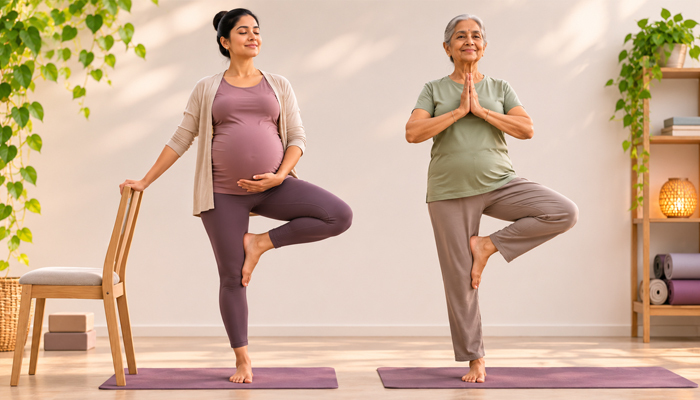
Watch a woman in her eighth month of pregnancy climb a flight of stairs. Watch her grandfather do the same. Two very different bodies, one unmistakable similarity: both move carefully, hand near the railing, eyes on the next step.
We usually tell both of them the same useless thing: be careful. But careful is not a skill. The more honest question is what is actually happening inside those two bodies, and whether anything can be done about it. The answer to the first half is a quiet revolution in the body's self-sense. The answer to the second half is older than the stairs themselves.
Balance Is a Three-Legged Stool
Standing upright without falling feels like doing nothing. It is one of the most complex computations your nervous system performs, and it runs on three streams of information.
The eyes report where you are in relation to the world. The vestibular system, a set of fluid-filled canals in the inner ear, reports how your head is moving and which way gravity pulls. And proprioception – the body's self-sense, carried by receptors in your muscles, tendons and joints – reports where every part of you is in space, moment by moment.
The brain blends all three, hundreds of times a second, and issues tiny corrections to keep you upright. Balance is not a state. It is a conversation. And in both ageing and pregnancy, the quality of that conversation changes.
What Ageing Does to the Conversation
With age, every leg of the stool weakens a little. Vision loses contrast and depth. The hair cells of the inner ear thin out – by some estimates, about 35 percent of adults over 40 already show signs of vestibular dysfunction, most of them unaware of it. And the proprioceptors themselves decline in number and sensitivity, while the nervous system that carries their messages slows down. The muscles that would catch a trip lose mass and fire more slowly.
The result is not just unsteadiness. It is a statistical crisis that most families treat as bad luck. The World Health Organization estimates that 28 to 35 percent of people over 65 fall each year, rising above 40 percent for those over 70, and about 71 percent of all fall deaths happen among adults over 60. In India, hospital data show women in their sixties now account for the largest share of fall-related fractures.
Then comes the quieter damage. After a fall, or even a near-fall, fear moves in. The older person walks less, goes out less, attempts less. Muscles weaken further, the proprioceptive map fades further, and the next fall becomes more likely. Fear of falling is itself a fall risk.
What Pregnancy Does to the Same System
Now consider the pregnant woman. Her balance problem is not decline; it is construction work on a moving foundation.
The hormone relaxin, which peaks around the twelfth week, loosens the ligaments of the pelvis and beyond, softening the very joints her stability depends on. Her centre of gravity shifts forward and upward as the baby grows, so her spine arches into a deeper curve to keep her upright. Her abdominal muscles, stretched over the growing belly, can no longer brace the trunk as they did. And her brain must redraw its internal map of her body week after week, because the body itself keeps changing.
The research reflects this. Studies measuring sway on force plates find that balance measurably declines in the second and third trimesters, stays diminished even six to eight weeks after delivery, and becomes increasingly dependent on vision, which is why a dark room or a cluttered floor becomes genuinely risky late in pregnancy. About one in four pregnant women falls during pregnancy, a rate comparable to adults over 65, and falls are the second most common cause of injury hospitalisation in pregnancy, after road accidents.
Two different bodies. The same conversation, disrupted.
Proprioception: The Trainable Leg of the Stool
Here is the hopeful part. Of the three balance systems, proprioception is the one that responds most readily to training, at any age. You cannot do much at home to regrow inner-ear hair cells, and ageing eyes need an optometrist. But the receptors in your muscles and joints sharpen with exactly the kind of input they were built for: slow, varied, attention-rich movement against gravity.
This is why balance training works, and why it matters which kind of training you choose.
Why Asana Is Proprioception Training in Disguise
A yoga asana practice is, almost point for point, a proprioceptive curriculum.
Standing postures ask you to organise your weight over a base of support and feel, in detail, where that weight actually sits. Single-leg poses are controlled balance challenges with a built-in lesson: wobble, sense, correct, repeat. Barefoot practice feeds the dense receptors of the soles. Slow transitions between postures train the nervous system to track a moving centre of gravity rather than a fixed one. Alignment cues – knee over ankle, weight even across the foot – are literally exercises in joint position sense. And the breath sets a tempo slow enough for all of this to be felt rather than rushed past.
The research has begun to measure what practitioners observe. A meta-analysis in the journal Age and Ageing found that yoga-based exercise produced meaningful improvements in balance and physical mobility in people over 60. A 2023 meta-analysis pooling trials in older adults found similar, significant gains in balance, flexibility and strength. In one study, just seven weeks of yoga improved postural sway and low-back stability, with the researchers attributing the change to improved neuromuscular control and proprioception rather than to strength. On the pregnancy side, a randomised pilot trial found that women in a weekly prenatal yoga programme improved on instrumented measures of gait and mobility compared with a support-group control, with no yoga-related adverse events.
The Answer: Teachers Trained for These Two Bodies
An older adult's asana practice is not a slower version of a young person's class, and a pregnant woman's is not a regular class with a few poses crossed out. Both are their own disciplines, with their own physiology, their own contraindications and their own progressions.
At hellomyyoga, this is exactly what our specialised teacher trainings exist for. The Geriatric Care program trains yoga teachers to work with older adults: understanding age-related changes in balance, strength, joints and confidence, and building practices that are safe, progressive and dignified. The Prenatal and Postnatal program does the same for the childbearing year: what relaxin does to ligaments, how the shifting centre of gravity changes every standing pose, which practices suit which trimester, and how to keep a mother steady from the first weeks through postpartum recovery.
The two students on the staircase do not need to be told to be careful. They need teachers who understand why their balance changed and know how to train it back. Details of both programs are on hellomyyoga.com.
A Simple Way to Begin
- For the older adult: practise standing up from a chair without using your hands, a few times daily, with the chair against a wall behind you. It trains strength and balance at once.
- For the pregnant woman: cat-cow, supported standing poses near a wall, and barefoot time on safe floors – and treat dim lighting and clutter as the hazards they now are.
- For everyone: stand on one leg while holding a counter, thirty seconds a side, most days. Feel the foot making its hundred small corrections. That feeling is proprioception at work.
- For teachers and family: never let fear of falling be managed by moving less. Managed well, movement is the treatment.
- Anyone with dizziness, a recent fall, or a pregnancy complication should work with a qualified teacher and their doctor before starting.
Balance was never the absence of movement. It is the body's capacity to keep answering movement, moment by moment, at seventeen and at seventy, with a baby on board and with grandchildren on the stairs. That capacity can be trained. It only asks to be trained wisely.
Sources
Research
- Yoga-based exercise improves balance and mobility in people aged 60 and over: a systematic review and meta-analysis – Age and Ageing (2016): https://academic.oup.com/ageing/article-abstract/45/1/21/2195366
- Effects of yoga on physical and psychological health among community-dwelling older adults: A systematic review and meta-analysis – International Journal of Older People Nursing (2023): https://onlinelibrary.wiley.com/doi/full/10.1111/opn.12562
- WHO Global Report on Falls Prevention in Older Age: https://iris.who.int/server/api/core/bitstreams/e178a56b-a9b8-402d-80a5-0d8d9ebf6a5d/content
- Falls fact sheet – World Health Organization: https://www.who.int/en/news-room/fact-sheets/detail/falls
- Measuring Vestibular Contributions to Age-Related Balance Impairment: A Review – PMC: https://pmc.ncbi.nlm.nih.gov/articles/PMC7900546/
- Risk factors for accidental falls during pregnancy – a systematic literature review – Journal of Maternal-Fetal & Neonatal Medicine: https://www.tandfonline.com/doi/full/10.1080/14767058.2021.1935849
- Postural equilibrium during pregnancy: Decreased stability with an increased reliance on visual cues – American Journal of Obstetrics & Gynecology: https://www.ajog.org/article/S0002-9378(06)00739-3/abstract
- Biomechanics of Gait during Pregnancy – PMC: https://pmc.ncbi.nlm.nih.gov/articles/PMC4283355/
- Prenatal Yoga for Back Pain, Balance, and Maternal Wellness: A Randomized, Controlled Pilot Study – PMC: https://pmc.ncbi.nlm.nih.gov/articles/PMC6710668/
- Effects of Yoga on Low Back Stability, Strength and Endurance – Virginia Tech: https://vtechworks.lib.vt.edu/server/api/core/bitstreams/56af9550-4d27-4546-9e43-ca95b5e12390/content
In the news
- Falls and their impact on the elderly: causes and prevention – The Hindu: https://www.thehindu.com/sci-tech/health/falls-and-their-impact-on-the-elderly-causes-and-prevention/article69974718.ece
- Falls not just a 70+ risk, women in 60s account for most fracture cases: AIIMS data – Times of India: https://timesofindia.indiatimes.com/city/delhi/falls-not-just-a-70-risk-women-in-60s-account-for-most-fracture-cases-aiims-data/articleshow/131594804.cms
- The balancing act of aging: Research for better balance in older adults – National Institute on Aging: https://www.nia.nih.gov/research/blog/2020/07/balancing-act-aging-research-and-funding-better-balance-older-adults
- Preventing falls during pregnancy – Washington State Magazine: https://magazine.wsu.edu/2025/04/25/preventing-falls-during-pregnancy/
- What happens to your brain when you're pregnant – clumsiness, food cravings, and moodiness? – The Conversation: https://theconversation.com/what-happens-to-your-brain-when-youre-pregnant-clumsiness-food-cravings-and-moodiness-55011