

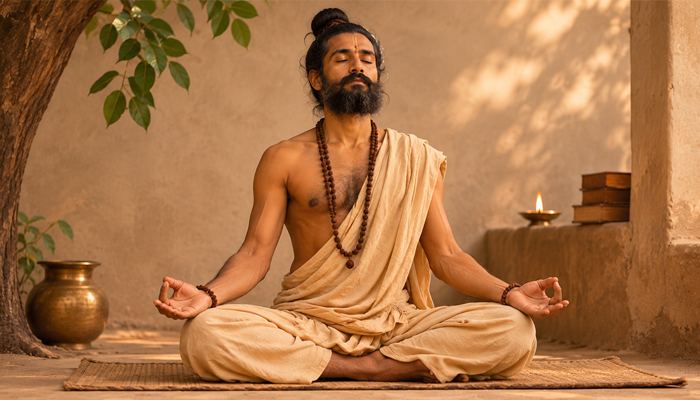
If physical fitness is the measure of a good yogi, how do we explain some of the greatest yogis in history?
Look at photographs of Swami Sivananda, Ramana Maharshi, Sri Ramakrishna Paramahamsa or Paramahansa Yogananda.
You may not see sculpted abdominal muscles, athletic physiques or bodies that resemble today’s popular image of a yoga practitioner.
Yet their names have survived generations. Their teachings continue to be studied, their books are read across continents, and seekers still turn to their wisdom.
What made them great yogis?
Was it how long they could hold a posture? How flexible their spines were? How much physical strength they possessed?
Or was there something else that we have gradually stopped recognising?
When Did the Body Become the Identity of a Yogi?
Scroll through social media today, and yoga is often represented through beautiful postures, extraordinary flexibility, impressive balance and muscular strength.
There is nothing inherently wrong with that.
The body deserves attention. Strength, stability, mobility and physical fitness are valuable, and asana can be a meaningful part of maintaining them.
But when the physical expression of yoga becomes the primary measure of a yogi, we risk confusing the practice with its purpose.
A person capable of performing an advanced backbend may possess extraordinary physical discipline. But does that tell us how they respond to anger?
Someone who can hold a handstand for five minutes may have remarkable balance. But what happens to that balance when life becomes uncertain?
Can flexibility in the spine tell us anything about flexibility in our thinking?
These questions are not meant to dismiss physical accomplishments. They invite us to look beyond them.
The Yogis Who Were Known for Something Other Than Their Bodies
Swami Sivananda: A Life of Service, Not Physical Display
Swami Sivananda (1887–1963) was a physician before becoming a spiritual teacher. He founded the Divine Life Society in Rishikesh in 1936 and developed an approach known as the Yoga of Synthesis, integrating different paths of yoga.
He became known for his teachings on selfless service, devotion, meditation, spiritual discipline and self-realisation.
His influence was not built on demonstrating advanced asanas.
It was built on making yoga’s philosophy and spiritual practices accessible through teaching, writing and service.
His legacy invites us to ask: Can service to humanity be as meaningful an expression of yoga as mastery over the body?
Ramana Maharshi: The Yogi Who Asked One Question
Ramana Maharshi (1879–1950) was not celebrated for conducting elaborate asana demonstrations.
He became known for atma-vichara, or self-enquiry, centred on the question:
Who am I?
His teachings directed attention towards the nature of the self and the source of the sense of ‘I’.
His path was rooted in contemplation, silence and inward observation.
For those who followed him, the important question was not what his body could perform, but what his teachings revealed about consciousness.
Sri Ramakrishna: Spiritual Depth in a Body That Experienced Illness
Sri Ramakrishna Paramahamsa (1836–1886) became one of India’s influential spiritual figures through devotion, spiritual practice and his teachings about different religious paths.
He was not known for physical athleticism.
In fact, during the final period of his life, he suffered from throat cancer.
His illness did not erase his spiritual influence. His disciples, including Swami Vivekananda, carried his teachings forward.
His life offers an important distinction:
Spiritual accomplishment does not necessarily mean freedom from physical illness.
A body can become ill, age or lose strength. These realities do not automatically determine the depth of someone’s spiritual practice.
Paramahansa Yogananda: A Legacy Beyond Postures
Paramahansa Yogananda (1893–1952) helped introduce Kriya Yoga and Indian spiritual teachings to a wide international audience.
His book Autobiography of a Yogi, first published in 1946, continues to introduce readers to yoga’s philosophical and contemplative traditions.
His legacy was shaped by meditation, spiritual education, his writings and the institutions he established.
People remember what he taught and the spiritual path he shared, rather than an athletic achievement.
There is an important clarification here. We cannot assume these teachers were physically unfit simply because they did not cultivate or display the kind of physique celebrated today.
What we can say is that their reputations were not founded on their appearance.
What Did Patanjali Actually Say About Yoga?
In the Yoga Sutras, Patanjali defines yoga through a statement that deserves renewed attention:
योगश्चित्तवृत्तिनिरोधः
Yogaś citta-vṛtti-nirodhaḥ — Yoga Sutra 1.2
Commonly understood as the stilling or regulation of the fluctuations of the mind.
Notice what this definition does not mention.
There is no requirement for a particular body shape, muscle definition or extraordinary flexibility.
Patanjali’s eightfold path includes yama, niyama, asana, pranayama, pratyahara, dharana, dhyana and samadhi.
Asana has its place, but it exists within a much wider discipline.
Physical practice can help cultivate steadiness, awareness and discipline. Yet the broader inquiry of yoga also extends towards how we think, perceive, behave and understand ourselves.
A Healthy Body and a Yogic Mind Are Not Opposites
It would be equally misleading to conclude that because great spiritual teachers were not recognised for their physiques, physical fitness is irrelevant to yoga.
The body is the instrument through which we practise, work, serve and participate in life.
Cultivating strength, mobility, balance and resilience can support our wellbeing and our capacity for sustained practice.
But physical fitness and spiritual maturity are not identical achievements.
A person may be physically strong and emotionally reactive.
Another may live with chronic illness or physical limitations while demonstrating remarkable patience, clarity and compassion.
Neither appearance alone tells us the full story.
We must also resist romanticising illness or physical neglect as signs of spiritual advancement. Disease is not evidence of wisdom, just as muscular strength is not evidence of self-realisation.
The real question is not whether a yogi should be physically fit. It is whether fitness alone is enough to define one.
What Are We Teaching the Next Generation of Yoga Practitioners?
For yoga educators, this question becomes especially important.
When a student enters a yoga classroom, what are we helping them develop?
The ability to perform increasingly difficult postures?
Or the capacity to understand their body, observe their mind, regulate their responses, develop discernment and live with greater awareness?
Ideally, good yoga education creates space for both physical development and inner growth.
An accomplished yoga teacher needs practical knowledge of anatomy, physiology, movement, breath and appropriate modifications. But teaching yoga also calls for listening, self-awareness, ethical judgement and sensitivity to individual circumstances.
The ability to perform a difficult asana is one skill.
The ability to understand why a particular student should or should not perform it is another.
And the ability to help someone relate differently to their own mind is yet another dimension of teaching.
All deserve attention.
Perhaps We Need to Reconsider What Makes Someone a Good Yogi
The great teachers of yoga were remembered for different reasons.
Some were philosophers. Some were contemplatives. Some were devoted to service. Others developed methods of practice or helped preserve and communicate spiritual knowledge.
Their approaches were not identical, and not every spiritual master followed the same tradition.
Yet their lives remind us that yoga has always held possibilities beyond physical performance.
Perhaps we need to ask different questions when we speak of yogic progress.
Not only, How flexible have I become?
But also, How rigid am I in my opinions?
Not only, How long can I remain still in an asana?
But also, Can I remain composed when something does not go my way?
Not only, How strong is my body?
But also, How do I respond when life exposes my vulnerability?
And not only, How much yoga do I practise?
But also, How much of that practice influences the way I live?
Because the body is one place where yoga is practised.
But the way we live is where much of its deeper meaning becomes visible.