
- What Connective Tissue Actually Is
- What Happens During a Long Hold
- The Nervous System Dimension
- Yin Yoga Benefits for Specific Populations
- Common Yin Poses and What They Target
- How to Approach Yin Practice Safely
- Yin as a Complement, Not a Replacement
- Deepening Your Understanding as a Teacher
- FAQs
Most yoga classes move. Vinyasa flows from pose to pose. Ashtanga builds heat through sequence. Even a slow Hatha class keeps the body engaged, muscles working, joints held up by muscular effort.
Yin yoga does the opposite. You arrive at a pose, release muscular effort, and stay. For three minutes. Sometimes five. Sometimes longer.
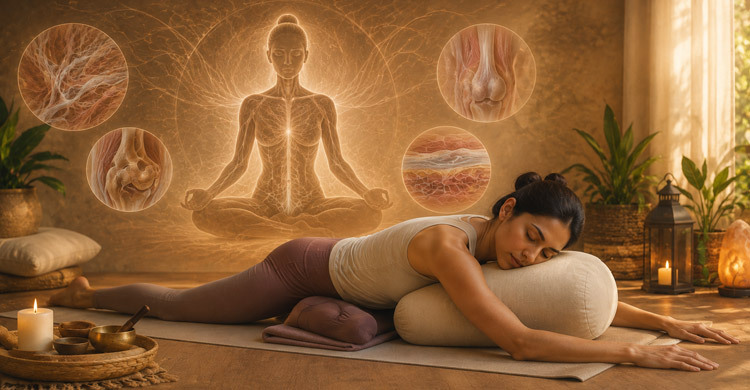
That stillness isn't passivity for its own sake. It's a deliberate method for reaching a layer of the body that active practice rarely touches: the connective tissue. Understanding what happens during those long holds explains why yin yoga benefits practitioners in ways that no amount of dynamic movement can replicate.
What Connective Tissue Actually Is
It helps to understand what yin yoga is actually working with before exploring what it does.
Connective tissue is the broad category that includes fascia, tendons, ligaments, and joint capsules. Unlike muscle, which responds well to rhythmic contraction and release, connective tissue is dense, relatively avascular (meaning it receives less blood flow), and slow to respond to stress. It has a different composition and a different timeline.
Fascia, in particular, has drawn significant attention in bodywork and movement science over the past two decades. It's the web-like tissue that surrounds and connects every muscle, organ, and bone in the body. When it becomes dehydrated, restricted, or thickened from repetitive movement patterns or prolonged sitting, it loses its glide. That loss of glide is what many people feel as stiffness, tightness, or a dull ache that stretching never quite reaches.
Tendons and ligaments are similarly dense. Designed for stability rather than elasticity, they respond to sustained, moderate tension — not quick dynamic loading.
Yin yoga's long holds are calibrated for exactly this tissue type.
What Happens During a Long Hold
When you hold a yin pose for three to five minutes in a state of muscular release, several things occur at the tissue level.
Creep and Plastic Deformation
Connective tissue responds to sustained, gentle stress through a process called creep. When load is applied slowly and held, the tissue gradually lengthens and deforms. This is distinct from the elastic response of muscle, which returns to its original length once tension releases.
With consistent practice, this creep can become a lasting change in tissue length and pliability — sometimes called plastic deformation, meaning the tissue takes on a new resting shape rather than snapping back entirely. It's one reason yin practitioners often report improvements in range of motion that feel different from what active stretching produces.
Hydration of Fascial Tissue
Fascia holds water. When it's compressed or stressed and then released, it cycles through a wringing-and-rehydration process. Long holds followed by a brief rest allow this exchange to happen more fully than shorter holds do. Well-hydrated fascia moves more freely, transmits force more efficiently, and is less prone to the kind of adhesion that creates chronic tightness.
Stimulation of the Joint Capsule
Many yin poses target areas around major joints: hips, spine, shoulders, knees. The joint capsule is a connective tissue structure that surrounds the joint and contributes to its stability and range. Gentle, sustained stress on the joint capsule — applied when the surrounding muscles are deliberately relaxed — can improve the capsule's pliability and the joint's overall mobility.
This matters especially for teachers working with older students or those recovering from injury, where joint capsule restriction is often the primary limiting factor rather than muscle tightness.
The Nervous System Dimension
Yin yoga benefits go beyond physical tissue. The long hold also creates a sustained parasympathetic stimulus.
When you hold a pose for several minutes without muscular effort, the nervous system reads the situation as safe and still. Heart rate settles. Breath slows. The body moves away from sympathetic activation and toward the rest-and-digest state.
This is not incidental. Chronic sympathetic dominance — the background hum of low-level stress that many people carry — contributes to fascial tension, reduced tissue hydration, and slower recovery from physical activity. A regular yin practice interrupts that cycle. It is, in this sense, both a physical and a regulatory practice.
Pratyahara, the yogic practice of withdrawing the senses inward, maps closely onto what happens in a well-held yin pose. The external world recedes. Attention turns inward. The mind learns to stay with sensation rather than flee from it. This isn't a metaphor for relaxation — it's a specific skill that transfers to every other dimension of practice and daily life.
Yin Yoga Benefits for Specific Populations
For Yoga Teachers
If you teach dynamic styles, your own practice is likely muscle-dominant. Yin offers a counterbalance, reaching the tissue that repeated active practice can actually compress and tighten over time. Many experienced teachers find that yin improves their range of motion in poses they've been doing for years, precisely because it works a different layer.
There's also a teaching intelligence that comes from holding poses for extended periods. You learn to observe sensation more carefully, to distinguish productive discomfort from harmful strain, and to guide students through the psychological dimension of stillness. These skills translate directly to working with clinical populations — seniors with restricted joint mobility, individuals in recovery, students navigating chronic pain.
Understanding how yoga affects the body from an early age offers useful context for why connective tissue health built through practices like yin can have lasting structural benefits across a lifetime.
For Practitioners with Joint Concerns
Because yin targets connective tissue rather than muscle, it's often more appropriate than active stretching for people with joint-related concerns. The gentle, sustained loading of the joint capsule and surrounding ligaments can support joint health without the compressive or shear forces that dynamic movement places on the body.
This is particularly relevant in the context of conditions like osteoarthritis. The relationship between gentle sustained movement, synovial fluid circulation, and joint health is well established in clinical practice. If you or your students are navigating knee discomfort, the broader conversation around managing knee pain in osteoarthritis is worth exploring alongside a yin practice.
For Practitioners Interested in Healing Traditions
Yin yoga has roots in Taoist philosophy and the concept of qi (life force energy) flowing through meridians in the body. In this framework, the long holds stimulate the meridian lines that run through the connective tissue, supporting the flow of prana and restoring energetic balance.
This resonates with the Ayurvedic understanding of the body's subtle channels — the srotamsi — and the role of tissue health in overall vitality. The conversation between traditional Indian and Chinese medicine on connective tissue, energy flow, and stillness-based practice runs deep. Practitioners like Deepak Sachdeva have explored healing through yoga in ways that speak to this integration of physical and energetic health.
Common Yin Poses and What They Target
A brief orientation to some foundational yin poses and the connective tissue they address:
- Dragon (Low Lunge variation): Targets the hip flexor complex, inguinal ligaments, and anterior joint capsule of the hip. Particularly useful for practitioners who sit for long periods.
- Butterfly (Baddha Konasana held passively): Works the inner groin, hip adductors, and the connective tissue of the inner thigh. Gravity does the work; no muscular effort required.
- Sleeping Swan (Yin Pigeon): One of the deepest hip openers in the yin repertoire. Targets the external rotators, the sacroiliac joint area, and the deep fascial layers of the gluteal region.
- Caterpillar (seated forward fold, passive): Works the entire posterior chain of connective tissue from the lumbar spine through the hamstrings. Allowing the spine to round targets the ligaments along the posterior spine rather than the muscles.
- Sphinx or Seal: Targets the lumbar fascia and the anterior longitudinal ligament of the spine. Useful for counteracting the flexion dominance of most daily movement.
In each of these, the instruction is the same: find the edge, release muscular effort, and stay. The tissue does the rest.
How to Approach Yin Practice Safely
Yin yoga is not without contraindications. Because it targets connective tissue rather than muscle, the feedback signals are different. Muscle stretch has a clear, familiar sensation. Connective tissue stress is subtler, and it's easier to overdo it without realising.
A few principles to carry into practice:
- Find the appropriate edge. Yin is not about going as deep as possible. Find a place where you feel sensation without sharp, shooting, or joint pain.
- Respect the rebound. After a long hold, move slowly. The tissue needs a moment to redistribute. Coming out of a pose quickly and immediately loading the joint can cause strain.
- Distinguish sensation from pain. A dull, spreading, achy sensation through a fascial line is generally appropriate. Sharp, pinching, or nerve-like sensations are not.
- Consistency over intensity. Three minutes held with appropriate tension three times a week will produce more lasting tissue change than an occasional deep session.
If you work with students who have hypermobility, osteoporosis, recent joint surgery, or inflammatory joint conditions, yin requires careful modification. The same qualities that make it beneficial for most people can become contraindicated for these populations without thoughtful adaptation.
Yin as a Complement, Not a Replacement
Yin yoga benefits are specific. They address a layer of the body that active practice doesn't reach and create a nervous system environment that most dynamic practice doesn't produce. But yin is not a complete practice on its own.
Connective tissue needs the support of healthy, strong muscle. Bone density responds to load-bearing movement. Cardiovascular health requires active practice. A well-rounded yoga practice holds both yang and yin qualities — effort and release, heat and stillness.
Think of yin as the practice that makes your active practice more available. When the fascia is hydrated and pliable, when the joint capsules move freely, when the nervous system has regular access to deep rest, everything else in your practice opens up.
That is the real gift of the long hold. Not just flexibility. Not just relaxation. A more responsive, more integrated body.
Deepening Your Understanding as a Teacher
If you teach yoga and want to understand the clinical dimensions of connective tissue health, joint mobility, and the therapeutic applications of practice, the depth of knowledge required goes well beyond a standard 200-hour training.
hellomyyoga's programs are designed by doctors, vaidyas, and yoga chikitsa acharyas who bring both clinical and traditional expertise to exactly these questions. Whether you're working with seniors whose joint capsules have become restricted, prenatal students whose connective tissue is under hormonal influence, or individuals in recovery whose tissue health is part of a larger rehabilitation picture — the clinical grounding matters.
Explore the full range of courses and teacher training programs at hellomyyoga.com.
FAQs
What is yin yoga and how is it different from other styles?
Yin yoga involves holding passive poses for three to five minutes or longer with muscles deliberately relaxed. Unlike active styles such as Vinyasa or Ashtanga, which primarily work muscle tissue, yin targets the deeper connective tissue — fascia, tendons, ligaments, and joint capsules. The long holds and muscular release are what distinguish it structurally from other styles.
How does yin yoga benefit connective tissue specifically?
Sustained, gentle stress on connective tissue triggers a process called creep, where the tissue gradually lengthens and becomes more pliable. Long holds also support fascial hydration by compressing and releasing the water-holding capacity of fascial tissue. Over time, consistent yin practice can improve joint capsule mobility and the overall pliability of the fascial web.
Is yin yoga safe for people with joint problems?
For many joint-related concerns, yin yoga is well-suited because it applies gentle, sustained loading rather than compressive or shear forces. That said, it requires careful modification for people with hypermobility, inflammatory joint conditions, osteoporosis, or recent joint surgery. A teacher with clinical training should guide these adaptations.
How often should you practice yin yoga to see results?
Connective tissue responds slowly. Regular practice three to four times a week — even shorter sessions — produces more lasting tissue change than infrequent deep sessions. Consistency matters more than intensity.
Can yin yoga help with stress and the nervous system?
Yes. The long holds in a state of muscular release create a sustained parasympathetic stimulus, moving the body away from sympathetic activation. Regular yin practice can interrupt patterns of chronic stress and support recovery, with downstream effects on tissue health and overall wellbeing.
What is the difference between yin yoga and restorative yoga?
Both are slow and floor-based, but they serve different purposes. Restorative yoga uses props to fully support the body so there is no stress on any tissue — the goal is complete release. Yin yoga applies a deliberate, gentle stress to connective tissue to stimulate adaptation. Sensation in yin is intentional; in restorative, the goal is its absence.
Does yin yoga have roots in traditional Indian practice?
Yin yoga as a named style was developed in the twentieth century, drawing primarily on Taoist philosophy and meridian theory. But the principle of sustained, still, inward-focused practice has deep resonance with yogic traditions — including pratyahara (sense withdrawal) and the understanding of prana flowing through the body's subtle channels. Many practitioners find that yin integrates naturally with an Ayurvedic and yogic worldview.
The body holds more than we give it credit for. The fascia remembers old patterns. The joint capsule tightens around habitual ranges. The nervous system learns to stay braced.
Yin yoga offers a way back into that tissue — slowly, deliberately, and with patience.
That patience is itself the practice.