

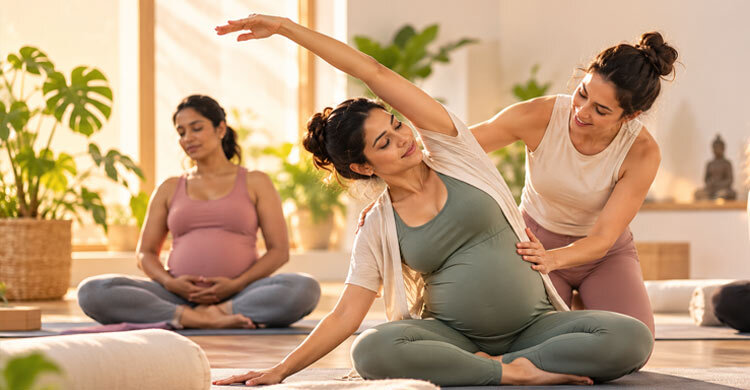
Prenatal and postnatal yoga teacher training prepares yoga teachers to adapt practice during pregnancy and after birth. Good training should develop an understanding of changing physiology, individual recovery, communication and the limits of a teacher’s role. It is education for teaching yoga, not a medical qualification or a substitute for maternity care.
A useful question to take into a pregnancy yoga classroom is simple: “What would help you feel supported today?” It leaves room for answers that a ready-made sequence cannot anticipate. A student may want movement, a quieter practice, a different position or permission to stop. The question does not assume that pregnancy feels the same to everyone.
This is where specialised teaching begins. Knowing a set of prenatal poses is one part of the work. Knowing when to change the plan, ask another question or refer a concern is another. The quality of the class depends on both.
What does it mean to adapt yoga during pregnancy?
Pregnancy is not an illness. Nor is it a reason to treat a familiar yoga practice as automatically suitable. The American College of Obstetricians and Gynecologists (ACOG) explains that changes in joint mobility, balance and breathing affect exercise during pregnancy. It lists modified yoga among suitable activities, while advising women to discuss exercise with their obstetrician during prenatal care.
The word “modified” matters. It points to a teaching process, rather than a universal list of safe poses. Previous experience, current symptoms, medical advice and comfort all belong in that process. A trimester is useful context; it cannot tell a teacher everything about the person in front of them.
A teacher therefore needs more than an alternative shape for each asana. They need to understand why an adaptation is offered, what the student reports when trying it and whether continuing is appropriate. A support is useful only if it actually supports this student. A smaller movement is useful only if it feels suitable today.
ACOG advises avoiding hot yoga and activities with a risk of falling. It also cautions against prolonged lying flat on the back. These are practical safety considerations, not tests of commitment. Someone who changes position or steps out of a practice is exercising judgement, not failing at yoga.
What can a classical teaching offer here?
Patanjali’s Yoga Sutra 2.46, “sthira-sukham-asanam”, is translated by the Centre for Yoga Studies as “Steady and comfortable is posture.” It offers a useful point of reflection for teachers: are we valuing steadiness and ease, or the appearance of a posture?
This is a philosophical connection, not a claim that the Yoga Sutras contain a modern prenatal exercise protocol. A classical text cannot replace obstetric guidance. It can, however, help us question a teaching habit: treating the visible form as the measure of a successful practice.
In a pregnancy class, ease should not mean that a student is expected to smile through discomfort. Steadiness should not mean holding a position after it no longer feels appropriate. The teacher’s task is to make a change possible without embarrassment. The language used around rest, props and choice is part of that task.
What does research on pregnancy yoga actually show?
There are reasons to be interested in pregnancy yoga, but interest should not become a promise. A 2022 systematic review by Corrigan and colleagues in BMC Pregnancy and Childbirth included 31 studies; 29 studies involving 2,217 women entered its meta-analysis. The pooled findings suggested improvements in anxiety, depressive symptoms and perceived stress.
The same review rated the evidence as low to very low quality across outcomes. The studies varied in their practices and methods, and the authors called for better research. A responsible summary holds these findings together: pregnancy yoga may support psychological well-being, but the evidence does not justify certainty about what an individual woman will experience.
This distinction matters when a teacher describes a class. “May help with stress” is different from “treats depression”. Support during pregnancy is different from a guarantee about labour or mode of birth. Birth outcomes should not become a scorecard for how faithfully someone practised.
Yoga teachers can offer a setting for movement, attention and rest. They should not turn that offer into a claim to treat a mental health condition. The NHS advises seeking help from a maternity professional or GP when distress persists or someone is struggling to cope. A referral is part of responsible support, not an admission that yoga has failed.
Why does postnatal teaching need its own judgement?
After birth, the teaching question changes. It is no longer enough to remove the prenatal modifications and return to the old sequence. Delivery, complications and the person’s current recovery all matter.
ACOG notes that someone with an uncomplicated vaginal delivery may be able to begin exercise soon after birth, when ready. After a caesarean birth or complications, it advises asking the obstetrician when exercise can begin. The NHS similarly distinguishes gentle activity after a straightforward birth from strenuous activity after a more complicated delivery.
There is no universal date on which every woman becomes ready for every practice. A postnatal check is an opportunity for advice, not a certificate that all movements will feel right. A teacher should respect the guidance a student has received and stop a practice that causes pain, rather than reinterpret pain as productive effort.
The phrase “getting your body back” is also worth retiring from the classroom. It makes the pre-pregnancy body the destination and can turn recovery into a deadline. A more useful aim is to support the person who is here now. A short, suitable practice need not apologise for being short. Rest need not earn its place by promising faster results later.
What should prenatal and postnatal TTC study develop?
Specialised training should help a teacher explain an adaptation, listen to a student’s response and recognise the limits of what a yoga class can address. Anatomy and physiology need to meet teaching decisions. Communication needs to include asking consent before hands-on help and giving students an easy way to decline.
Safety also includes knowing when to stop. ACOG lists warning signs such as vaginal bleeding, dizziness or faintness, chest pain, and fluid leakage as reasons to stop exercise and contact the obstetrician. Training should make referral decisions clear; a teacher should never try to manage such symptoms through a different pose or breathing technique. This article is not a screening checklist or an individual practice plan.
hellomyyoga’s published Prenatal and Postnatal TTC curriculum brings together physiology and psychology with Dr Vineeta Ketkar, prenatal asana with Anirudh Gupta, Ayurveda for pregnancy and postpartum wellness with Dr Sharon Samuel, and pranayama, chanting and meditation with Samanta Duggal. Its published format combines recorded study with live Zoom learning.
These subject areas are a starting point for evaluating a course, not proof of clinical competence. Ayurvedic concepts and contemplative practices should be understood in their own context. Their inclusion does not establish the safety of a medicine, herb or supplement during pregnancy or breastfeeding, and a yoga certificate does not grant authority to prescribe them.
The deeper purpose of prenatal and postnatal yoga teacher training is to make the teacher’s judgement more careful. To notice when the plan no longer fits. To avoid making a woman responsible for a promised outcome. To offer a practice that can change without losing its meaning. Sometimes the most valuable thing a teacher knows is when not to teach the next pose.
Sources
- ACOG: Exercise During Pregnancy.
- ACOG: Exercise After Pregnancy.
- Corrigan et al. (2022): systematic review and meta-analysis of pregnancy yoga.
- NHS: Keeping fit and healthy with a baby.
- NHS: Mental health in pregnancy.
- Centre for Yoga Studies: Yoga Sutra 2.46.
- hellomyyoga: published TTC curriculum and programme overview.
Educational article only. Pregnancy and postnatal exercise should follow advice suited to the individual from their maternity care team.