
To become a yoga therapist, complete a 200-hour yoga teacher training, gain one to two years of teaching experience, then enroll in an IAYT- or BCYT-accredited program requiring specialized training and a supervised clinical practicum. The accredited program alone typically takes two or more years, and that clock starts only after you already hold a 200-hour certification, so the full journey from scratch is longer still.
Yoga therapy is a distinct clinical profession, and the path to it is structured and sequential. If you are a working yoga teacher ready to deepen your practice into a clinical direction, the steps ahead are clear and achievable.
What Is Yoga Therapy and How Does It Differ from Teaching Yoga?
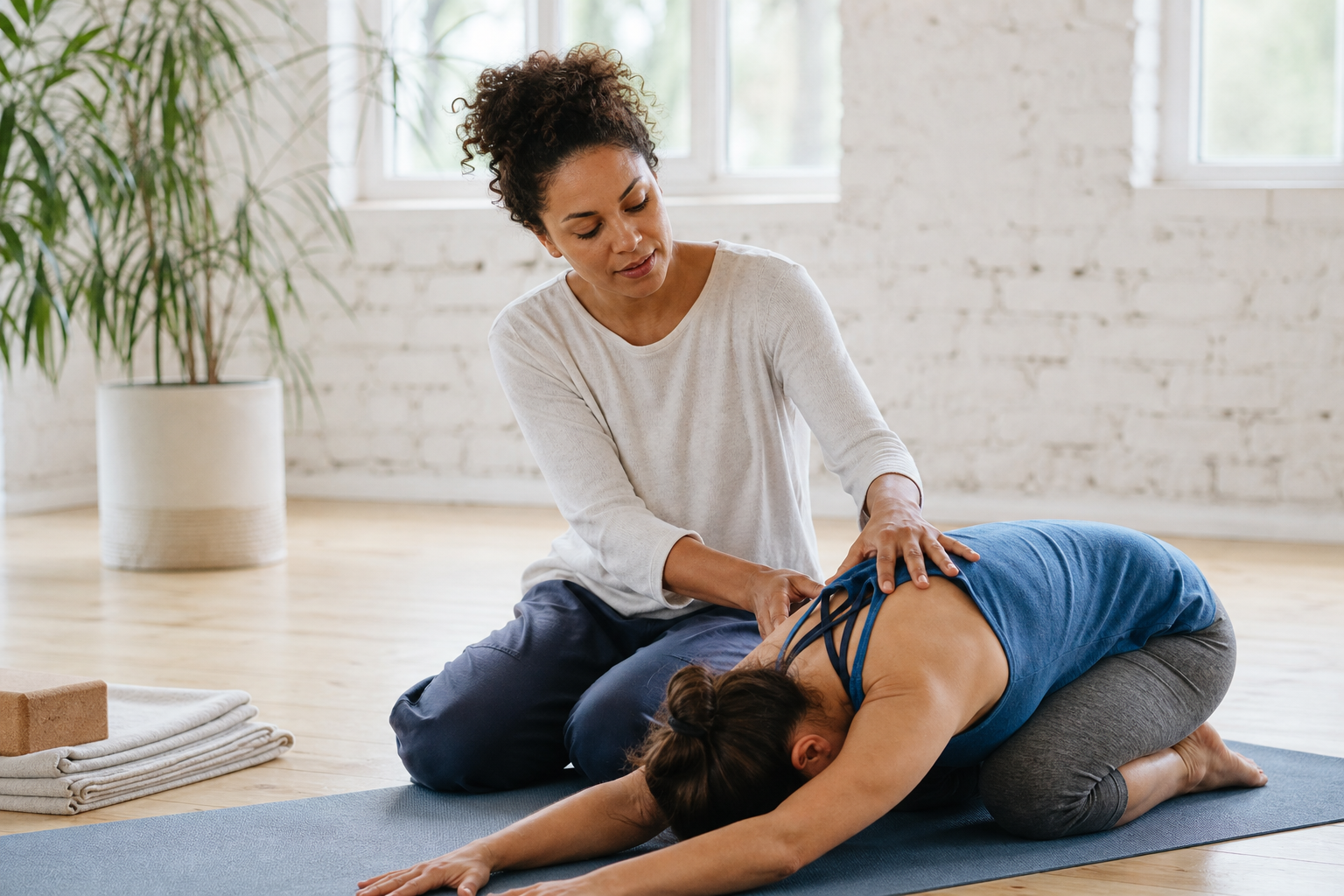
Yoga therapy is a clinical discipline that applies yogic tools, including asana (postures), pranayama (yogic breathing), meditation, and lifestyle guidance, to address specific health conditions in individual clients. A yoga teacher leads group classes and supports general well-being. A yoga therapist works one-on-one or in small therapeutic groups, adapting practice to a person's medical history, physical limitations, and health goals.
The distinction matters because it shapes the entire training path. General yoga teaching requires no clinical knowledge. Yoga therapy demands it.
Two bodies set the international standard for this work. The International Association of Yoga Therapists (IAYT) is the primary global accreditation body, issuing the C-IAYT credential to practitioners who meet its professional standards. According to a 2024 report from Australia's Department of Social Services, IAYT requires a minimum of 1,000 hours of training for certified practitioners. The British Council for Yoga Therapy (BCYT) performs a similar function in the UK, accrediting training organizations against national occupational standards for the profession.
Both bodies require adherence to a defined Scope of Practice and Code of Ethics, which means yoga therapists operate within clear professional boundaries, referring clients to medical providers when a condition falls outside their scope. This clinical accountability is what separates the credential from a general teacher training certificate.
Is It Worth It to Become a Yoga Therapist?
For many yoga teachers, the credential opens doors that general teaching does not. Yoga therapists can work in clinical and integrative health settings, including hospitals, rehabilitation centers, and private therapeutic practice, alongside physiotherapists, physicians, and mental health professionals. That expanded scope is the clearest career argument for pursuing the qualification.
Published salary data for yoga therapists is limited. No major labor statistics body tracks the profession separately. What practitioner networks suggest is that yoga therapists in clinical or private practice earn more per session than group teachers, though income varies widely by location and setting.
There is also a personal dimension. Many yoga teachers pursue yoga therapy training because they encounter students with health challenges in class and want to serve them more skillfully. The training builds clinical confidence alongside professional credentials.
The investment is real: the program is long, the supervised hours are substantial, and the commitment runs for years. Whether it is worth it depends on whether clinical practice, rather than group teaching, is where you want your career to go.
Step-by-Step Path to Becoming a Yoga Therapist
The path from yoga teacher to credentialed yoga therapist follows a clear sequence. Here are the steps in the order you take them:
-
Complete a foundational yoga teacher training of at least 200 hours. [S1] This is the starting point. A 200-hour certification gives you grounding in asana, anatomy, sequencing, and teaching methodology. Most accredited yoga therapy programs expect this foundation before you apply. Spend time actually teaching after you graduate, not just holding the certificate.
-
Build one to two years of active teaching experience. Work with real students in real classes. This period matters because yoga therapy programs assume you already understand how to read a room, modify poses, and manage a group. Clinical training builds on those skills; it does not replace them.
-
Research and enroll in an accredited yoga therapy program. [S2] Choose a program accredited by IAYT or, if you are based in the UK, by BCYT. IAYT-accredited programs meet the 1,000-hour minimum training standard the organization requires for certified practitioners, so confirm that any program you consider meets that threshold. According to YogaTherapy.Health, IAYT-accredited programs typically run for a minimum of two years, so plan your timeline accordingly. Look carefully at the curriculum: strong programs cover anatomy and physiology, psychopathology, assessment skills, and condition-specific therapeutic applications alongside the yogic framework. Our guide to yoga teacher training and certification covers the foundational layer of this path in detail.
-
Complete your supervised clinical practicum. [S3] This is where classroom learning meets real clients. You will work with individuals under the supervision of an experienced mentor, applying therapeutic yoga to specific health presentations. The practicum is not optional; it is a core requirement for graduation and credential eligibility. Track your hours carefully from the start.
-
Apply for the C-IAYT credential. Once you have completed your accredited program and its clinical requirements, you can apply to IAYT for the Certified Yoga Therapist (C-IAYT) designation. The application involves submitting documentation of your training hours, practicum completion, and agreement to IAYT's Scope of Practice and Code of Ethics. Application fees exist; confirm the current figures directly with IAYT, as they are not publicly itemized.
-
Maintain your credential through continuing education. The C-IAYT is not a one-time achievement. IAYT requires ongoing professional development to keep the credential active, so factor continued learning into your long-term plan.
How to Choose the Right Yoga Therapy Training Program
Not every yoga therapy program is equal, and choosing the wrong one can cost you years of work. The most important filter is accreditation: a program accredited by IAYT or, for UK-based practitioners, BCYT, confirms that the curriculum meets recognized professional standards and that graduates are eligible for the C-IAYT credential.
Beyond accreditation, work through this checklist before you commit:
- Faculty credentials. Look for instructors who hold the C-IAYT credential themselves, or who have documented clinical backgrounds in medicine, physiotherapy, or psychology alongside their yoga training. Programs designed by clinicians produce clinically confident graduates.
- Curriculum depth. The program should cover anatomy and physiology, psychopathology, health assessment, and condition-specific therapeutic applications, not just an extended asana curriculum. Ask to see the syllabus before you enroll.
- Practicum structure. Confirm how supervised client hours are organized, who supervises them, and how many hours are required. A program that leaves practicum logistics vague is a warning sign.
- Format and schedule. Consider whether the program runs in person, online, or as a hybrid. If you are in Canada, look for programs that explicitly state IAYT accreditation, since regional bodies such as those serving Ontario or Toronto do not replace international credentialing. Yoga therapy training in Canada follows the same IAYT pathway as programs elsewhere; there is no separate federal or provincial licensing body for the profession.
- Community and mentorship. A strong program connects you with peers and experienced practitioners, not just course material. Peer learning matters in a clinical field.
- Graduation and credential eligibility. Confirm that completing the program makes you eligible to apply for the C-IAYT. Some programs use yoga therapy language in their marketing without meeting IAYT's accreditation standards.
If you are exploring online yoga therapy training or in-person options, both can lead to the same credential, provided the program itself is accredited. The format question is separate from the quality question.
Online vs. In-Person Yoga Therapy Training: Which Format Fits You?
Both online and in-person yoga therapy training can lead to the C-IAYT credential. The format does not determine quality; accreditation does. What format does determine is how well the program fits your life.
Online yoga therapy training suits you if you live far from an accredited program, need schedule flexibility around work or family, or are based somewhere like rural Ontario or a smaller Canadian city where in-person options are limited. Many IAYT-accredited programs now deliver lectures, anatomy modules, and case study work through live video sessions and recorded content. The supervised clinical practicum, however, almost always requires in-person client contact, even in otherwise online programs. Check this carefully before you enroll.
In-person training suits you if you learn best through direct physical feedback, want regular face-to-face mentorship, or prefer the immersive pace of residential intensives. Some practitioners find that working with bodies in a room, watching postural patterns and breathing in real time, builds clinical instincts that screen-based learning cannot fully replicate.
Hybrid programs, which combine online coursework with periodic in-person intensives, have become a practical middle path. You get the flexibility of remote study alongside the hands-on depth of in-person modules.
hellomyyoga is an online yoga education platform that offers condition-specific clinical teacher training, including Geriatric Yoga Care, Prenatal and Postnatal Yoga, and Cancer Survivor Rehabilitation Yoga, delivered through self-paced courses and live Zoom sessions. These programs are designed by doctors, vaidyas, and yoga chikitsa acharyas, and they build condition-specific clinical knowledge that can support your broader therapeutic studies. Note that these are standalone clinical training courses; confirm with any program you are considering whether they count toward IAYT accreditation hours.
What Does a Master’s in Yoga Therapy Add to Your Career?
A master's in yoga therapy is not required to practice as a credentialed yoga therapist. The C-IAYT credential is the recognized professional standard, and it is earned through an accredited certificate or diploma pathway, not through academic degree study. Most working yoga therapists follow the certificate route.
That said, a master's-level program adds something a certificate cannot: academic research training, deeper engagement with health sciences, and the kind of institutional credibility that matters in certain settings. If you want to work within a hospital system, contribute to clinical research, teach at a university, or build a practice that bridges yoga therapy and conventional medicine at a policy level, a master's degree strengthens your position.
The practical question is cost and time. A master's program runs longer and costs more than a certificate pathway. For most yoga teachers entering the field, the certificate route to C-IAYT is the faster, more direct way to begin clinical practice. Pursue a master's only if you plan to work in research, academia, or hospital systems where an academic credential strengthens your position.
Think of the master's as a second stage, not a prerequisite.
How Much Does Yoga Therapy Certification Cost?
Yoga therapy certification involves several distinct cost categories, and the total varies widely depending on the program you choose, your location, and your format.
The largest expense is program tuition. IAYT-accredited programs run for a minimum of two years, so you are looking at at least two years of tuition payments, and longer programs with more contact hours naturally cost more. Tuition ranges differ significantly between institutions, countries, and delivery formats, so request a full fee breakdown from any program you are seriously considering.
Beyond tuition, budget for study materials, anatomy and physiology resources, and any travel or accommodation costs if your program includes in-person intensives. The supervised clinical practicum may also carry its own costs depending on how your program structures it.
When you apply for the C-IAYT credential, IAYT charges an application fee. The current figure is not publicly itemized on their site, so confirm it directly with IAYT before you plan your budget.
The honest framing is this: yoga therapy training is a multi-year professional investment. Going in with a clear picture of all cost categories, not just tuition, helps you plan without surprises.
Prices and plan limits verified as of October 2026.
FAQs
How long does it take to become a yoga therapist?
The path has three main stages: a 200-hour teacher training, one to two years of active teaching experience, and an accredited yoga therapy program. Accredited programs require substantial coursework and a supervised clinical practicum on top of that, so the total commitment runs well beyond the program's minimum length. Altogether, most people commit several years from their first teacher training to earning the C-IAYT credential, though the exact timeline depends on your program's structure and pace.
Can I become a yoga therapist without a 200-hour yoga teacher training first?
Most accredited yoga therapy programs expect applicants to have a foundational yoga teacher training before they enroll. The 200-hour certification establishes the teaching and anatomical foundation that clinical training builds on. If you are starting from scratch, completing that foundational step first is the practical route before applying to a yoga therapy program.
What is the C-IAYT credential and how do I apply for it?
The C-IAYT (Certified Yoga Therapist) is the credential issued by the International Association of Yoga Therapists to practitioners who complete an IAYT-accredited program, meet its training hour minimum, and fulfill supervised clinical practicum requirements. To apply, you submit documentation of your training hours, practicum completion, and agreement to IAYT's Scope of Practice and Code of Ethics. Application fees apply; confirm current figures directly with IAYT.
Is yoga therapy regulated differently in Canada than in other countries?
Yoga therapy is not a federally or provincially regulated health profession in Canada, meaning there is no government licensing body for the title. The recognized professional standard for practitioners across Canada, including in Ontario and Toronto, is IAYT accreditation and the C-IAYT credential. If you are pursuing yoga therapy training in Canada, look specifically for programs that carry IAYT accreditation rather than relying on regional or provincial endorsements alone.
What conditions do yoga therapists typically work with?
Yoga therapists work within a defined Scope of Practice set by their accrediting body, applying yogic tools to clients with specific health presentations under a therapeutic framework. The range of conditions addressed depends on the therapist's training, clinical experience, and the boundaries of their professional scope. Practitioners always refer clients to medical providers when a condition falls outside that scope.
Conclusion
Becoming a yoga therapist is a structured process: foundational teacher training, real teaching experience, an accredited program of at least 1,000 hours with supervised clinical work, and then the C-IAYT credential application. The path takes years, but each stage builds directly on the one before it.
Your clearest next step is to confirm whether any program you are considering holds IAYT accreditation, then request its full syllabus and practicum details. Those two pieces of information will tell you more about a program's quality than any marketing description. If you are still building your foundational teaching skills, start there first.