
- What the Research Says About Yoga and Blood Pressure
- Which Practices Are Most Beneficial
- Critical Precautions That Most Guides Skip
- Hypertension Comorbidities: What Changes the Picture
- Supervised Clinical Practice vs. Home Practice
- For Yoga Teachers: Closing the Clinical Knowledge Gap
- Frequently Asked Questions
- A Practical Starting Point
Yoga for hypertension is one of the most searched therapeutic applications of the practice — and the interest is well-founded. High blood pressure affects a significant portion of the adult population, and many people are actively looking for ways to support their cardiovascular health alongside medication and lifestyle changes. If you teach yoga or practise it seriously, understanding how to approach hypertension safely isn't optional. It's essential.
This article covers what the research actually says, which practices are genuinely helpful, and the precautions that too many guides leave out entirely.
What the Research Says About Yoga and Blood Pressure
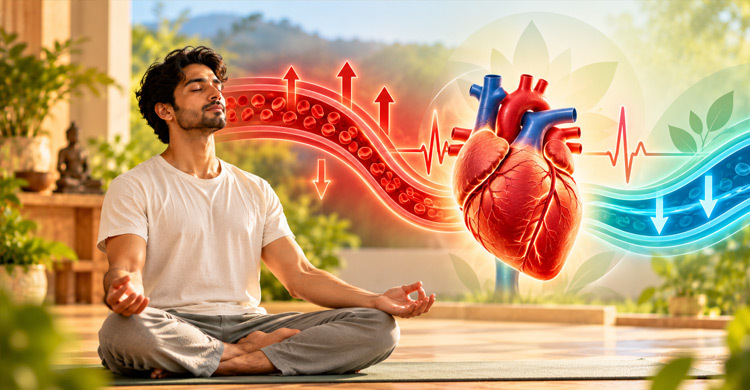
The evidence base for yoga as a supportive tool in hypertension management has grown considerably. In its 2025 report, PLOS One published a systematic review covering 30 randomised controlled trials involving 2,283 participants. The findings were meaningful: compared with a waitlist control, yoga was associated with a mean systolic blood pressure reduction of 7.95 mmHg.
That's a clinically relevant number. For context, a 5 mmHg drop in systolic pressure is associated with a measurable reduction in cardiovascular risk at the population level. Yoga is not a replacement for antihypertensive medication — but as an adjunct to standard care, the numbers support its role.
Most of the studied interventions combined three elements: asana (physical postures), pranayama (yogic breathing techniques), and some form of relaxation or meditation. The combination appears to matter. Programs that used postures alone showed weaker effects than those integrating breathwork and guided relaxation.
Which Practices Are Most Beneficial
Gentle Asana With an Emphasis on Grounding
Not all postures are equal for someone managing high blood pressure. The most appropriate asanas are those that keep the head at or near heart level for short durations, avoid intense muscular strain, and support the nervous system rather than stimulate it.
Poses that work well include:
- Sukhasana (easy seated pose) with slow, steady breathing
- Balasana (child's pose) for its calming effect on the nervous system
- Viparita Karani (legs up the wall) with appropriate duration limits
- Shavasana (corpse pose) as a primary relaxation tool — not just a closing ritual
- Gentle supine twists with no breath-holding
Avoid or modify any posture that requires sustained muscular gripping, breath retention (kumbhaka), or prolonged inversion where the head drops significantly below the heart.
Pranayama That Calms Rather Than Stimulates
Breathwork is arguably the most potent tool in a hypertension-aware yoga practice. The parasympathetic nervous system responds directly to slow, extended exhalation — and this is where much of yoga's blood pressure benefit likely originates.
Practices with good evidence and low risk include:
- Nadi Shodhana (alternate nostril breathing) at a slow, even pace
- Extended exhalation breathing, where the exhale is twice the length of the inhale
- Bhramari (humming bee breath), which has a notably calming effect on the nervous system
Avoid Kapalabhati (skull-shining breath) and Bhastrika (bellows breath) for anyone with uncontrolled hypertension. Both are vigorous, stimulating practices that can spike blood pressure acutely. They aren't contraindicated forever, but they require stable, well-managed blood pressure before being introduced.
Meditation and Yoga Nidra
Yoga Nidra (yogic sleep — a guided body-scan relaxation practice) and seated meditation are low-risk, high-benefit components for hypertension management. They activate the parasympathetic response, reduce circadian cortisol patterns, and support sleep quality, all of which contribute to blood pressure regulation over time.
If a student can only do one thing consistently, a 20-minute Yoga Nidra session daily is among the most accessible and safe starting points.
Critical Precautions That Most Guides Skip
This is where most articles on yoga for hypertension fall short. General guidance to "practise gentle yoga" isn't enough when you're teaching someone with stage 2 hypertension, a history of stroke, or who is managing multiple antihypertensive medications at once.
Transitions From Floor to Standing
Orthostatic hypotension — a sudden drop in blood pressure when standing — is common in people on antihypertensive medication. Moving quickly from a supine or seated posture to standing can cause dizziness, lightheadedness, or fainting.
Teach your students to:
- Roll to the side before pressing up from lying down
- Pause in a seated position for several breaths before standing
- Rise slowly, using a wall or chair for support if needed
- Stay still for a moment once standing before moving into the next posture
This isn't excessive caution. It's standard safe practice for anyone on blood pressure medication — and something many yoga teachers have never been explicitly taught.
Inversions: When to Modify or Avoid
Full inversions, including Sirsasana (headstand) and Sarvangasana (shoulder stand), are contraindicated for anyone with uncontrolled hypertension. These postures increase intracranial pressure and can cause dangerous blood pressure spikes.
Adho Mukha Svanasana (downward-facing dog) sits in a grey area. For someone with well-managed, mild hypertension and no symptoms, a brief hold may be acceptable. For someone with stage 2 hypertension or a recent cardiovascular event, it should be modified or replaced entirely.
When in doubt, keep the head above the heart or use a supported variation.
Breath Retention and Straining
Kumbhaka (breath retention) and the Valsalva manoeuvre — which occurs when someone strains or holds their breath during effort — both cause acute blood pressure spikes. Remind students to breathe continuously during effort and never hold the breath through a challenging posture.
This applies especially to standing balances and poses requiring core engagement. Cueing "keep breathing" isn't just a rhythm reminder. For a hypertensive student, it's a safety instruction.
Red-Flag Symptoms: Stop Practice Immediately
Any of the following during practice means stopping and seeking medical attention:
- Sudden severe headache
- Visual disturbances or blurred vision
- Chest tightness or pain
- Shortness of breath disproportionate to effort
- Dizziness or faintness that doesn't resolve with rest
- Numbness or tingling in the face, arms, or hands
These can be signs of a hypertensive crisis or cardiovascular event. A yoga teacher is not a first responder — but knowing when to stop and call for help is part of responsible teaching.
Medication Timing
If a student takes antihypertensive medication in the morning, their blood pressure may be at its lowest an hour or two after dosing. Scheduling an intense or extended practice during this window increases the risk of dizziness, particularly during standing transitions.
Encourage students to notice how they feel at different times of day relative to their medication schedule, and to share that information with their doctor. A simple home blood pressure monitor, used before and after practice for a few weeks, can give both teacher and student useful data about how the body is actually responding.
Hypertension Comorbidities: What Changes the Picture
Many people with hypertension also live with other conditions that affect how yoga should be adapted. This is where clinical knowledge becomes genuinely important for yoga teachers.
Hypertension with obesity: Avoid deep forward folds that compress the abdomen. Use props generously. Prioritise breathing and relaxation over posture depth.
Hypertension with osteoarthritis: Joint loading in weight-bearing poses needs careful modification. For guidance on managing this combination, the hellomyyoga blog has a detailed discussion on yoga and knee pain from osteoarthritis that's worth reading alongside this article.
Hypertension with anxiety or stress-related conditions: This combination is extremely common. The psychological dimension of blood pressure is significant, and managing psychological health through mind-body practices is a relevant supporting read.
Hypertension in older adults: Geriatric populations need additional attention to balance, fall risk, and medication interactions. This is one of the reasons clinical specialisation in geriatric yoga care exists as a distinct discipline — not simply a variation of general teaching.
Supervised Clinical Practice vs. Home Practice
There's a meaningful difference between yoga studied in a supervised clinical setting and a student practising at home with a general video. Most of the trials in the PLOS One 2025 systematic review used supervised protocols with trained instructors, and the safety outcomes in those settings reflect that oversight.
For home practice, the precautions above become even more important. Students with hypertension should ideally have a clear plan from their doctor or a clinically trained yoga teacher before practising independently. Encouraging students to monitor their blood pressure at home — particularly around new practices — gives them concrete feedback and builds a responsible self-care habit.
If you're a yoga teacher who regularly works with students managing chronic conditions, holistic health steps offers a useful framework for integrating these considerations into a broader wellness approach.
For Yoga Teachers: Closing the Clinical Knowledge Gap
Understanding yoga for hypertension at this level of detail is not standard in most 200-hour or 500-hour teacher training programmes. Generic foundational training covers anatomy broadly but rarely addresses the specific contraindications, medication interactions, and comorbidity modifications that come up in real teaching situations.
This is precisely the gap that clinically focused education is designed to close. hellomyyoga's programmes are developed by doctors, vaidyas (Ayurvedic practitioners), and yoga chikitsa acharyas (yoga therapy specialists) — specifically to give working teachers the clinical grounding they need when a student arrives with a condition that general training didn't prepare them for.
The Metabolic Syndrome through Yoga self-study course, available on hellomyyoga, addresses conditions that frequently co-occur with hypertension — including insulin resistance and cardiovascular risk factors — from both a clinical and Ayurvedic perspective. It's a practical, self-paced resource for teachers who want to deepen their understanding without pausing their teaching schedule.
For those building toward working with therapeutic populations more broadly, hellomyyoga's specialised teacher training programmes in Geriatric Yoga Care, Prenatal and Postnatal Yoga, and Cancer Survivor Rehabilitation Yoga offer the kind of structured clinical depth that general training simply doesn't cover. These are hybrid programmes designed by doctors and yoga therapy specialists, built for teachers who want to practise responsibly in complex health contexts.
Explore the full range of courses and teacher training programmes at hellomyyoga.com. The free hmyTV interview series is also a useful starting point — giving you access to expert faculty discussions before any purchase commitment.
Frequently Asked Questions
Can yoga lower blood pressure in people with hypertension?
Yes, the evidence supports yoga as a useful adjunct to standard hypertension care. In its 2025 report, PLOS One's systematic review of 30 randomised controlled trials found yoga was associated with a mean systolic blood pressure reduction of 7.95 mmHg compared with a waitlist control. It is not a replacement for medication, but the effect is clinically meaningful.
Which yoga practices are safest for someone with high blood pressure?
Gentle asana, slow pranayama such as Nadi Shodhana and extended exhalation breathing, Yoga Nidra, and seated meditation are the most appropriate starting points. Vigorous breathing techniques like Kapalabhati and Bhastrika should be avoided until blood pressure is well controlled.
Are inversions safe for people with hypertension?
Full inversions such as headstand and shoulder stand are contraindicated for anyone with uncontrolled hypertension. Partial inversions like downward-facing dog may be acceptable for mild, well-managed cases but should be approached with caution and modified or replaced when in doubt.
What symptoms should make someone stop yoga practice immediately?
Sudden severe headache, visual disturbances, chest pain or tightness, dizziness, and numbness or tingling in the face or limbs are all red-flag symptoms. Practice should stop immediately and medical attention sought.
Does medication timing affect yoga practice safety?
Yes. Antihypertensive medications can cause blood pressure to drop significantly in the hours after dosing. Practising during this window increases the risk of dizziness, particularly during transitions from lying or sitting to standing. Students should discuss timing with their doctor and pay attention to how they feel at different points in the day.
What is the difference between supervised clinical yoga and home practice for hypertension?
Supervised protocols offer real-time monitoring, immediate modification, and trained oversight — which is the setting in which most research evidence was gathered. Home practice is possible but requires clear guidance, awareness of contraindications, and ideally some form of blood pressure self-monitoring to track the body's response.
Do yoga teachers need special training to work with hypertensive students?
General teacher training rarely covers the clinical depth needed to safely adapt practice for hypertension, especially when comorbidities or medications are involved. Clinically focused education — designed by doctors and yoga therapy specialists — gives teachers the specific knowledge that standard foundational programmes do not provide.
A Practical Starting Point
Yoga for hypertension is a genuinely useful therapeutic application of the practice — but only when approached with the right knowledge. The evidence supports it. The precautions are specific and learnable. And the gap between general yoga instruction and clinical competence is real, but it is also closeable.
Whether you're a practitioner managing your own blood pressure or a teacher whose students are, the principles here give you a grounded, safe framework to work from. Start with breath, prioritise transitions, know the red flags, and keep the practice gentle until the body signals it's ready for more.