

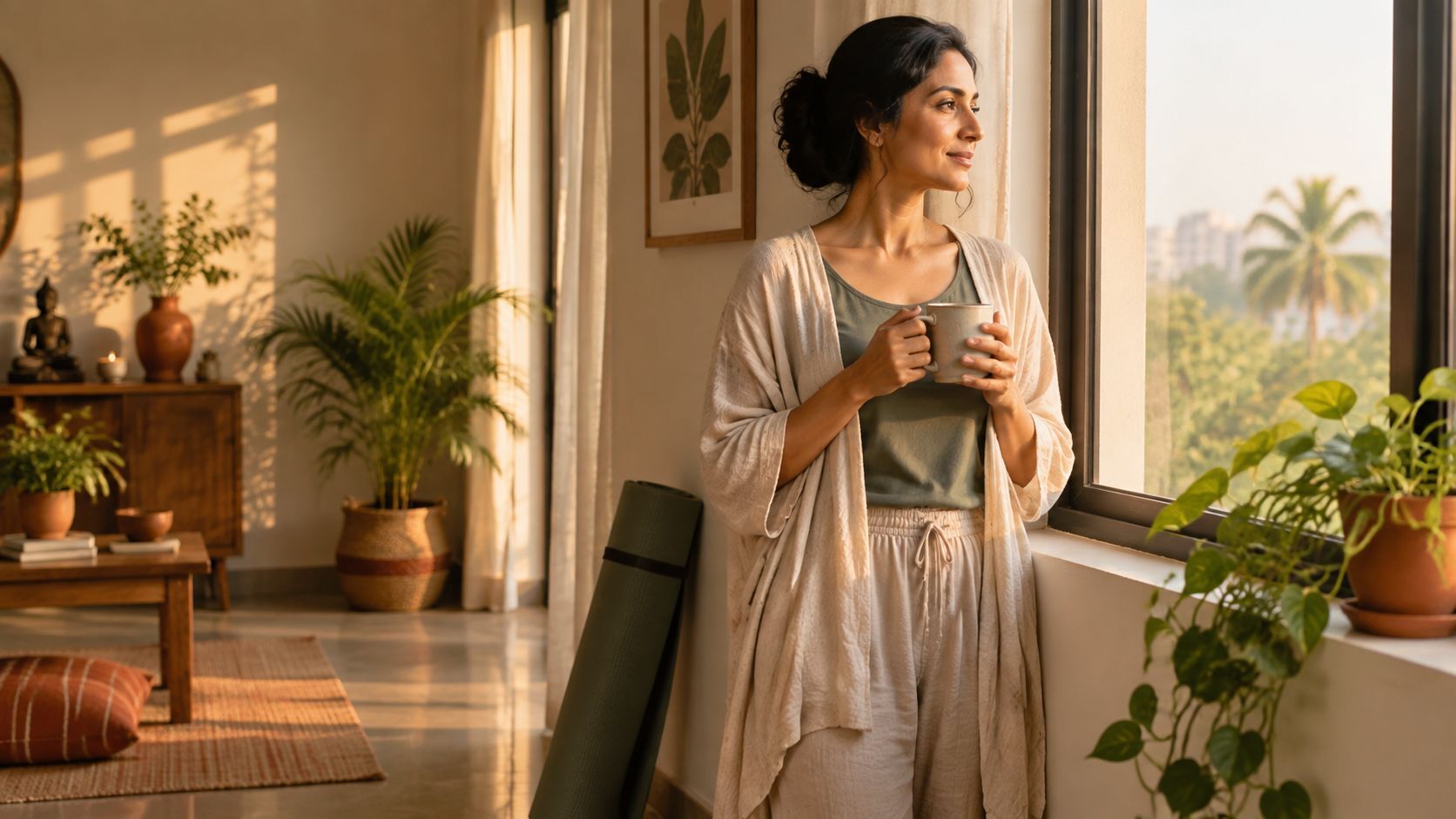
Imagine finishing a yoga class with a quiet mind. Your shoulders have softened. For an hour, there was nowhere else to be.
Then you pick up your phone. An unanswered message irritates you. Someone else’s achievement makes your own morning feel inadequate. By lunchtime, the calm seems to belong to another person.
Was the practice unsuccessful?
Perhaps the more useful question is whether we have asked one hour of practice to do the work of an entire way of living.
Yoga as a way of life means allowing practice to shape how we act, relate and pay attention beyond the mat. It does not require a perfect routine, permanent calm or withdrawal from ordinary responsibilities. It asks whether the qualities we value in practice have a place in the rest of our day.
The difficult part is rarely understanding this idea. It is remembering it when we are tired, hurt or in a hurry.
The mat is a beginning, not the whole map
Physical practice gives yoga a visible form. We can photograph a posture, measure how long we hold it and notice changes in strength or movement. A less reactive conversation is harder to display.
Yet in the eight-limbed path described in Patanjali’s Yoga Sutras, asana is one part of a much wider discipline. Yama and niyama concern ethical restraints and observances. Pranayama concerns breath regulation. The path also includes the withdrawal of the senses, concentration, meditation and absorption. [1]
This is a spiritual framework, not an ancient productivity system. Its purpose cannot be reduced to becoming more efficient at work or less inconvenient to other people.
Still, it offers a searching question for daily life: what are we practising when we are not consciously practising yoga?
We may be rehearsing comparison. We may be training ourselves to answer every interruption immediately. We may be becoming very skilled at ignoring exhaustion.
A way of life begins when these repetitions become visible.
Ahimsa in the middle of an ordinary day
Ahimsa, commonly translated as non-harming or non-violence, is one of the yamas. [1] It can sound like a large moral ideal, distant from the small frictions of a working day.
Consider how ordinary its questions can become.
Can I disagree without humiliating someone? Can I recognise pain in a posture without treating my body as an obstacle to defeat? Can I correct a mistake without turning it into a verdict on my worth?
These are contemporary applications, not literal instructions from an ancient text about office life. They bring an ethical principle into situations we actually meet.
Non-harming does not mean accepting mistreatment. A clear boundary may be kinder and more honest than repeated agreement followed by resentment. Nor does it mean never feeling anger. Anger and the decision to injure someone with it are not the same thing.
Yoga in daily life can begin in that difference: feeling something fully while taking responsibility for what we do next.
Contentment without giving up
Santosha, one of the niyamas, is usually translated as contentment. [1] It is easy to misunderstand it as an instruction to stop wanting change.
But there is a difference between working towards something and making peace conditional on achieving it.
A person can seek better work without believing that their current salary measures their human value. A student can study seriously without treating every result as a final judgment. A parent can want more support without deciding that gratitude requires silence.
One way to bring contentment into modern life is to notice when enough keeps moving. Yesterday’s goal becomes today’s minimum. The body must be more flexible. The house must be better. Even meditation must produce a more impressive version of the self.
If yoga becomes another place to compete, its language may change while the underlying habit remains untouched.
The practice is to recognise the habit, not to feel guilty for having it.
Study before self-improvement
Svadhyaya is often described today as self-study. In the classical framework, it also has a specific connection to the study and recitation of sacred teachings. [1] Remembering this protects it from becoming another name for endlessly analysing ourselves.
Study offers something beyond our own immediate reactions. A text, a thoughtful teacher or a sustained conversation can interrupt the assumption that the way we currently see things is the only way to see them.
Alongside that study, an ordinary reflection can be revealing: what happened just before I lost patience? Was I hungry, frightened, overcommitted or trying to appear capable?
This is inquiry, not a private prosecution.
The point is not to monitor every thought until life becomes tense. It is to understand a repeated response well enough to have another choice.
A practice small enough to belong to your life
A yogic life need not begin with a dramatic timetable. For someone caring for an infant, working shifts or managing an illness, an elaborate morning routine may be unrealistic.
Instead, choose one point where awareness is usually absent.
It might be the moment before replying to a difficult message. Read it once without composing your defence. Notice what is happening in your body. Then decide whether a reply is needed now.
It might be the first few minutes of a meal, taken without another stream of information. Or a short, appropriate movement practice learned with guidance, without comparing your body to yesterday’s performance.
At the end of the day, ask a specific question: where did I act with a little more care, and where would I like to try again?
These are suggested experiments, not a prescription or a test of whether someone is a genuine yogi. Their value lies in whether they make practice more honest and sustainable.
Learning that reaches beyond technique
A posture can be demonstrated quickly. Understanding the attitude behind practice takes longer.
For readers who want to study beyond exercise, hellomyyoga’s course catalogue brings together learning that includes pranayama and mental-health-related themes. [2] The useful question when choosing a programme is not how many techniques it contains, but whether its teaching helps you understand why, when and how to practise.
Learning should leave room for questions. It should also leave room for the realities of your body, your responsibilities and your need for medical or psychological care when appropriate. A yoga programme is education, not a substitute for individual treatment.
The measure is how we return
There will be mornings when we practise and still become impatient. There will be days without practice when we manage to be unexpectedly generous.
A way of life cannot be judged by a single good hour or a single difficult one.
The mat remains valuable. So does the conversation after it. So does the decision to rest, tell the truth, apologise or ask for help.
Perhaps yoga begins to become a way of life when we stop asking only, “How well did I practise today?” and start asking, “What did my practice make possible in the way I lived?”
SOURCES
[1] Edwin Bryant, “Yoga Sutras of Patanjali,” Internet Encyclopedia of Philosophy. Used for the eight limbs and the classical context of ahimsa, santosha and svadhyaya. Everyday examples in this essay are contemporary reflections, not quotations or translations of sutras.
https://iep.utm.edu/yoga/
[2] hellomyyoga course catalogue. Used only to verify the broad learning connection, not enrolment availability or therapeutic outcomes.
https://courses.hellomyyoga.