

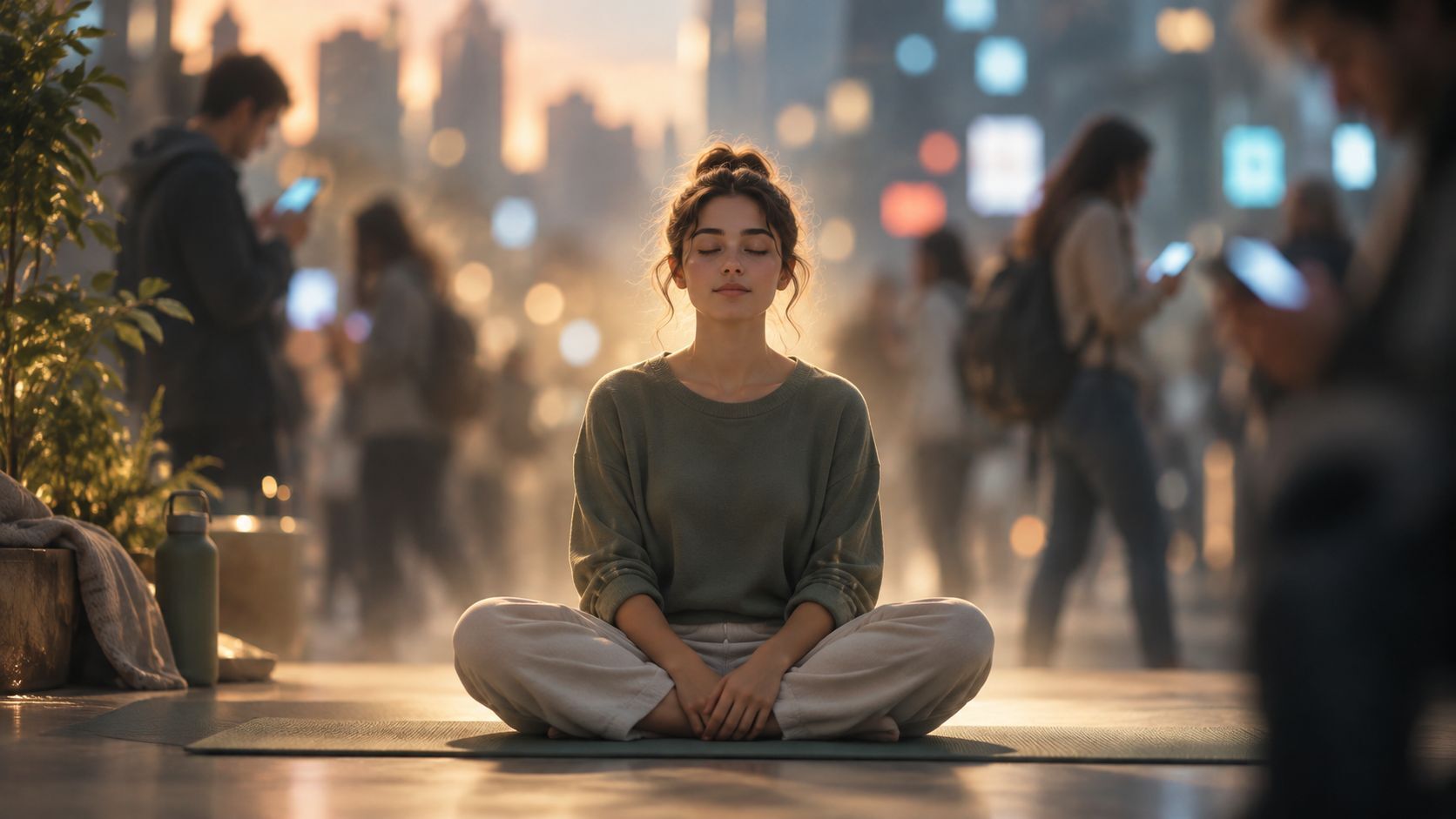
Picture a student closing a laptop after a long evening of work. The assignment is finished. Rest should be possible.
Then comes a message about an entrance exam, a friend’s internship announcement and a video explaining everything successful people do before sunrise.
Nothing urgent has happened. Yet the day feels unfinished again.
This imagined scene raises a question worth taking seriously: what happens when a young person experiences ordinary life as a continuous assessment?
Yoga may offer support through movement, rest and the practice of attention. But anxiety is not proof of weak character, too much comfort or too little discipline. Nor does every anxious person have an anxiety disorder.
There is no single explanation for an entire generation. There should be no single prescription either.
The problem with calling a generation anxious
The phrase can sound sympathetic while quietly becoming an accusation. Young people are described as oversensitive, unable to cope or less resilient than those who came before them.
That comparison tells us very little about an individual who is struggling.
It also bundles together people in different circumstances. A teenager facing bullying, a graduate worried about work and a young caregiver managing family illness do not share one cause simply because they are close in age.
WHO identifies several influences on adolescent mental health, including adversity, peer pressure, identity, home life, relationships, violence and socioeconomic problems. Supportive families, schools and communities matter too. [1]
Those findings concern adolescents; they are not a complete account of everyone in their twenties or thirties. They do offer a useful correction to a familiar shortcut: distress emerges within a life, not just inside an isolated mind.
Some pressures need a conversation. Others need material help, safer environments or clinical care. None should be dismissed because a person is young.
When every part of life becomes a performance
Comparison does not begin with a phone. But digital spaces can provide an endless supply of things to compare: bodies, marks, friendships, relationships, salaries and apparent happiness.
WHO notes that media influence can widen the gap between an adolescent’s lived reality and their perceptions or aspirations. [1] This is not evidence that social media alone causes anxiety. It is a reason to ask how a particular person experiences what they see.
Does the phone offer friendship and support? Does it make every quiet moment feel like falling behind? Does a learning community encourage curiosity, or turn learning into another race?
The same tool can occupy different places in different lives.
Yoga has something useful to ask here, provided we do not turn it into one more performance. If a class becomes another comparison of bodies, flexibility or perfect morning routines, the pressure may simply acquire a different costume.
A practice meant to make room for attention should not become another audience to satisfy.
What yoga can realistically offer
Yoga may help with some anxiety symptoms and aspects of general well-being, including stress management. Evidence in children and adolescents is promising but limited by weaknesses in study quality. NCCIH cautions that those findings are not conclusive. [2]
There is a further distinction between feeling anxious and having a diagnosed anxiety disorder. A supportive practice may belong in someone’s care without being sufficient treatment. Research in adults cannot simply be transferred to children, and findings for one yoga programme do not establish that every class will have the same result.
With those limits in place, yoga can still provide a useful setting for learning.
A movement class can invite a person to notice their body without judging its appearance. A rest period can allow them to stop producing something. A carefully taught attention practice can provide an opportunity to notice distraction and return, rather than treat distraction as a personal failure.
These are possibilities to look for in teaching, not guaranteed clinical outcomes. Choice, adaptation and permission to stop are more useful than pressure to appear calm.
A different relationship with attention
In Patanjali’s eight-limbed framework, pratyahara concerns withdrawal from sense objects, while dharana concerns concentration. [3] These belong to a spiritual discipline, not a historical argument about smartphones.
As a contemporary reflection, however, they invite us to question the assumption that every stimulus deserves an immediate response.
A young person might experiment with doing one ordinary activity without switching between several streams of information. A teacher might leave a short period without instruction instead of filling every second. A family might agree that a meal does not need to become a discussion of achievement.
None of this requires declaring technology the enemy. It requires noticing when access to everything has become an obligation to attend to everything.
The intention is not to empty the mind on command. It is to explore whether attention can be guided with less force and less self-criticism.
Support should not become another demand
“You should do yoga” can become one more instruction given to a person who already feels inadequate.
A more helpful opening may be, “Would it help to try something together?” Or, “Would you prefer to talk, walk, rest or get some support?”
For young adults interested in practice, an adaptable beginner class with a qualified teacher may be a reasonable place to explore movement and rest. The teacher should welcome questions and avoid promises to cure anxiety. For children and adolescents, teaching should be age-appropriate and coordinated with caregivers and relevant health professionals when needed.
Beginners should not be pushed into forceful breathing or long breath holds. If inward attention increases distress, a person should be allowed to keep their eyes open, change the focus or stop. A yoga class is not a test of how much discomfort someone can endure.
Just as important are the conditions outside the class. A student needs adults who respond to bullying. An overworked employee needs realistic expectations. A person experiencing discrimination needs safety and support, not a lesson in accepting the unacceptable.
Learning has a place; so does treatment
When anxiety persists, worsens or interferes with sleep, study, work or relationships, professional assessment matters. Panic, avoidance and withdrawal should not be managed indefinitely through self-help alone. Immediate danger or thoughts of self-harm call for urgent local emergency or crisis support and contact with a trusted person.
Yoga teachers can support practice within their competence. They should not diagnose a mental-health condition or ask someone to abandon treatment.
We do young people a disservice when we offer either extreme: that yoga fixes everything, or that a daily practice can offer nothing of value.
A better question to ask
Perhaps the question is not, “Why is this generation so anxious?”
Perhaps it is, “What are the people around us being asked to carry, and what support would make that burden more manageable?”
Yoga may be one part of that support. It can be a place where the body is not an image to perfect, attention is not something to sell and rest does not have to be earned.
But the invitation must remain humane. Young people do not need to become better at silently tolerating every pressure placed on them. They need room to practise, people who listen and access to care when they need it.
SOURCES
[1] WHO, “Mental health of adolescents,” 2025. Used for multiple determinants, protective environments and media-related pressures. No claim about one generation being more anxious than another is made.
https://www.who.int/news-room/fact-sheets/detail/adolescent-mental-health
[2] NCCIH, “Yoga: Effectiveness and Safety.” Used for yoga’s possible role, limits of evidence in children and adolescents, anxiety-disorder uncertainty and beginner safety.
https://www.nccih.nih.gov/health/yoga-effectiveness-and-safety
[3] Edwin Bryant, “Yoga Sutras of Patanjali,” Internet Encyclopedia of Philosophy. Used for the classical context of pratyahara and dharana. Digital-life applications are the essay’s contemporary reflections.
https://iep.utm.edu/yoga/