

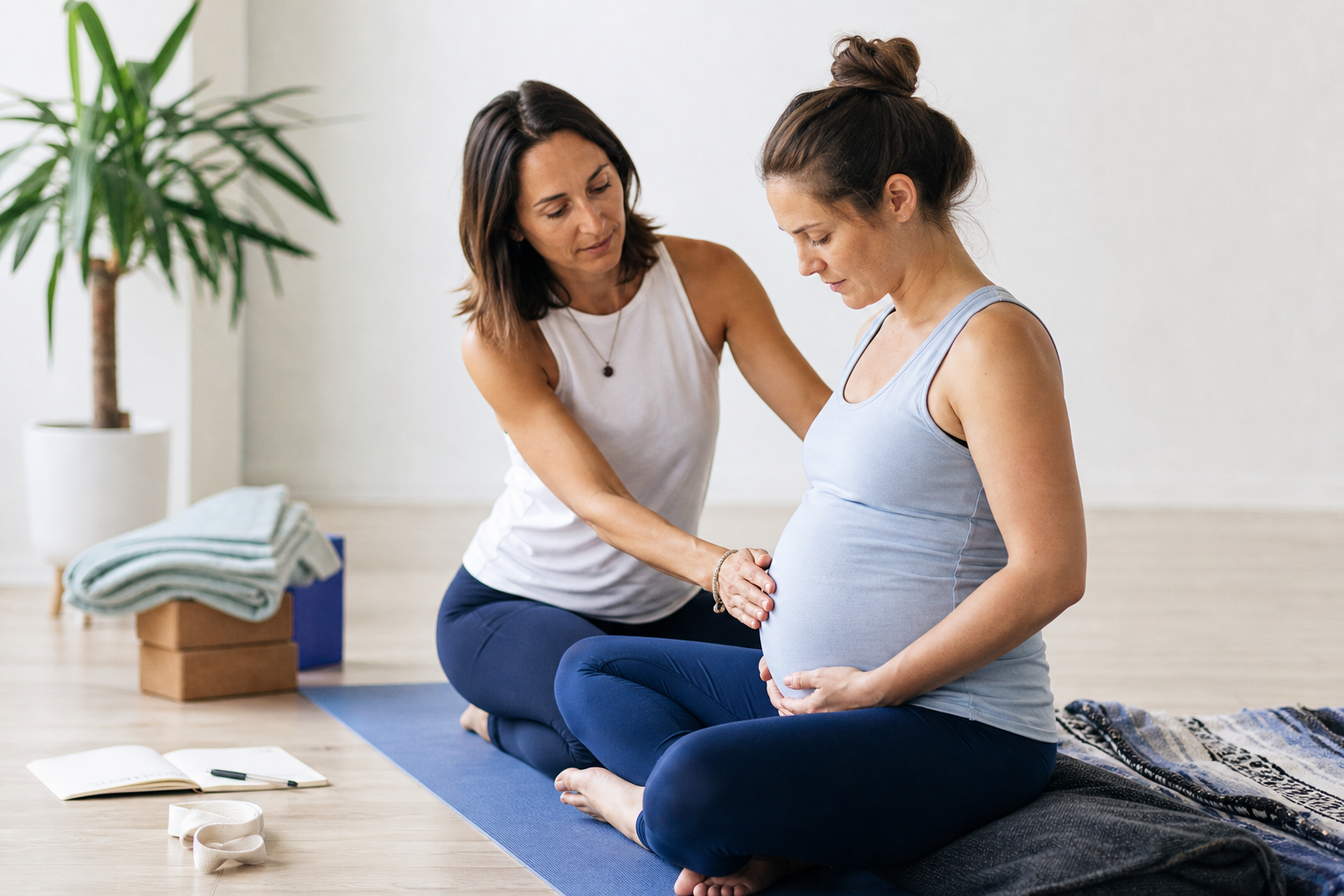
A prenatal yoga instructor course leads to the RPYT credential, but the path has specific prerequisites most new teachers do not expect: a 200-hour RYT credential first, then an 85-hour prenatal specialty training through a Registered Prenatal Yoga School, plus documented teaching experience before registering with Yoga Alliance. The full process typically takes six to twelve months, depending on your starting point and the format you choose.
What Is the RPYT Credential and Why Does It Matter?
The RPYT, or Registered Prenatal Yoga Teacher, is a specialty credential issued by Yoga Alliance. It signals that a teacher has completed structured training in prenatal anatomy, trimester-specific sequencing, and safe modifications for pregnant students, beyond what a standard 200-hour program covers.
For context on why this specialty is worth pursuing: according to Growth Market Reports' 2025 analysis, the global prenatal fitness market was valued at USD 1.84 billion in 2024, and the same report forecasts it will reach USD 3.89 billion by 2033, growing at an annual rate of 8.7%. Studios, hospitals, and birth centers increasingly look for instructors who hold a recognized specialty credential rather than a general teaching certificate.
Holding the RPYT also gives your students a clear signal of competence. Pregnant students and their care providers want to know that a teacher understands contraindications, trimester differences, and when to refer a client to a medical professional. A general RYT certificate does not communicate that.
The credential requires an 85-hour prenatal specialty training completed through a school registered with Yoga Alliance as a Registered Prenatal Yoga School. That training must be separate from your base 200-hour program. Once you finish the coursework and meet the teaching experience requirement, you register the specialty with Yoga Alliance to receive the designation.
Do You Need to Be an RYT-200 Before Taking a Prenatal Yoga Instructor Course?
Yes, a 200-hour RYT certification is a prerequisite for the RPYT pathway. Yoga Alliance requires that you hold a current RYT-200 (or higher) registration before you can register a prenatal specialty credential. Without that base credential, the 85-hour prenatal training hours cannot be applied toward the RPYT designation, even if the coursework itself is excellent.
What counts toward your 200 hours? A training must come from a Yoga Alliance Registered Yoga School (RYS-200 or above) to satisfy the requirement. Programs that are not registered with Yoga Alliance, however well designed, do not count toward RYT registration. If you completed a training years ago, check whether your school held RYS status at the time you graduated.
If you are still working toward your RYT-200, finish that training first, then move directly into a prenatal specialty program. The two trainings build on each other. Prenatal anatomy, pelvic floor awareness, and breath modifications make far more sense once you have a working foundation in alignment principles and sequencing.
One more thing to confirm before enrolling: make sure the prenatal program you choose is offered through a school that holds Registered Prenatal Yoga School status with Yoga Alliance. Not every prenatal yoga course carries that designation, and only hours completed through a registered school will satisfy the RPYT requirement.
How to Get Certified: 4 Steps to the RPYT
The RPYT pathway has four stages. Each builds on the one before it, so the order matters.
-
Complete a 200-hour yoga teacher training program. Your base training must come from a Yoga Alliance RYS-200 accredited school. This training covers foundational anatomy, philosophy, sequencing, and teaching methodology. Once you finish and register with Yoga Alliance, you hold the RYT-200 designation and are eligible to move to the next stage.
-
Enroll in and complete an 85-hour prenatal specialty training through a Registered Prenatal Yoga School. The school must hold Yoga Alliance's Registered Prenatal Yoga School status. The 85 hours cover prenatal anatomy, trimester-specific modifications, contraindications, postnatal care, and safe sequencing for pregnant students. This training can be completed online, in person, or in a hybrid format, provided the school is appropriately registered.
-
Accumulate specialized teaching experience after finishing the coursework. After completing the 85-hour training, you need documented teaching hours working specifically with prenatal students. Keep a teaching log that records dates, student populations, and session lengths. This documentation is what you submit when you register the credential.
-
Register the specialty certification with Yoga Alliance to receive the RPYT credential. Once your coursework and teaching hours are in order, you submit your application to Yoga Alliance. Note that Yoga Alliance charges fees for credential registration; for reference, the organization charges a one-time $85 application fee for teachers applying via the Experienced Teacher Pathway. Confirm the current fee structure for the RPYT specialty registration directly with Yoga Alliance before applying, as fees and pathways can be updated.
A few practical notes on timing: the 85-hour training can often be completed in four to eight weeks in a self-paced online format, or over several weekends in an in-person intensive. The teaching experience stage is usually what extends the overall timeline. Plan for at least three to four months of active teaching after your coursework before you have enough documented hours to apply. Building relationships with prenatal students takes time, and rushing that stage can leave gaps in your log.
Create a teaching log spreadsheet on day one of your prenatal training, and record every session as you go. Reconstructing teaching records after the fact is far harder than maintaining them in real time.
What Does a Prenatal Yoga Instructor Course Actually Cover?
A quality prenatal yoga instructor course goes well beyond modified poses. The curriculum is structured around the physiological and emotional changes of pregnancy, so you can make safe, informed decisions in every class you teach.
Most 85-hour programs organize their content into these core areas:
-
Prenatal anatomy and physiology. You study how pregnancy changes the musculoskeletal system, cardiovascular function, and connective tissue. This includes the role of relaxin (a hormone that loosens joints during pregnancy), shifts in the center of gravity, and how the growing uterus affects breathing mechanics and abdominal engagement.
-
Trimester-specific sequencing and modifications. Each trimester brings different needs and contraindications. You learn which poses to avoid in the first trimester, how to adapt standing and supine work in the second, and what to prioritize for comfort and stability in the third. You also learn how to read a student's energy and adjust on the spot.
-
Pelvic floor awareness. Prenatal training gives significant attention to the pelvic floor, including how to cue engagement and release, why both matter during pregnancy, and how to avoid loading patterns that increase discomfort or risk.
-
Breathwork and pranayama for pregnancy. Certain pranayama (yogic breathing) practices are contraindicated during pregnancy. You learn which techniques support relaxation and labor preparation, and which to set aside until the postnatal period.
-
Postnatal care and return-to-practice guidance. Many programs include an introduction to postnatal recovery, covering how the body heals after birth and how to support a student's gradual return to a fuller practice.
-
Contraindications and when to refer. You study red flags, common pregnancy complications, and the boundaries of a yoga teacher's scope of practice. Knowing when to refer a student to her midwife or physician is as important as knowing which poses to teach.
-
Class design and trauma-informed language. Prenatal students bring a wide range of experiences. Good programs address how to create a safe, inclusive environment and use language that supports rather than pressures.
Evaluating a program's syllabus against these areas is a reliable way to compare course quality before you enroll.
Online vs. In-Person vs. Hybrid: Which Prenatal Yoga Instructor Course Format Fits You?
All three formats can satisfy Yoga Alliance requirements, provided the school holds Registered Prenatal Yoga School status. The right choice depends on your schedule, learning style, and access to in-person practice opportunities.
| Format | Flexibility | Hands-on practice | Typical timeline | Best for |
|---|---|---|---|---|
| Online (self-paced) | High: study on your own schedule | Lower: you arrange practice teaching independently | 4 to 8 weeks for coursework | Working teachers, caregivers, or those in areas without local programs |
| In-person intensive | Low: fixed dates and location | High: supervised practice teaching included | 1 to 3 weekends or a week-long retreat | Learners who prefer direct feedback and structured immersion |
| Hybrid | Medium: recorded content plus scheduled live sessions | Medium: live Zoom or in-person sessions for practice | 6 to 12 weeks | Those who want flexibility without losing real-time instruction |
Online prenatal yoga instructor courses have grown substantially as schools have moved their registered programs to digital platforms. A self-paced online format lets you work through anatomy modules and video demonstrations at your own pace, which suits teachers who are already working full schedules. The trade-off is that you need to be proactive about arranging supervised practice teaching, since the program will not place you in front of students automatically.
In-person formats give you direct feedback from a trainer while you practice adjustments and sequencing. If you learn best by doing and want someone to correct your cueing in real time, an in-person intensive is worth the travel and scheduling commitment. Search for a prenatal yoga instructor course near you through the Yoga Alliance school directory, which lists registered schools by location.
Hybrid programs combine recorded or self-paced content with live online sessions, often via video call. This format suits teachers who want the flexibility of online learning but value regular contact with an instructor and cohort. Live sessions typically cover practice teaching, Q&A, and case discussions that are harder to replicate through video alone.
Whichever format you choose, confirm that the school holds Registered Prenatal Yoga School status with Yoga Alliance before you enroll. The format matters far less than the school's registration status when applying for your RPYT credential.
How hellomyyoga’s Prenatal and Postnatal Yoga Training Fits This Path
hellomyyoga is an online wellness education platform built exclusively for yoga practitioners and instructors seeking professional development and clinical specialization. Its Prenatal and Postnatal Yoga teacher training is one of three specialized certification programs on the platform, alongside Geriatric Yoga Care and Cancer Survivor Rehabilitation Yoga.
All programs are designed by doctors, vaidyas (Ayurvedic practitioners), and yoga chikitsa acharyas (yoga therapy teachers), which gives the curriculum a clinical depth that general yoga teacher training programs rarely include. The prenatal and postnatal program covers the physiological changes of pregnancy, trimester-specific sequencing, postnatal recovery, and the Ayurvedic perspective on supporting a pregnant student's overall well-being.
The platform delivers training through a combination of self-paced course content and live Zoom sessions, making it a hybrid format suited to practitioners who need scheduling flexibility without losing access to live instruction. This structure aligns with the prenatal yoga online training model described in the previous section.
hellomyyoga's programs are designed as specialist continuing education for yoga professionals. The platform operates as a continuing education provider, meaning its courses are built for instructors who want to deepen their knowledge and expand their scope of practice. Contact hellomyyoga directly to verify current registration status before enrolling.
For practitioners in India or those seeking training grounded in both clinical yoga and Ayurvedic principles, hellomyyoga offers a level of specialization that broader online platforms do not typically provide. You can browse the full range of yoga courses on hellomyyoga to see how the prenatal program sits alongside other specialist offerings. The Mitra Community Forum and hmyTV interview series give students ongoing access to peer discussion and expert perspectives beyond the course itself.
Prenatal Yoga Certification in California and Other States: What to Check
California does not have a state-issued license for prenatal yoga teachers. The same is true in most US states. Yoga teaching is not regulated at the state level the way physical therapy or midwifery is, so the RPYT credential from Yoga Alliance remains the primary professional standard regardless of where you teach.
That said, there are practical considerations worth checking before you start teaching prenatal classes in any state.
Scope of practice. A prenatal yoga teacher is not a birth worker, a doula, or a medical provider. Your role is to guide movement, breath, and relaxation, not to advise on labor management, fetal positioning, or medical decisions. This distinction matters in every state, and staying clearly within it protects both you and your students.
Liability insurance. Most studios and wellness centers that host prenatal yoga classes require instructors to carry professional liability insurance. Prenatal teaching carries a higher perceived risk than general yoga classes, so some insurers offer specific riders or policies for prenatal specialists. Check with your current provider before you begin teaching this population, and confirm what your policy covers.
Venue requirements. Some hospitals and birth centers that offer prenatal yoga programs may ask for additional documentation, such as a background check or proof of CPR certification, beyond the RPYT credential itself.
FAQs
What is the difference between a prenatal yoga teacher and a birth doula?
A prenatal yoga teacher guides students through movement, breathwork, and relaxation practices during pregnancy. A birth doula provides continuous emotional and physical support during labor and delivery. These are different roles with different training requirements and different scopes of practice. A prenatal yoga teacher does not advise on labor decisions or provide hands-on support during birth. Some practitioners hold both credentials, but each requires separate, dedicated training.
Is there a free prenatal yoga instructor course that counts toward RPYT?
No verified free program that satisfies Yoga Alliance's RPYT hour requirements is currently available. Some platforms offer free introductory content or sample modules, which can help you assess a program's approach before enrolling, but those hours do not count toward the 85-hour specialty requirement. The RPYT pathway requires training through a Yoga Alliance Registered Prenatal Yoga School, and registered programs carry a cost. If cost is a barrier, look for payment plans or early enrollment discounts offered by individual schools.
How long does it take to complete an 85-hour prenatal yoga training?
The coursework itself typically takes four to eight weeks in a self-paced online format, or one to three weekends in an in-person intensive. A hybrid program usually runs six to twelve weeks. The coursework timeline is only part of the picture, though: after you finish the training, you still need to accumulate documented teaching hours with prenatal students before you can register the RPYT credential. That stage commonly adds three to four months or more to the overall timeline.
Do RPYT credentials need to be renewed, and how often?
Yoga Alliance requires all registered teachers to renew their credentials periodically and to complete continuing education hours as part of that renewal. The RPYT specialty is maintained alongside your base RYT registration. Continuing education providers, sometimes designated by Yoga Alliance as approved continuing education providers, offer courses that count toward renewal. Check the current renewal cycle and continuing education requirements directly on the Yoga Alliance website, as these details are updated from time to time.
Can I teach prenatal yoga without the RPYT if I already hold a 200-hour RYT?
Technically, nothing legally prevents an RYT-200 from teaching a prenatal yoga class. A 200-hour training does not cover prenatal anatomy, trimester-specific contraindications, or pelvic floor considerations in any depth, though. Teaching this population without specialized training carries real risk for your students and exposes you to professional liability. Most reputable studios and wellness centers also prefer or require the RPYT for instructors leading dedicated prenatal classes. Completing the specialty training is the responsible path, not just a credential formality.
Conclusion
Becoming a certified prenatal yoga instructor follows a clear sequence: finish your RYT-200, complete an 85-hour prenatal specialty training through a Yoga Alliance Registered Prenatal Yoga School, document your teaching hours with prenatal students, and register the RPYT credential with Yoga Alliance. The full process takes most people six to twelve months, with the teaching experience stage usually setting the pace.
Your most useful next step is to confirm where you stand on the 200-hour prerequisite, then search the Yoga Alliance school directory for registered prenatal programs that match your preferred format, whether online, in-person, or hybrid. If you want training grounded in clinical yoga and Ayurvedic principles, explore what specialist platforms offer before committing to a general program. Start your teaching log on day one of your prenatal training. That single habit will save you the most time when you are ready to apply.