

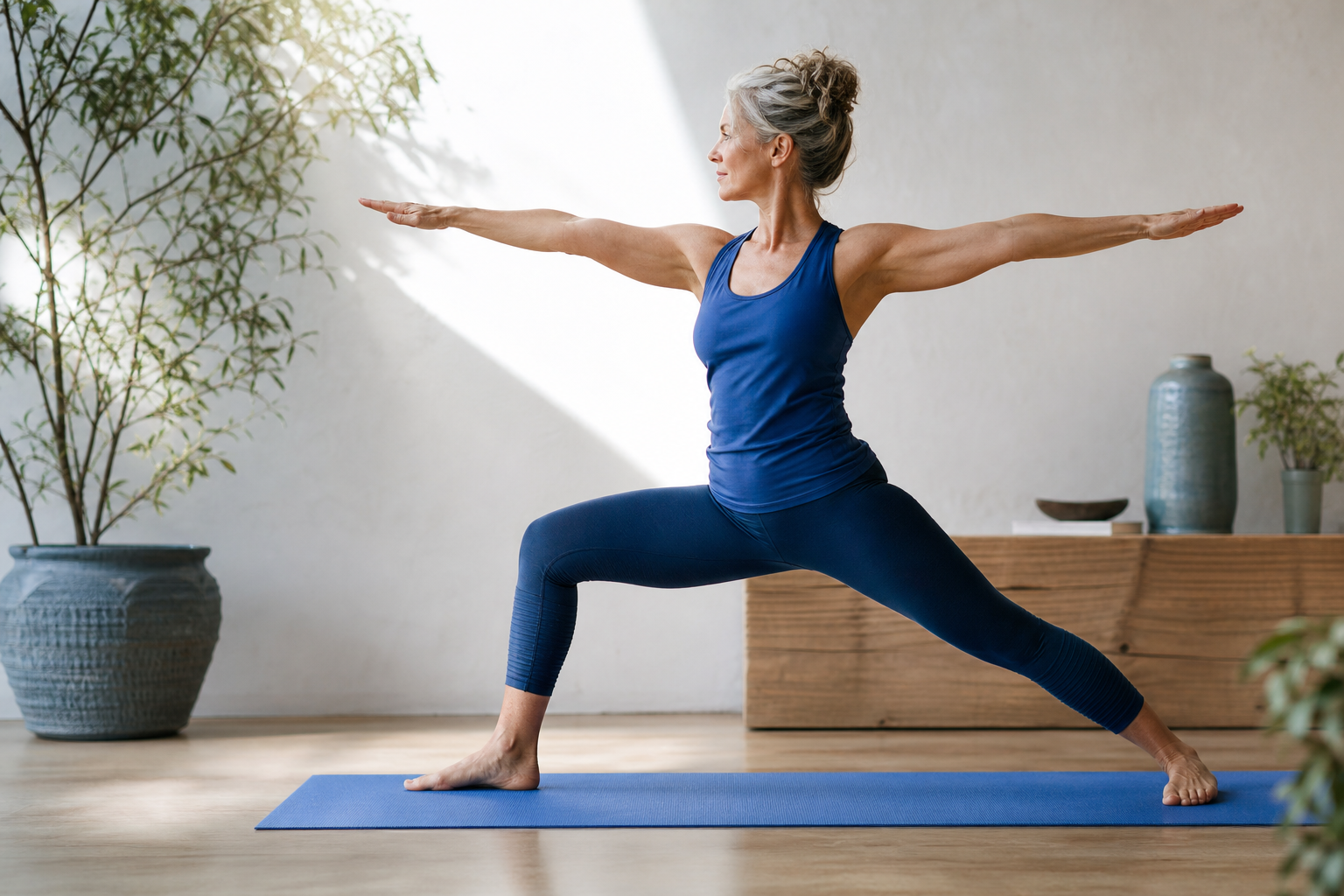
Yoga can help build bone strength in people with osteoporosis by applying controlled compression and torque to the skeleton. Safe poses include Tree Pose, Triangle, Warrior II, and Bridge. Avoid deep spinal flexion and unsupported twists. Hold each pose 30 to 60 seconds and use props to stay stable. This guide covers which poses to do, which to skip, and how to practice yoga for osteoporosis without guessing at your own safety.
Can Yoga Actually Improve Bone Mineral Density?
Yes, yoga can improve bone mineral density when practiced consistently with the right poses. The key mechanism is mechanical loading: when a muscle pulls against bone, or when you bear weight through a limb, the skeleton responds by building new bone tissue. Yoga creates that stimulus through weight-bearing standing poses, isometric holds, and controlled torque.
The need for safe, effective approaches is real. Research estimates that 137 million women worldwide are at high risk for osteoporotic fractures, and in Canada alone, approximately 2.2 million people aged 40 and older live with osteoporosis. These numbers point to a large population that needs movement strategies that strengthen rather than strain.
The clinical evidence is encouraging. In a study of premenopausal women, an 8-month yoga program produced a 9.1 ± 4.0% increase in bone formation markers compared to a decrease in the control group. A separate 10-year study of the Fishman Method, a specific 12-pose sequence designed to stimulate bone density through torque and compression, found that compliant practitioners experienced a monthly bone mineral density gain in the spine of 0.0029 g/cm². These come from different study designs and populations, so their figures should not be read as interchangeable, but together they suggest a consistent direction. These come from different study designs and populations, so their figures should not be read as interchangeable, but together they suggest a consistent direction.
No single yoga style or sequence has been proven superior for every person. What the evidence supports is regular practice, correct alignment, and adequate hold time.
Before You Begin: What to Do Before Starting Yoga for Osteoporosis
Starting yoga with osteoporosis is safe for most people. A few preparation steps will make your practice both more effective and much safer.
-
Get a DEXA scan before you begin. A dual-energy X-ray absorptiometry (DEXA) scan measures your bone mineral density at the spine and hip. This gives you a baseline. Without it, you cannot know whether your practice is working or whether your bone density is changing over time. Ask your doctor to arrange one and keep the results so you can compare them after six to twelve months of consistent practice.
-
Consult your doctor or a physiotherapist. Tell them you plan to start yoga and share your DEXA results. They can flag any sites of particular fragility, such as compression fractures in the thoracic spine, that should shape which poses you attempt and which you modify.
-
Look for a teacher trained in working with low bone density. Not every yoga instructor has clinical training in this area. Bone Fit™ is an evidence-based training program for health and fitness professionals that equips them to prescribe safe exercise for people with osteoporosis. Bone Fit also offers a locator tool so you can find a trained professional near you. Asking a prospective teacher whether they have this kind of background is a fair and useful question.
-
Gather your props before your first session. A sturdy chair, two yoga blocks, and a non-slip mat are the minimum. Props are not a sign of limitation; they are how you hold correct alignment while your strength and balance develop.
-
Start with beginner yoga for osteoporosis, not a general class. General yoga classes may include forward folds, deep twists, and inversions that carry real fracture risk for people with low bone density. A class or program designed specifically for osteoporosis will sequence poses differently from the start.
12 Yoga Poses for Osteoporosis That Build Bone Strength
The Fishman Method identifies 12 poses that stimulate bone density through torque and compression. These poses load the hip, spine, and wrist in ways that signal the body to build bone. Below is the full list with the mechanical reason each pose works and practical guidance on how to approach it.
1. Tree Pose (Vrksasana)
You stand on one leg, pressing the sole of the opposite foot into your inner thigh or calf. The single-leg stance loads the hip and femur directly. Use a wall or chair back for balance if needed.
2. Triangle Pose (Trikonasana)
The lateral stretch and rotation in Triangle create torque along the spine and load the hip of the standing leg. Keep the spine long rather than rounding toward the floor.
3. Warrior II (Virabhadrasana II)
The bent front knee drives weight through the hip and femur while the arms create isometric load through the shoulder girdle. This is one of the strongest hip-loading poses in the sequence.
4. Side-Angle Pose (Utthita Parsvakonasana)
Similar to Warrior II in hip loading, this pose adds a lateral spinal stretch. Place your forearm on your thigh rather than reaching your hand to the floor if your balance is uncertain.
5. Warrior I (Virabhadrasana I)
The upright torso and lifted arms load the lumbar spine and hip simultaneously. Keep the pelvis squared forward to avoid excessive rotation at the lower back.
6. Downward-Facing Dog (Adho Mukha Svanasana)
This pose loads the wrists, arms, and shoulder girdle in a way that can stimulate bone density at the wrist and forearm. Note that some clinical guidelines advise caution here for people with significant spinal osteoporosis. Discuss it with your clinician before including it.
7. Bridge Pose (Setu Bandhasana)
Lying on your back with knees bent, you press the feet into the floor and lift the hips. This loads the spine and hip extensors without any forward flexion risk. It is one of the safest strengthening poses for people with vertebral fragility.
8. Locust Pose (Salabhasana)
A gentle prone backbend that strengthens the muscles along the spine without compressing the vertebrae forward. It builds the paraspinal muscles that support upright posture and reduce fracture risk.
9. Corpse Pose Variation with Block (Savasana variation)
Placing a block under the thoracic spine in a supported backbend gently extends the upper back, counteracting the forward rounding that often accompanies osteoporosis-related vertebral changes.
10. Chair Pose (Utkatasana)
The partial squat position loads the hip and femur under the body's own weight. Hold the pose at a depth that feels stable, and use a wall behind you if balance is a concern.
11. Extended Side Stretch (Parsvottanasana, modified)
In the modified version, you keep the torso upright rather than folding over the front leg. This loads the hip and femur while avoiding the forward spinal flexion that raises fracture risk.
12. Supine Hand-to-Foot Pose (Supta Padangusthasana)
Lying on your back, you extend one leg upward, using a strap around the foot. This stretches the hamstrings without any spinal flexion and gently loads the hip joint through the range of motion.
A note on props and modifications. For any standing pose, a chair placed beside your mat gives you something to touch for balance without changing the mechanical loading of the pose. Yoga blocks under your hands in Triangle or Side-Angle Pose let you keep a long spine rather than rounding to reach the floor. Keeping the spine straight and never rounding the back is the single most important safety rule across all 12 poses.
How Long Should You Hold Each Pose to Strengthen Bones?
Hold each pose for at least 30 to 60 seconds to create enough mechanical pressure for bone formation. Bone responds to sustained load, not just momentary stress. A brief touch-and-go movement does not give osteoblasts, the cells that build bone, enough sustained pressure to respond.
This principle is supported by the research. In a study of premenopausal women, an 8-month yoga program that included sustained holds produced a 9.1 ± 4.0% increase in bone formation markers compared to a decrease in the control group. The program's structure, not just the poses themselves, contributed to that outcome.
In practice, 30 seconds is a reasonable starting point if you are new to holding poses. Work toward 60 seconds as your strength and balance improve. If a pose feels unstable at 30 seconds, shorten the hold and add a prop rather than rushing through it with poor alignment. Stability and alignment matter more than duration. A 20-second hold with a long spine and a steady base does more good than a 60-second hold with a rounded back.
Aim to practice most days of the week. Bone responds to repeated, consistent loading over months, not to occasional sessions. Each hold is one small deposit in a long-term account.
Which Yoga Poses Should Be Avoided With Low Bone Density?
Certain movement patterns raise fracture risk significantly for people with osteoporosis. Knowing them is just as important as knowing which poses to practice.
Deep spinal flexion is the clearest category to avoid. Any pose that rounds the spine forward under load, such as a full seated forward fold (Paschimottanasana), a standing forward bend with a rounded back, or Plow Pose (Halasana), places compressive force on the front of the vertebral bodies. For someone with low bone density in the spine, that force can be enough to cause a wedge fracture, even without any impact or fall.
Unsupported inversions carry a different risk. Full inversions like Headstand (Sirsasana) and Shoulderstand (Sarvangasana) place the cervical spine under load it was not designed to bear in that direction. A fall from an inversion at any age can be serious; with osteoporosis, the consequences are more severe.
High-impact transitions deserve attention too. Jumping between poses, common in some vinyasa styles, creates sudden compressive forces that exceed what a fragile skeleton can safely absorb. Move between poses slowly and deliberately.
Twists and Downward-Facing Dog are contested. Some clinical sources permit gentle, open-chain twists performed with a neutral spine and no forced rotation, while others advise avoiding all rotational spinal loading for people with significant vertebral osteoporosis. There is no settled consensus on this point. The same disagreement applies to Downward-Facing Dog: it loads the wrists and shoulders usefully, but the spinal position may not suit everyone. The right approach is to raise these poses specifically with your doctor or physiotherapist rather than applying a blanket rule in either direction.
As a general principle, if a pose requires you to round your spine, bear weight through your neck, or move quickly from one position to another, treat it as something to question before attempting without guidance.
Is Yoga Safe for People With Osteoporosis in the Spine?
Yes, yoga is safe for people with spinal osteoporosis when practiced with correct alignment, appropriate modifications, and props. The key is keeping the spine in a neutral or gently extended position throughout your practice, never rounding it forward under load.
Spinal osteoporosis most commonly affects the thoracic and lumbar vertebrae. The fractures associated with it are typically compression fractures, where the front of a vertebral body collapses. Forward flexion, especially under load or with momentum, is the movement most likely to cause that. Every pose in a well-designed osteoporosis practice is either neutral, extended, or lateral, never flexed forward.
Props make this possible in poses that might otherwise pull you into a rounded position. In Triangle Pose, a block under your lower hand lets you keep the spine long instead of reaching toward the floor. In any seated pose, sitting on a folded blanket tilts the pelvis forward and helps the lumbar spine maintain its natural curve. Using chairs, walls, or yoga blocks for stability reduces the risk of falling during balance poses, which matters as much as spinal alignment for people with fragile bones.
The broader point is that yoga practiced with attention to how the body is positioned, rather than how far it can go, is a safe and beneficial practice for people managing osteoporosis in the spine.
For Yoga Instructors: Teaching People With Osteoporosis
If you teach yoga and want to work safely with older adults and people with low bone density, clinical grounding matters. Understanding how the aging skeleton responds to load, which poses carry risk, and how to modify a practice for someone with vertebral fragility will make your teaching more effective and your students safer. If you teach yoga, hellomyyoga offers certifications and short self-study courses, including a Geriatric Yoga Care program, that cover the anatomical reasoning and practical sequencing skills needed for this population.
Prices and plan limits verified as of October 2026.
FAQs
What is the difference between osteoporosis and osteopenia, and does it change which poses are safe?
Osteopenia means bone density is lower than normal but not yet in the osteoporosis range. Osteoporosis is a more significant loss of density that raises fracture risk substantially, particularly at the spine and hip. In practice, the same safety principles apply to both: avoid deep spinal flexion, use props, and hold poses with good alignment. Someone with osteopenia may tolerate a slightly wider range of poses, but the poses to avoid remain the same, and consulting a clinician before starting is equally important for both.
How often should someone with osteoporosis practice yoga each week?
Bone responds to repeated, consistent loading over months, so practicing most days of the week produces better results than one or two longer sessions. Aim for five to six days if possible, even if some sessions are shorter. A 20-minute practice with correct alignment and adequate hold times is more useful than a 60-minute session once a week. Start with three days per week if daily practice feels like too much, then build gradually as your strength and balance improve.
Can men with osteoporosis benefit from yoga the same way women do?
Yes. Osteoporosis is less common in men but still affects a significant number, and the mechanical principles behind bone loading do not differ by sex. Weight-bearing poses, isometric holds, and controlled torque stimulate bone formation in both men and women. The same poses, the same hold times, and the same safety precautions apply. Men are sometimes diagnosed later because osteoporosis is less routinely screened in male patients, which makes a DEXA scan baseline equally important for men who want to track whether their practice is producing results.
Should I tell my yoga teacher I have osteoporosis before class?
Yes, always. A teacher who knows your diagnosis can offer modifications before a pose becomes a problem rather than after. They can cue you away from deep forward folds, watch your spinal alignment in twists, and suggest prop setups that keep you safe. If your teacher is unfamiliar with osteoporosis or seems unsure how to adapt poses for you, that is useful information too. It is a reasonable prompt to look for a teacher with specific training in working with low bone density, such as someone who has completed a Bone Fit certification.
Are online yoga classes safe for people with osteoporosis, or is in-person instruction better?
Online classes can be safe when the instructor is trained in working with low bone density and when you have already learned the key safety principles, particularly how to keep a neutral spine and when to use props. In-person instruction has an advantage early on because a teacher can observe your alignment directly and correct it in real time. If you are new to yoga or have significant spinal osteoporosis, starting with a few in-person sessions to establish correct habits is a sensible approach before moving to online practice.
Conclusion
Yoga can support bone health in people with osteoporosis when the right poses are practiced with correct alignment, adequate hold times, and appropriate props. The evidence points consistently toward weight-bearing standing poses, isometric holds, and controlled torque as the mechanisms that matter. Avoiding deep spinal flexion and unsupported inversions reduces fracture risk without limiting the benefits.
Before you start, get a DEXA scan to establish a baseline, talk to your doctor about any sites of particular fragility, and look for a teacher with clinical training in this area. If you are an instructor wanting to work more confidently with this population, exploring a structured certification in geriatric yoga care is a practical next step that will shape how you sequence, cue, and modify for every client with low bone density.