
- What Anulom Vilom Actually Is
- The Autonomic Nervous System: A Brief Orientation
- How Alternate Nostril Breathing Influences the ANS
- The Difference Between a Single Session and Sustained Practice
- Anulom Vilom Across the Lifespan
- Technique Notes for Serious Practitioners
- Pranayama, Sound, and the Nervous System
- For Yoga Teachers: Why This Knowledge Changes Your Teaching
- The Practice Is the Research
- Frequently Asked Questions
Most people who practise anulom vilom think of it as a calming technique — something to do before bed, or before a difficult conversation. That framing isn't wrong. But it's incomplete. The anulom vilom benefits that matter most aren't the ones you feel in a single session. They emerge over weeks and months of consistent practice, and they operate at a level most practitioners never examine: the autonomic nervous system.
This article is for yoga teachers and serious practitioners who want to understand what's actually happening beneath the breath. Not just the sensation of calm, but the physiological shift that sustained alternate nostril breathing creates in the body's regulatory systems.
What Anulom Vilom Actually Is
Anulom vilom (alternate nostril breathing) is a pranayama technique in which you breathe through one nostril at a time, alternating sides in a deliberate pattern. The left nostril is associated with the ida nadi — the lunar, cooling channel — and the right with the pingala nadi, the solar, activating channel. Classical yogic texts describe the practice as a method for purifying the nadis and balancing the flow of prana through the body.
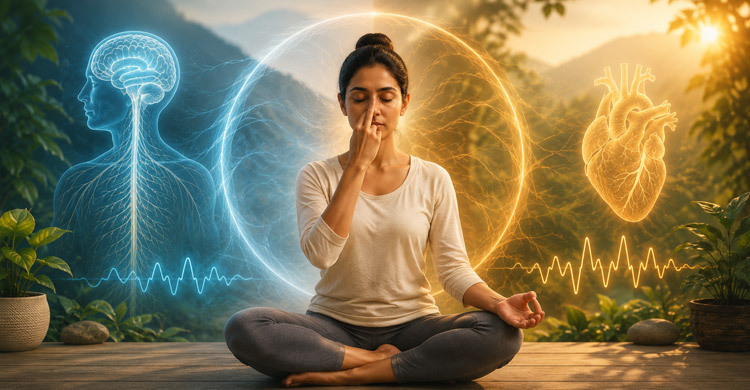
In modern physiological terms, this maps onto something measurable. The left nostril preferentially activates the right hemisphere of the brain and the parasympathetic branch of the autonomic nervous system. The right nostril activates the left hemisphere and the sympathetic branch. Alternate nostril breathing cycles through both — and with sustained practice, it trains the nervous system toward greater balance between these two states.
This is not metaphor. It is the mechanism behind the anulom vilom benefits that practitioners report and researchers have begun to document.
The Autonomic Nervous System: A Brief Orientation
The autonomic nervous system (ANS) governs the body's involuntary functions: heart rate, digestion, blood pressure, respiratory rate, immune response, and hormonal signalling. It has two primary branches.
The sympathetic branch activates the body for action. It raises heart rate, shunts blood to the muscles, dilates the pupils, and suppresses digestion. It is the system behind the stress response.
The parasympathetic branch returns the body to rest. It slows the heart, stimulates digestion, lowers blood pressure, and supports repair and immune function. It is the system behind recovery.
Most people in contemporary life spend a disproportionate amount of time in sympathetic dominance. Chronic stress, poor sleep, sedentary postures, and shallow breathing all reinforce this imbalance. The result is a nervous system perpetually braced for a threat that never resolves.
Yogic tradition understood this pattern long before the vocabulary existed to describe it. Pranayama, and anulom vilom in particular, was designed to address exactly this dysregulation.
How Alternate Nostril Breathing Influences the ANS
The mechanism works through several pathways at once.
The Nasal Cycle and Hemispheric Influence
The body naturally alternates nasal dominance roughly every 90 to 120 minutes in a rhythm called the nasal cycle. Research has confirmed that nasal dominance correlates with hemispheric brain activity: right nostril dominance corresponds to greater left-hemisphere activity and sympathetic tone; left nostril dominance corresponds to greater right-hemisphere activity and parasympathetic tone.
Anulom vilom deliberately intervenes in this cycle. By consciously alternating nostrils in a controlled ratio, the practice stimulates both branches of the ANS in sequence, training the system toward symmetry rather than chronic dominance of one side.
Slow Breathing and Heart Rate Variability
The pace of anulom vilom matters as much as the pattern. Classical instruction typically involves a ratio of inhalation, retention, and exhalation, with the full breath cycle extending well beyond the ordinary resting rate of 12 to 20 breaths per minute. Slowing the breath to around 5 to 6 cycles per minute is associated with increased heart rate variability (HRV) — a key marker of autonomic flexibility.
High HRV indicates that the heart can respond fluidly to changing demands, accelerating and decelerating efficiently. Low HRV is associated with cardiovascular disease, anxiety disorders, and impaired stress recovery. Sustained pranayama practice is one of the few accessible, non-pharmacological ways to improve HRV over time.
Kumbhaka and the Vagal Response
Kumbhaka (breath retention) is typically introduced gradually as a practitioner's capacity deepens. The pause after inhalation or exhalation creates a brief, controlled state of apnea — and this stimulates the vagus nerve, the primary conduit of parasympathetic signalling from the brainstem to the visceral organs. Repeated vagal stimulation over months of practice is thought to increase what researchers call vagal tone: the baseline level of parasympathetic influence on the heart and organs.
Higher vagal tone is associated with better emotional regulation, lower inflammatory markers, improved digestive function, and more resilient cardiovascular response to stress. This is why experienced pranayama practitioners often describe a quality of equanimity that goes beyond relaxation. The nervous system has genuinely changed.
The Difference Between a Single Session and Sustained Practice
A single session of anulom vilom will almost certainly make you feel calmer. That is real, and it matters. But it is a temporary shift — a brief tilt toward parasympathetic dominance that fades within hours.
Sustained practice, meaning daily or near-daily sessions over weeks and months, produces structural adaptation. The nervous system doesn't just respond to the practice in the moment; it begins to reorganise around it. Baseline HRV rises. Resting heart rate often decreases. The threshold for sympathetic activation increases, meaning the body requires a larger stressor to trigger the same anxious response.
Ayurvedic tradition describes this kind of deep, gradual restoration through the concept of rasayana — the science of rejuvenation and tissue renewal. Pranayama, practised with consistency and correct technique, is considered a rasayana for the prana vaha srotas (the channels of vital energy). The wisdom behind rasayana offers a useful lens here: renewal is not an event but a process that compounds over time.
This is why yogic texts prescribe pranayama as a daily discipline rather than an occasional tool. The benefits are cumulative, and they are dose-dependent.
Anulom Vilom Across the Lifespan
The autonomic implications of this practice are not uniform across all bodies. Age, hormonal status, and existing health conditions all shape how the ANS responds and how quickly adaptation occurs.
In Middle Age
The autonomic nervous system undergoes measurable changes during midlife, particularly in women navigating perimenopause and menopause. Hormonal shifts reduce the buffering effect of oestrogen on cardiovascular reactivity, and sympathetic tone tends to increase. Research into health issues in middle-aged women consistently highlights cardiovascular risk, sleep disruption, and mood dysregulation as primary concerns — and these are precisely the domains where improved autonomic balance, through sustained pranayama, shows the most clinical relevance.
In Older Adults
Ageing is associated with a progressive decline in HRV and vagal tone, a process sometimes called autonomic ageing. This contributes to increased cardiovascular risk, reduced immune resilience, and slower recovery from physical and emotional stress. Gentle, sustained pranayama practice is one of the few interventions accessible to older adults that directly addresses this decline without requiring physical exertion or pharmaceutical management. For yoga teachers working with senior students, understanding this mechanism isn't optional — it's foundational.
In Anxiety and Stress-Related Conditions
Chronic anxiety is, at its root, a state of sustained sympathetic dominance. The body has learned to stay braced. Anulom vilom, practised consistently, offers a physiological counter-training. It is not a substitute for clinical care, but as an adjunct practice, its mechanism is coherent and its safety profile is excellent.
Technique Notes for Serious Practitioners
If you have been practising anulom vilom for years, some of these points may refine what you already do. If you are newer to the practice, they will save you time.
- Ratio matters more than speed. A common starting ratio is 1:1:2 — inhale for 4 counts, hold for 4, exhale for 8. The extended exhalation is what activates the parasympathetic response most directly. Don't rush the exhale.
- Nasika mudra should be relaxed. Many practitioners grip the nose too firmly, creating tension in the face and neck that counteracts the calming effect. The touch should be light.
- Consistency outperforms duration. Fifteen minutes daily produces more lasting autonomic change than a 60-minute session once a week. The nervous system adapts to what it encounters regularly.
- Morning practice sets the baseline. Practising before the day's stressors accumulate trains the ANS from a rested state, which appears to produce more durable adaptation than evening-only practice.
- Kumbhaka should be introduced gradually. Breath retention is a powerful stimulus. Introducing it too quickly — or holding too long — can activate the sympathetic system rather than the parasympathetic one. Work with a knowledgeable teacher before extending retention significantly.
Pranayama, Sound, and the Nervous System
Pranayama does not operate in isolation. Yogic tradition consistently pairs breathwork with sound, mantra, and meditation as mutually reinforcing practices. The science and experience behind chanting reveals a similar autonomic mechanism: the extended exhalation required for sustained vocalisation stimulates the vagus nerve through the same pathway as slow pranayama. Combining anulom vilom with mantra or meditation practices like Transcendental Meditation can deepen the parasympathetic response beyond what either practice achieves alone.
Ancient wisdom, operating through a coherent mechanism. The traditions knew what they were doing.
For Yoga Teachers: Why This Knowledge Changes Your Teaching
Understanding the autonomic dimension of pranayama changes how you sequence a class, how you explain a practice to a student with anxiety, and how you adapt breathwork for older adults or those recovering from illness.
A student who arrives with chronic stress, cardiovascular concerns, or hormonal imbalance is not just a candidate for relaxation techniques. Their autonomic nervous system needs consistent, skilled training. Knowing the mechanism means you can explain the rationale, set realistic expectations, and design a practice that compounds over time rather than offering temporary relief.
This is the level of depth that hellomyyoga's programs are built around. The curriculum at hellomyyoga.com is designed by doctors, vaidyas, and yoga chikitsa acharyas who bring exactly this kind of clinical and classical understanding to teacher training. Whether you are deepening your own practice or building the knowledge base to teach pranayama in clinical or specialised settings — that foundation matters.
The Practice Is the Research
Yogic tradition did not wait for peer-reviewed journals to validate what practitioners had observed over centuries. The autonomic effects of anulom vilom were mapped through direct, sustained inquiry — through teachers practising, observing, refining, and transmitting what they found.
Modern research is now confirming the mechanisms. But the most important data you will ever have is your own sustained practice. Not a week of trying it, but months of showing up for it — tracking what shifts in your sleep, your stress threshold, your emotional steadiness, your physical recovery.
That is where the real anulom vilom benefits live. Not in a single session, but in the slow, cumulative rewiring of a nervous system learning, finally, to rest.
Frequently Asked Questions
What are the main anulom vilom benefits for the nervous system?
Sustained anulom vilom practice trains the autonomic nervous system toward greater balance between its sympathetic (activating) and parasympathetic (resting) branches. Over weeks and months of consistent practice, this shows up as improved heart rate variability, lower resting heart rate, better stress recovery, and a higher threshold for anxiety responses.
How long does it take to see lasting changes from anulom vilom?
Temporary calming effects appear within a single session. Lasting autonomic adaptation typically requires consistent daily practice over four to eight weeks at minimum. The changes are cumulative — the longer and more regularly you practise, the more durable the shift in your baseline nervous system state.
What is the best ratio for anulom vilom to activate the parasympathetic response?
A ratio that emphasises a longer exhalation — such as 1:1:2 (inhale, hold, exhale) — is most effective for parasympathetic activation. The extended exhale stimulates the vagus nerve directly. Beginners can start without retention and extend the exhale gradually.
Is anulom vilom safe for older adults?
Yes, with appropriate guidance. The practice is gentle and does not require physical exertion, making it well suited for older adults. The autonomic benefits are particularly relevant for seniors, as ageing is associated with declining vagal tone and reduced heart rate variability. Breath retention should be introduced slowly and only under qualified instruction.
How does anulom vilom differ from other pranayama practices in its autonomic effects?
Anulom vilom is distinctive because it alternates nostril stimulation, directly influencing both hemispheric brain activity and both branches of the ANS in sequence. Other pranayama techniques may emphasise one branch more strongly — bhramari and sitali tend to be more parasympathetic, while kapalabhati and bhastrika are more sympathetic. Anulom vilom's alternating pattern is specifically designed to create balance rather than activation in one direction.
Can anulom vilom help with anxiety and sleep problems?
As a complementary practice, yes. Chronic anxiety and sleep disruption are often rooted in sympathetic dominance, and sustained anulom vilom practice addresses this directly through vagal stimulation and improved HRV. It is not a substitute for clinical treatment where that is indicated, but its physiological mechanism is coherent and its safety profile is excellent.
Should yoga teachers learn the clinical basis of pranayama before teaching it?
Ideally, yes. Teaching pranayama without understanding its autonomic effects means you cannot safely adapt the practice for students with cardiovascular conditions, anxiety disorders, or age-related changes in nervous system function. Clinical knowledge allows you to explain the rationale, set appropriate expectations, and recognise when a student's response calls for modification.