

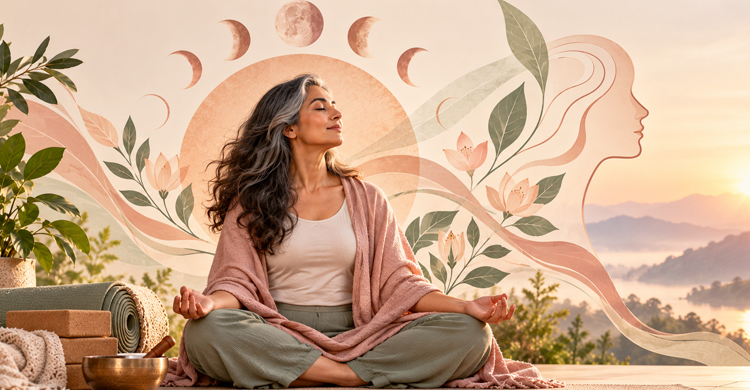
Somewhere tonight, a woman in her late forties will lie awake at 3 a.m. again. Her sleep broke for no clear reason. Her knees ache on stairs they never used to notice. Her patience with people she loves has worn strangely thin. If she mentions any of this, she will probably hear one sentence: “It’s your age. It happens to everyone.” And that will be the end of the conversation.
That is the real problem with menopause. Not that it happens, but that for many women it happens without much preparation, language or company.
A transition, not an event
Menopause is usually marked in hindsight: twelve months after the final menstrual period. But nobody experiences it as a single point. The transition around it, often called the perimenopausal years, unfolds gradually, and it is different for every woman. The World Health Organization describes menopause as a natural biological process, most often occurring between 45 and 55. That framing matters. This is not an illness.
Yet “natural” does not mean “unimportant.” Sleep that stops repairing. Sudden waves of heat. Moods that feel unfamiliar to the woman herself. And in the years after, quieter shifts continue in the bones, the heart and the joints. For a stage of life that touches so many families, surprisingly little is said about it beforehand.
Between the clinic and the kitchen
Menopause has a real place in medical care, and good clinical guidance exists for those who seek it. Yet a consultation has its edges. Back at home, the everyday questions remain: how to sleep better, what to eat, how to move, how to rest, how to make sense of what is changing. Between clinical guidance and daily life lies a wide space of ordinary questions, and many women say they wish they had known more, earlier.
How Ayurvedic tradition sees this stage
Ayurveda has never looked at menopause as a problem to be fixed. In its traditional framework, life moves through stages, and the later decades are associated with a natural rise in vata, the principle linked with movement, dryness and change. Within that lens, the dryness, broken sleep, restlessness and aches many women report are not read as random misfortunes. They are seen as patterns, and the traditional response to patterns is everyday care: food, routine (dinacharya), rest, warmth, and steadiness of mind.
This is a traditional way of seeing, not a medical diagnosis. But for many women it offers something real: a language for what they are experiencing, and a daily rhythm to hold them through it.
Where yoga fits, and where it does not
Thoughtfully adapted yoga practice can be a steady companion in these years: gentle, weight-bearing movement as part of an active life, breath awareness as a way of settling the mind, and rest practiced as a skill, in the very phase of life when rest can become difficult. Appropriately adapted movement and breath support general wellbeing. They do not replace medical care, and questions about hormone therapy, bone health or persistent symptoms belong with a doctor.
Learning menopause, not just enduring it
This is the space that hellomyyoga’s learning programs on menopause are built for. Not symptom lists, and not a syllabus to memorise, but understanding: how Ayurvedic tradition reads the stages of a woman’s life, and how modern medicine and yoga therapy look at the same body.
That learning is led by people who stand in both worlds. Dr. Sharon Samuel is an Ayurvedic doctor and head of the department of Prasuti Tantra and Stri Roga (Ayurvedic obstetrics and gynaecology) at a leading Ayurvedic medical institution. Dr. Vineeta Ketkar has practiced as a family physician since 1980 and trained for a decade under B.K.S. Iyengar; her work sits where medicine and yoga therapy meet.
Learning from teachers like these changes the question. Menopause stops being something to get through quietly and becomes something to understand: in your own body, in your mother’s, in your students’, in the women you care for.
A transition that deserves preparation
Menopause is not a decline to be hidden. It is a long, ordinary, extraordinary transition, and it deserves what every other major life transition gets: preparation, language and care. Whether you are in it, approaching it, or supporting someone through it, understanding this stage through yoga and Ayurveda is a form of self-care that begins long before any remedy.
That is what therapeutic self-care really means: knowing your own body well enough to care for it wisely.
Source: World Health Organization, Menopause fact sheet – https://www.who.int/news-room/fact-sheets/detail/menopause