

- What Is Prana Vayu?
- The Five Pranic Winds: An Overview
- How the Five Vayus Work Together
- Prana Vayu in Yoga Therapy
- The Vayus and the Three Doshas
- Practical Implications for Your Practice
- FAQs
Breath is the most visible expression of prana, but prana itself is far more than breath. In classical yogic and Ayurvedic thought, prana is the animating life force moving through every living body — and it doesn't move as a single undifferentiated current. It moves as five distinct winds, each with its own direction, location, and function. These are the pancha vayus, and understanding them changes how you read your own body, your practice, and your students' experiences on the mat.
This article covers each of the five pranic winds in detail, explains how they interact within yogic physiology, and shows why this knowledge matters practically — not just philosophically.
What Is Prana Vayu?
The word vayu means wind or air in Sanskrit. In yogic physiology, it refers to the directional movement of prana within the body. Prana vayu is both the name for the life force in general and the specific name of one of the five sub-vayus that govern different physiological and energetic processes.
Together, the five vayus form a complete map of how vital energy organises itself in a living being. They appear in texts like the Taittiriya Upanishad, the Prasna Upanishad, and the Hatha Yoga Pradipika, and they remain central to how yoga chikitsa — therapeutic yoga — understands health and disease.
The Five Pranic Winds: An Overview
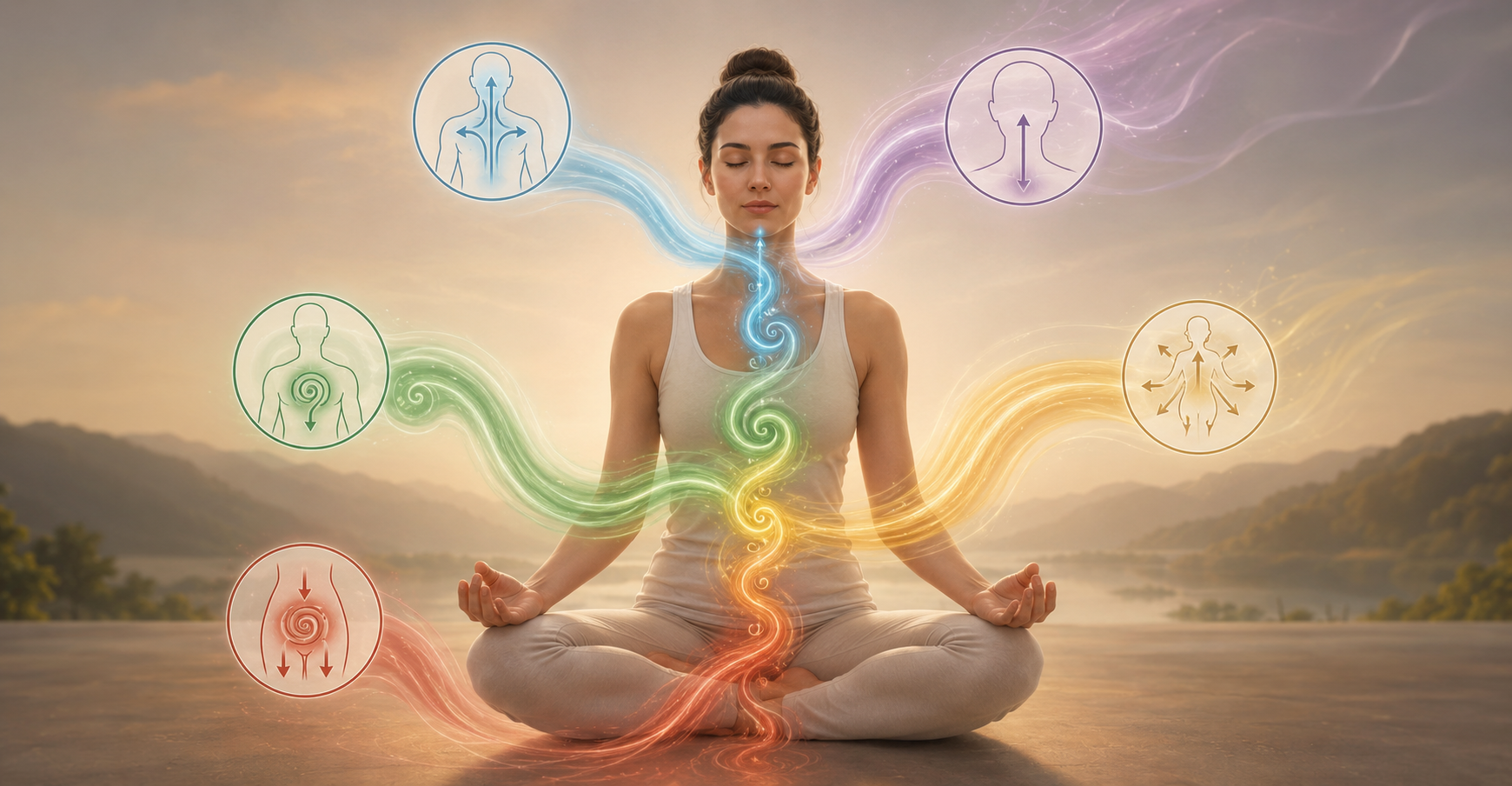
Each vayu has a primary location in the body, a direction of movement, and a set of functions it governs. Disruption in any one of them creates recognisable patterns of imbalance, and many yoga practices, pranayamas, and mudras are designed specifically to restore or redirect these currents.
1. Prana Vayu
Location: Chest, heart, lungs
Direction: Inward and upward
Prana vayu is the receptive force. It governs inhalation, the intake of food, sensory impressions, and experience itself. Every time you draw breath in, you are activating it. Associated with the heart and respiratory system, it energises both the mind and the senses.
When prana vayu is strong and balanced, there is clarity of perception, emotional receptivity, and genuine vitality. When it weakens, shallow breathing, anxiety, difficulty concentrating, and a sense of disconnection from experience often follow.
Practices that support prana vayu include deep diaphragmatic breathing, chest-opening postures like Bhujangasana and Ustrasana, and pranayamas like Nadi Shodhana.
2. Apana Vayu
Location: Pelvis, lower abdomen
Direction: Downward and outward
Apana vayu is the force of elimination and release. It governs the downward movement of energy and is responsible for excretion, menstruation, childbirth, and the expulsion of waste. It also underlies the rooting quality of the lower body in standing postures.
A healthy apana vayu supports regularity, reproductive health, and emotional groundedness. When disturbed, constipation, irregular menstruation, difficulty letting go emotionally, and a persistent sense of being ungrounded are common signs.
Practices that support apana vayu include Malasana, Pavanamuktasana, Ashwini Mudra, and Mula Bandha. For yoga instructors working with prenatal students or older adults, understanding apana vayu is especially important — both populations frequently experience significant disruption in this region.
3. Samana Vayu
Location: Navel region, digestive system
Direction: Centripetal, moving inward toward the navel
Samana vayu is the balancing and assimilating force. It governs digestion, metabolism, and nutrient absorption, and plays a key role in maintaining equilibrium between prana and apana. Energetically, it is the force that draws things toward the centre.
When samana vayu is functioning well, digestion is strong, energy is steady, and the mind can process and integrate experience effectively. Weakness here often shows up as poor digestion, bloating, post-meal fatigue, and difficulty making decisions.
Twisting postures like Ardha Matsyendrasana, abdominal breathing, and Agni Sara Kriya are commonly used to stimulate samana vayu.
4. Udana Vayu
Location: Throat, head, upper chest
Direction: Upward
Udana vayu governs upward movement, expression, and ascent. It is associated with speech, swallowing, the upward movement of consciousness during sleep and meditation, and the process of dying. In yogic philosophy, it is udana vayu that carries prana upward through the sushumna nadi at the time of death.
On a practical level, udana vayu supports clear communication, willpower, and the capacity for higher states of awareness. Imbalance here can manifest as a weak or strained voice, difficulty expressing oneself, thyroid irregularities, or persistent mental fog.
Postures and practices that work with udana vayu include Sarvangasana, Halasana, Simhasana, Jalandhara Bandha, and chanting. The vibrational quality of mantra and chanting has documented effects on the vagus nerve and the throat region, making it a natural tool for balancing this vayu.
5. Vyana Vayu
Location: Pervades the entire body
Direction: Outward from the centre, circulatory
Vyana vayu is the expansive, distributing force. It governs circulation, the movement of blood and lymph, the coordination of limbs, and the distribution of prana throughout the body — acting as an integrating current that connects all the other vayus.
When vyana vayu is strong, circulation is good, movement is coordinated and easeful, and there is a felt sense of wholeness. When it is weak, poor circulation, stiffness, lack of coordination, and a fragmented relationship between body and mind are common.
Dynamic sequences like Surya Namaskar, full-body postures, and any movement that emphasises flow and coordination all support vyana vayu.
How the Five Vayus Work Together
The vayus don't operate in isolation. They form an interdependent system, and the health of one affects all the others.
Prana and apana are often described as the primary pair, with samana acting as the mediating force between them. When the two are brought together through pranayama and bandha practice — particularly through Kumbhaka, or breath retention — the resulting energy is said to awaken the central channel, the sushumna nadi.
Udana and vyana support this process by ensuring that the upward movement and distribution of awakened energy are coordinated throughout the body.
This is why pranayama in classical yoga is never simply a breathing exercise. It is a precise intervention in the pranic body, designed to regulate these five currents and create the conditions for deeper states of practice and awareness. For a useful perspective on how subtle energy practices work at a physiological level, the mechanics of transcendental meditation explained by Anand Shrivastava offers a thoughtful point of entry.
Prana Vayu in Yoga Therapy
For yoga instructors working in therapeutic contexts, the pancha vayu framework is one of the most clinically useful tools available. It gives you a way to assess a student's energetic presentation and choose practices that address the root of their difficulty — not just the surface symptom.
A student who is anxious and breathes shallowly likely has a disturbed prana vayu. Chronic digestive issues often point to samana vayu needing support. A student recovering from surgery or illness frequently shows depleted vyana vayu, which explains why their whole body feels disconnected and slow to respond.
This kind of thinking underpins the clinical yoga programs at hellomyyoga.com, where courses in Geriatric Yoga Care, Prenatal and Postnatal Yoga, and Cancer Survivor Rehabilitation Yoga are designed by doctors, vaidyas, and yoga chikitsa acharyas. In these programs, the pancha vayu framework isn't treated as abstract philosophy — it's applied directly to how you structure a session, choose modifications, and track a student's progress.
The Vayus and the Three Doshas
The pancha vayus also map onto Ayurvedic physiology in ways worth understanding. Vata dosha, which governs movement and the nervous system, is most directly connected to the vayus — all five are considered sub-types of vata, and disturbances in vata often manifest as disruptions in specific vayus.
This is part of why Ayurvedic practitioners and yoga therapists so often work in tandem, and why understanding your own constitutional type, or prakriti, can clarify which vayus are most likely to need attention. If you're new to the Ayurvedic framework for constitution, the article on three basic natural personality types offers a grounded introduction to how prakriti shapes individual tendencies.
Practical Implications for Your Practice
You don't need to be a yoga therapist to use this framework. Even as a practitioner, knowing which vayu you're working with in any given moment changes the quality of your attention.
When you focus on the inhalation, you're working with prana vayu. When you focus on the exhale and release, you're working with apana vayu. When you hold at the navel and feel the heat of digestion, that's samana vayu. When you chant or speak an intention aloud, you're engaging udana vayu. When you move through a full-body flow with awareness of circulation and coordination, you're activating vyana vayu.
This level of understanding makes practice more intentional and more effective. It also makes you a better teacher — because you can explain to students not just what to do, but why a particular practice produces the effect it does.
For further reading on the foundational texts that discuss prana and the subtle body, the list of must-read books for yoga lovers includes several titles that go considerably deeper into these concepts.
FAQs
What is the difference between prana and prana vayu?
Prana in its broadest sense refers to the universal life force that animates all living beings. Prana vayu is one of the five specific sub-currents of that life force within the human body, governing inhalation, the heart region, and the intake of sensory experience. The term is used in both senses in yogic literature, which can cause confusion, but context usually makes the meaning clear.
Where does prana vayu reside in the body?
Prana vayu is primarily located in the chest and heart region. It governs the respiratory system, the heart, and the intake of breath, food, and sensory impressions. Its movement is inward and upward.
Can the five vayus become imbalanced?
Yes. Stress, poor diet, irregular sleep, emotional suppression, and sedentary habits can all disrupt the flow of one or more vayus. Yoga practice, pranayama, Ayurvedic diet, and lifestyle adjustments are all used to restore balance.
How do pranayama and bandhas affect the vayus?
Pranayama practices directly regulate the movement of prana and apana vayu. Bandhas — particularly Mula Bandha and Uddiyana Bandha — redirect apana vayu upward and concentrate samana vayu at the navel, creating conditions for the activation of the central channel. This is why bandhas are considered advanced practices that require proper instruction.
Are the five vayus mentioned in classical yoga texts?
Yes. The pancha vayus are described in several Upanishads, including the Taittiriya and Prasna Upanishads, as well as in Ayurvedic texts like the Charaka Samhita and in hatha yoga texts like the Hatha Yoga Pradipika.
How does understanding the vayus help yoga teachers?
It gives teachers a framework for understanding why specific practices produce specific effects, and for adapting sequences to address a student's particular needs. In therapeutic yoga, it is one of the primary tools for assessment and sequencing.
Do I need advanced training to apply this knowledge?
A basic understanding of the vayus can inform your own practice immediately. For applying it in therapeutic or clinical contexts, formal training in yoga therapy or yoga chikitsa is recommended. hellomyyoga.com offers structured programs designed specifically for instructors seeking this kind of clinical depth.
The pancha vayus are not a metaphor. They describe real patterns of energy and function in the body — patterns that classical yoga has been mapping and working with for thousands of years. The more precisely you understand them, the more precisely you can practice, teach, and support the people in your care.