

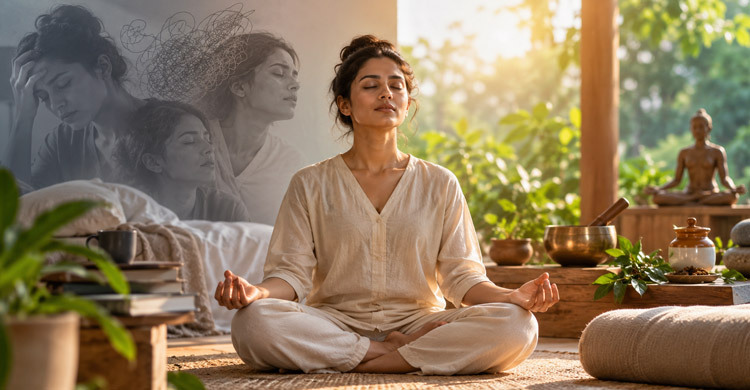
There are times when the body is tired, but rest does not feel enough.
The mind continues to move.
Thoughts repeat. Emotions linger. The nervous system remains alert even when there is no immediate danger. We may sleep, exercise, eat well and try to “think positively,” yet still feel unsettled somewhere within.
Perhaps healing, then, is not always about doing more.
Sometimes it begins by finding something to anchor ourselves to.
The breath.
The body.
A mantra.
A daily ritual.
Silence.
Contemplation.
A practice that gently brings us back to ourselves.
This is where the deeper therapeutic understanding of Yoga becomes particularly relevant.
Yoga Was Never Only About the Body
In the traditional understanding of Yoga Chikitsa, yogic practices are applied deliberately to restore balance across the body, mind and pranic dimension. Asana, breath, mantra and lifestyle are not treated as disconnected practices; they become different ways of meeting the whole human being.
This becomes especially meaningful when we speak about mental wellbeing.
Because the mind does not exist separately from the body.
Fear can change the breath.
Stress can tighten the jaw and shoulders.
Grief may leave the body feeling heavy.
Anxiety can make stillness uncomfortable.
Exhaustion can affect our ability to think clearly.
And sometimes the body continues carrying an experience long after the mind believes it has moved on.
Yoga gives us another way of approaching these experiences—not by forcing the mind to become quiet, but by creating conditions in which quietness may gradually become possible.
Before Asking the Mind to Be Calm, Give It Somewhere to Rest
We often give ourselves instructions:
Stop overthinking.
Calm down.
Sleep better.
Be positive.
Focus.
But an overwhelmed mind may not respond simply because we have instructed it to.
It needs an anchor.
The breath can become that anchor.
Feeling the feet against the ground can become an anchor.
The rhythm of a familiar mantra can become an anchor.
A slow movement practised with awareness can become an anchor.
Returning to the same quiet corner every morning can become an anchor.
An anchor does not necessarily remove what is happening around us.
It gives us a place from which to meet it.
And gradually, instead of being carried away by every thought, sensation or emotion, we begin developing the capacity to observe.
That small space between experiencing and reacting is deeply valuable.
The Body Is Often the First Doorway Back
When the mind feels scattered, beginning directly with meditation can sometimes feel difficult.
The body offers a more tangible entry point.
A slower asana practice asks us to notice:
Where am I holding unnecessary effort?
Can I soften my shoulders?
Can I feel my feet?
Can I move without rushing?
Can I stay present for one complete breath?
In Yoga Chikitsa, asana is not selected only for flexibility or fitness. Practices are considered in relation to their effects on the individual and the nervous system.
This changes our relationship with movement.
The question is no longer:
How far can I go?
It becomes:
What does my system need today?
Some days we may need movement.
Some days stillness.
Some days strength.
Some days softness.
Learning to recognise the difference is itself a form of self-awareness.
Breath: The Anchor We Carry Everywhere
Perhaps one of Yoga's most accessible gifts is that the breath is always with us.
Pranayama turns breathing from an unconscious process into a field of awareness.
Instead of immediately changing the breath, we can first observe it.
Is it hurried?
Shallow?
Interrupted?
Held?
Easy?
Where do we feel it?
What happens when we lengthen the exhalation gently?
What happens when we stop trying to control every moment and simply listen?
Traditional Yoga Chikitsa uses different pranayama practices according to the individual and the intended effect; practices such as Nadi Shodhana and Bhramari have traditionally been used for balancing and calming qualities.
Breath therefore becomes more than a technique.
It becomes a conversation between the body and the mind.
Contemplation Is Different From Overthinking
We live in a time of enormous mental stimulation.
We consume information almost continuously.
Messages. News. Work. Opinions. Videos. Notifications. Advice.
The mind rarely gets an opportunity to digest what it has already received.
Yet contemplation requires something different from information.
It requires space.
Contemplation is not endlessly analysing a problem.
It is staying quietly with a question without demanding an immediate answer.
What am I actually feeling?
What is creating agitation within me?
What am I holding that can be released?
What genuinely restores me?
What deserves my attention—and what does not?
What remains when the noise settles?
These are not questions that need to be answered in five minutes.
Sometimes carrying the right question is more transformative than rushing toward an answer.
This is where practices such as Svadhyaya—self-study—become deeply relevant to modern mental wellbeing.
Yoga does not only teach us how to stretch the body.
It teaches us how to observe ourselves.
Mantra: Giving the Mind One Place to Return
The mind naturally seeks something to hold.
If we do not consciously give it an anchor, it may attach itself to worry, memory, comparison or anticipation.
Mantra offers another possibility.
The repetition of sound gives the wandering mind a point of return.
We wander.
We return.
We become distracted.
We return.
Again and again.
Traditional Yoga Chikitsa includes mantra and chanting as part of its wider therapeutic toolkit rather than viewing them simply as additions to physical yoga.
Perhaps this repeated returning is itself part of the practice.
Mental wellbeing does not necessarily mean never becoming disturbed.
It may mean learning how to return when we are disturbed.
Rest Is Also a Practice
Modern life often makes rest feel like something we earn after completing everything else.
Yoga offers another perspective.
Rest can be intentional.
Restorative practices and Yoga Nidra create conditions in which we stop constantly asking the body to perform. Within the Yoga Chikitsa framework, rest is treated as an active part of supporting the nervous system rather than simply an absence of activity.
For a mind accustomed to stimulation, deep rest may initially feel unfamiliar.
But healing cannot happen only through effort.
There also has to be space for assimilation.
Space to breathe.
Space to feel.
Space to be quiet without producing anything.
Healing the Mind, Body and Inner Self
We often divide ourselves into separate compartments.
Physical health.
Mental health.
Emotional health.
Spiritual life.
But our lived experience rarely follows these boundaries.
A difficult emotion changes our physiology.
Physical exhaustion influences our thoughts.
The quality of our sleep changes our emotional resilience.
The way we breathe changes how we experience a stressful moment.
Our sense of meaning influences how we move through suffering.
Yoga Chikitsa asks us to see the person as an interconnected whole rather than reducing practice to a posture or a symptom.
This may be one of its most important lessons for our time.
Healing is not always about eliminating discomfort.
Sometimes healing means developing the capacity to stay present with ourselves while discomfort is passing through.
To recognise what needs care.
To understand when we need movement and when we need rest.
To know when self-practice is enough—and when professional medical or mental-health support is needed.
To become more intimate with our own inner landscape.
What Can You Anchor Yourself To?
Your anchor does not have to be complicated.
It might be five conscious breaths before reaching for your phone in the morning.
A mantra repeated quietly.
Ten minutes of gentle movement.
Sitting in silence.
Writing one page in a journal.
Walking without headphones.
Watching the breath instead of immediately reacting to a difficult emotion.
Returning to one meaningful teaching every day.
The practice itself may be simple.
What matters is the returning.
Because slowly, the anchor becomes familiar.
And familiarity creates steadiness.
Steadiness creates space.
Space makes contemplation possible.
And within that space, we may begin hearing something that the noise of everyday life makes difficult to hear:
ourselves.
Yoga as a Way of Returning
Yoga Chikitsa is not a new wellness trend. Its traditional understanding sees Yoga as a way of supporting balance through movement, breath, mantra, lifestyle and awareness rather than treating these as isolated tools.
Perhaps its relevance today extends beyond illness.
It speaks to the exhausted mind.
The overstimulated nervous system.
The person searching for meaning.
The individual who appears functional externally yet feels disconnected internally.
And it reminds us that wellbeing is not created only by adding more practices to our lives.
Sometimes it comes through remembering what allows us to return.
Return to the breath.
Return to the body.
Return to silence.
Return to awareness.
Return to what matters.
The world may continue to move quickly. Our practice can become the place where we learn not to lose ourselves within it.