

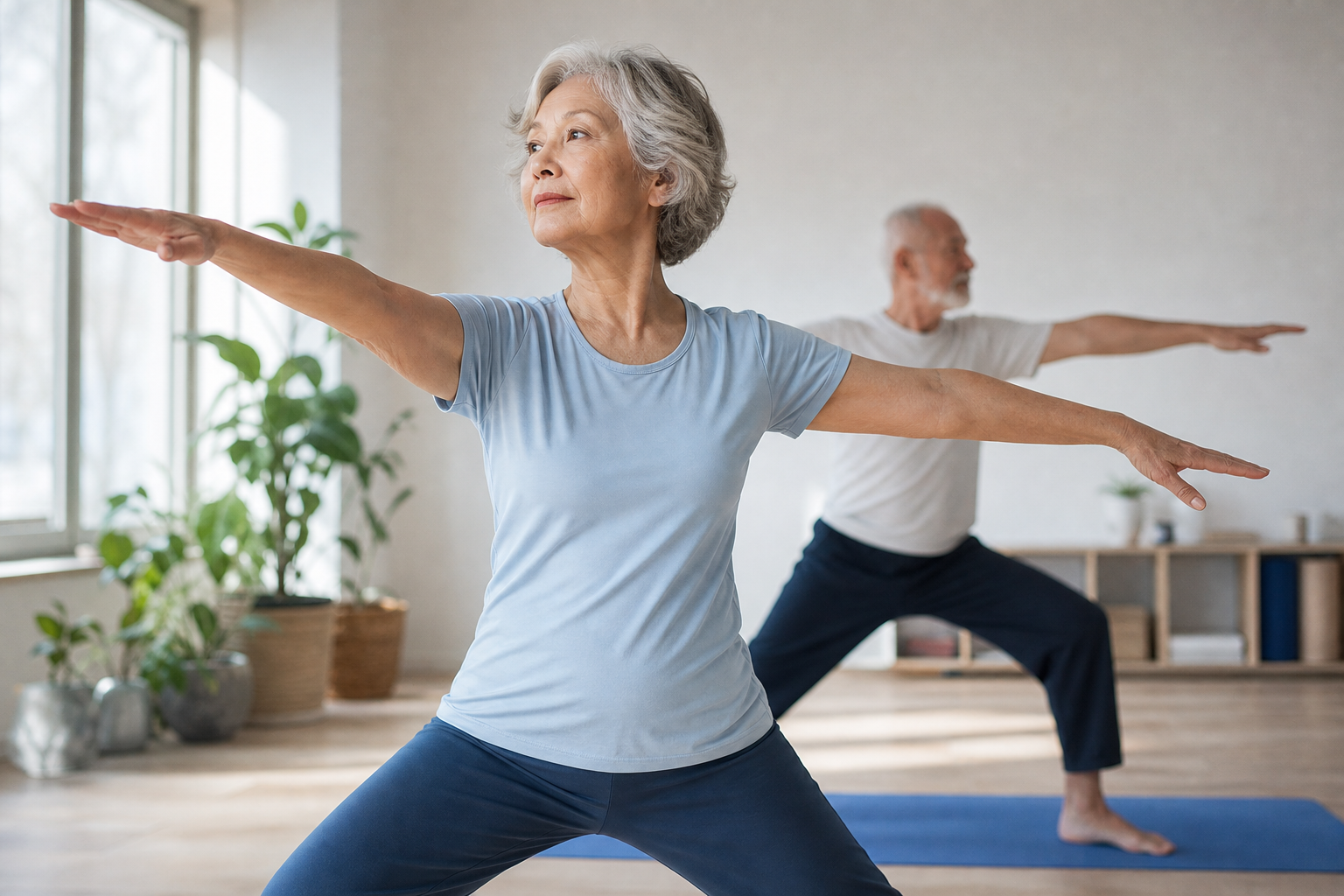
Yoga for older adults is one of the most evidence-backed movement practices available, with research showing real gains in balance, flexibility, lower-body strength, and mental health. Starting safely means getting medical clearance first, then choosing a gentle or chair-based style, keeping support nearby, and practicing two to three days a week, building gradually from there. This guide walks you through each of those decisions in the order you need to make them, so every step builds on a solid foundation.
What Does Yoga Actually Do for Older Adults?
The case for yoga in later life is stronger than many people expect. A 2019 meta-analysis of 22 randomized controlled trials found that yoga significantly improved balance (effect size 0.7), lower-body flexibility (effect size 0.5), and lower limb strength (effect size 0.45) in older adults compared with inactive controls. Those three qualities are exactly what the body needs to stay upright and independent.
Falls are a serious concern. According to blog.slowdive.app's 2026 report, the CDC notes that more than 1 in 4 older adults in the US falls each year, and falling once doubles the chance of falling again. Yoga's emphasis on balance training and body awareness directly addresses that risk, though it should always be practiced with appropriate safety measures in place.
The mental health benefits are equally well documented. The same 2019 meta-analysis found yoga significantly improved depression (effect size 0.64), sleep quality (effect size 0.65), and perceived mental health (effect size 0.6) in older adults. These are not small effects.
Interest in yoga among older adults has grown steadily. A 2016 study in Evidence-Based Complementary and Alternative Medicine found that yoga participation among community-dwelling older adults rose from 1.3% in 2002 to 3.3% in 2012. That growth reflects a broader recognition that yoga is accessible at any age, provided you approach it thoughtfully.
The physical and mental benefits are real, but they come with a responsibility to practice carefully. Older joints, connective tissue, and bone density respond differently than they did at 40. The steps that follow are designed with that reality in mind. The sections below focus on what matters most when you are just getting started.
Step 1: Talk to Your Doctor Before You Begin
Before you roll out a mat or search for a class, speak with your physician. This step is not optional, and it is not just a formality. Research published in 2021 in OBM Geriatrics found that yoga participants aged 65 and older have a greater rate of injury compared with other age groups. A brief conversation with your doctor can identify risks before they become problems.
Here is what to cover with your doctor:
- Tell your doctor you plan to start yoga and describe the style you are considering, whether that is chair yoga, gentle hatha, or a floor-based class.
- Ask specifically about osteoporosis, recent joint replacements, uncontrolled blood pressure, a history of falls, and any condition affecting your spine or joints. These are the conditions most likely to require modifications or restrictions.
- Ask whether any movements should be avoided entirely, such as deep forward folds if you have vertebral compression fractures, or inversions if you have glaucoma or high blood pressure.
- Request written notes if your doctor recommends specific limitations, so you can share them with a yoga instructor before your first class.
- If you are managing a chronic condition, ask whether a physical therapist or a yoga instructor with clinical training would be a more appropriate starting point than a general community class.
Most physicians will encourage yoga for older adults, particularly gentler styles. The goal of this conversation is not to find reasons to avoid yoga but to start with accurate information about your body.
Step 2: What Is the Best Type of Yoga for Older Adults?
Not all yoga is the same, and the style you choose matters as much as how often you practice. According to GoodRx's 2023 data, 35% of adults over 70 experience mobility issues that can make traditional yoga practice inaccessible. The four styles below are the most practical starting points for older adults, particularly those who are new to the practice.
Chair yoga is the most accessible option for yoga for elderly beginners and for anyone managing joint pain, limited range of motion, or balance concerns. Poses are performed seated or using a chair for standing support, which removes the floor-transfer challenge entirely. It is also the safest entry point for yoga for seniors over 80 or anyone returning to movement after illness or surgery.
Gentle hatha yoga uses slow, held poses with an emphasis on breath and alignment rather than flow or intensity. Classes typically include standing, seated, and supine poses with props such as blocks and straps. This style suits yoga for seniors over 60 and over 70 who have reasonable mobility and want a fuller range of movement than chair yoga offers.
Restorative yoga uses bolsters, blankets, and blocks to support the body completely in passive poses held for several minutes at a time. There is almost no muscular effort involved. It is particularly useful for older adults dealing with fatigue, chronic pain, or high stress, and it pairs well with other more active styles.
Iyengar-inspired practice places a strong emphasis on precise alignment and uses props extensively to bring poses to the student rather than expecting the student to contort toward the pose. This approach works well for yoga for seniors over 70 who want to build strength and flexibility carefully, with clear instruction and close attention to form.
When choosing between these styles, start with chair yoga or gentle hatha if you are unsure. You can always progress to a more demanding style once you know how your body responds.
Step 3: Set Up a Safe Practice Space at Home
A safe environment reduces injury risk before you attempt a single pose. You do not need a dedicated room or expensive equipment, but a few deliberate choices make a real difference.
Follow these steps when preparing your space:
- Clear a floor area of at least six feet by four feet, free of loose rugs, cords, or furniture edges that could catch a foot or a hand.
- Place a non-slip yoga mat on a hard, even surface. Carpet can feel softer but it shifts underfoot during balance work, which increases fall risk.
- Position a sturdy, armless chair within arm's reach of where you will stand. A dining chair with four legs and no wheels is ideal. This is your primary support for standing and balance poses.
- Identify a clear section of wall nearby as a secondary support. A wall works well for poses where a chair feels too close or too far.
- Warm up for at least 10 to 15 minutes before moving into any pose that demands range of motion or balance. Older joints and connective tissue need more time than younger tissue to become pliable. Gentle ankle circles, seated neck rolls, and slow shoulder rolls are enough to start.
- Keep your phone within reach in case you need help, particularly if you are practicing alone.
Lighting matters more than most guides mention. Practice in a well-lit room so you can see the floor clearly and judge distances accurately. Natural light is ideal, but a bright overhead light works fine.
Props are not a sign of weakness. Blocks, a strap, and a folded blanket under the knees or hips can make the difference between a pose that helps and one that strains. Most of these items cost very little, and many community centers lend them during class.
Step 4: Beginner Yoga Poses for Seniors, With Modifications
A 2016 study involving 20 older adults with an average age of 70.7 used biweekly 60-minute hatha yoga sessions over 32 weeks and recorded measurable gains in physical function. The poses below reflect the kinds of accessible, supported movements used in that type of program. None of them require floor work to begin, and each one has a modification for those who need extra support.
The 2019 meta-analysis that found significant improvements in balance (effect size 0.7) and lower-body strength used yoga interventions across multiple studies. These poses target those same outcomes.
Mountain Pose (Tadasana)
Stand with feet hip-width apart, arms at your sides, and weight evenly distributed. Press through all four corners of each foot. Hold for five to eight breaths. Modification: stand with your back lightly touching a wall for feedback and support.
Chair-Supported Standing Forward Fold
Stand behind a chair, hands resting on the back. Hinge forward at the hips, keeping the spine long, until you feel a gentle stretch in the hamstrings. Hold for four to six breaths. Modification: keep a slight bend in the knees throughout. If forward folding causes discomfort in the lower back, stay upright and focus on the hip hinge alone.
Seated Cat-Cow
Sit toward the front of a chair with feet flat on the floor. On an inhale, lift the chest and gently arch the back. On an exhale, round the spine and draw the chin toward the chest. Repeat six to eight times. This pose gently mobilizes the entire spine without any floor transfer.
Tree Pose (Vrksasana)
Stand beside a chair with one hand resting on the back. Shift weight onto one foot and place the sole of the other foot against the ankle or calf, never against the knee joint. Hold for four to six breaths, then switch sides. Modification: keep the raised foot's toes lightly touching the floor for extra stability.
Legs Up the Wall (Viparita Karani)
Sit sideways against a wall, then gently swing your legs up so they rest against the wall while your back lies flat on the floor. Stay for two to five minutes. This restorative pose supports circulation and reduces leg fatigue. Modification: place a folded blanket under the hips for comfort, or keep a slight bend in the knees.
Knowing the difference between a stretch and pain is the most important skill in any yoga practice. A healthy stretch is diffuse, mild, and fades within a breath or two of easing back. Sharp, joint-based, or sudden pain is a signal to stop the pose immediately and rest. Never push through joint pain, and never hold a pose that causes any sensation in the spine beyond mild warmth.
Step 5: How Often Should a 70-Year-Old Do Yoga?
Two to three sessions per week is the evidence-backed target. The American College of Sports Medicine recommends neuromuscular exercises such as yoga for older adults at least 2 to 3 days per week, a frequency supported by research published in a 2025 Scientific Reports study. That frequency is enough to build balance and strength without overtaxing recovery.
A sample weekly schedule for a beginner might look like this:
- Monday: 20-minute gentle hatha or chair yoga session
- Wednesday: 20-minute session, same style or a short restorative practice
- Friday: 25-minute session, adding one or two new poses from the beginner sequence above
Start with 15 to 20 minutes per session and add five minutes every two weeks as your body adapts. Consistency over 8 to 12 weeks is when most practitioners notice measurable gains in balance and flexibility, not intensity in a single week.
Rest days between sessions are not wasted days. Connective tissue adapts during recovery, not during the session itself. If you feel sore or fatigued, take an extra rest day rather than pushing through. One short restorative session focused on supported poses and breathing is fine on a rest day if you feel well enough.
For yoga for seniors over 70 and over 80, two sessions per week is a completely adequate long-term target. Three sessions per week is worth aiming for once the habit feels comfortable, but two is enough to see real benefit.
How to Find a Yoga Class or Instructor for Older Adults
Finding the right class matters as much as choosing the right style. Look for classes labeled "gentle," "chair," "senior," or "therapeutic" rather than general beginner classes, which can still move faster than is comfortable for older adults returning to movement.
For in-person options, community centers, senior centers, libraries, and hospital wellness programs often host low-cost or free yoga classes specifically for older adults. Ask whether the instructor has training in working with seniors or any clinical background in movement therapy.
Online classes expand your options considerably. SilverSneakers offers live online, local community, and on-demand yoga classes designed for older adults, with instructors trained specifically for senior populations. Membership may be included with qualifying Medicare Advantage plans, though eligibility depends on your specific health plan, so check with your insurer directly.
When evaluating any instructor, ask two questions before your first class: what experience they have teaching older adults, and how they handle modifications for participants with joint or balance concerns. A good instructor will welcome both questions. If you are a yoga teacher looking to build clinical knowledge in this area, hellomyyoga offers a specialized Geriatric Yoga Care teacher training certification, designed by doctors, vaidyas, and yoga chikitsa acharyas, for practitioners seeking deeper expertise with older adult populations.
FAQs
Is there a free yoga routine for seniors over 70?
Many free options exist. YouTube channels run by physical therapists and certified senior yoga instructors offer guided routines ranging from 10 to 30 minutes. Search specifically for "chair yoga for seniors" or "gentle yoga over 70" to filter out faster-paced content. The poses in Step 4 of this guide also form a usable starting routine you can follow without any equipment beyond a sturdy chair.
Does Medicare cover yoga for seniors?
Medicare coverage for yoga is not straightforward. Original Medicare does not typically cover yoga as a standalone service. Some Medicare Advantage plans include fitness benefits that may cover programs like SilverSneakers, which offers yoga classes for older adults. Check your specific plan documents or call your insurer to find out what fitness or wellness benefits your plan includes, since eligibility varies widely.
Can someone over 80 safely start yoga for the first time?
Yes, with appropriate precautions. Chair yoga is specifically designed for people who cannot easily get up and down from the floor, making it a practical entry point at any age. The most important steps are getting medical clearance first, choosing a qualified instructor familiar with older adult needs, and starting with short sessions of 15 minutes or less. Research confirms that older adults can gain meaningful improvements in balance and flexibility even when starting late in life, provided they practice consistently and safely.
Is chair yoga as effective as mat yoga for older adults?
Chair yoga produces real physical benefits, including improved flexibility, balance, and joint mobility, particularly for people who cannot safely practice on the floor. It may not build the same degree of lower-body strength as standing mat poses, but for yoga for elderly beginners or anyone managing significant mobility limitations, it is a better choice than attempting poses the body is not ready for. Many older adults combine both, using a chair for standing balance work and a mat for seated and supine poses.
What should older adults avoid in a yoga class?
Avoid deep inversions such as headstands or shoulder stands, which place pressure on the neck and can raise blood pressure. Avoid deep unsupported forward folds if you have osteoporosis or vertebral compression fractures. Skip any pose that requires rapid transitions, as these increase fall risk. In any class, avoid pushing into sharp or joint-based pain. If a teacher does not offer modifications or encourages you to push through discomfort, that class is not the right fit.
Conclusion
Yoga supports balance, lower-body strength, flexibility, and mental health in older adults, and the evidence behind those benefits comes from randomized controlled trials, not anecdote. Starting safely means following a clear sequence: medical clearance first, then a style that matches your current mobility, then a consistent practice of two to three sessions per week.
The most useful next step is also the simplest. Talk to your doctor this week, then try a single 15-minute chair yoga or gentle hatha session before the end of the month. Stick with two to three sessions per week, and within 8 to 12 weeks you should notice real changes in how steadily you stand and how freely you move.