

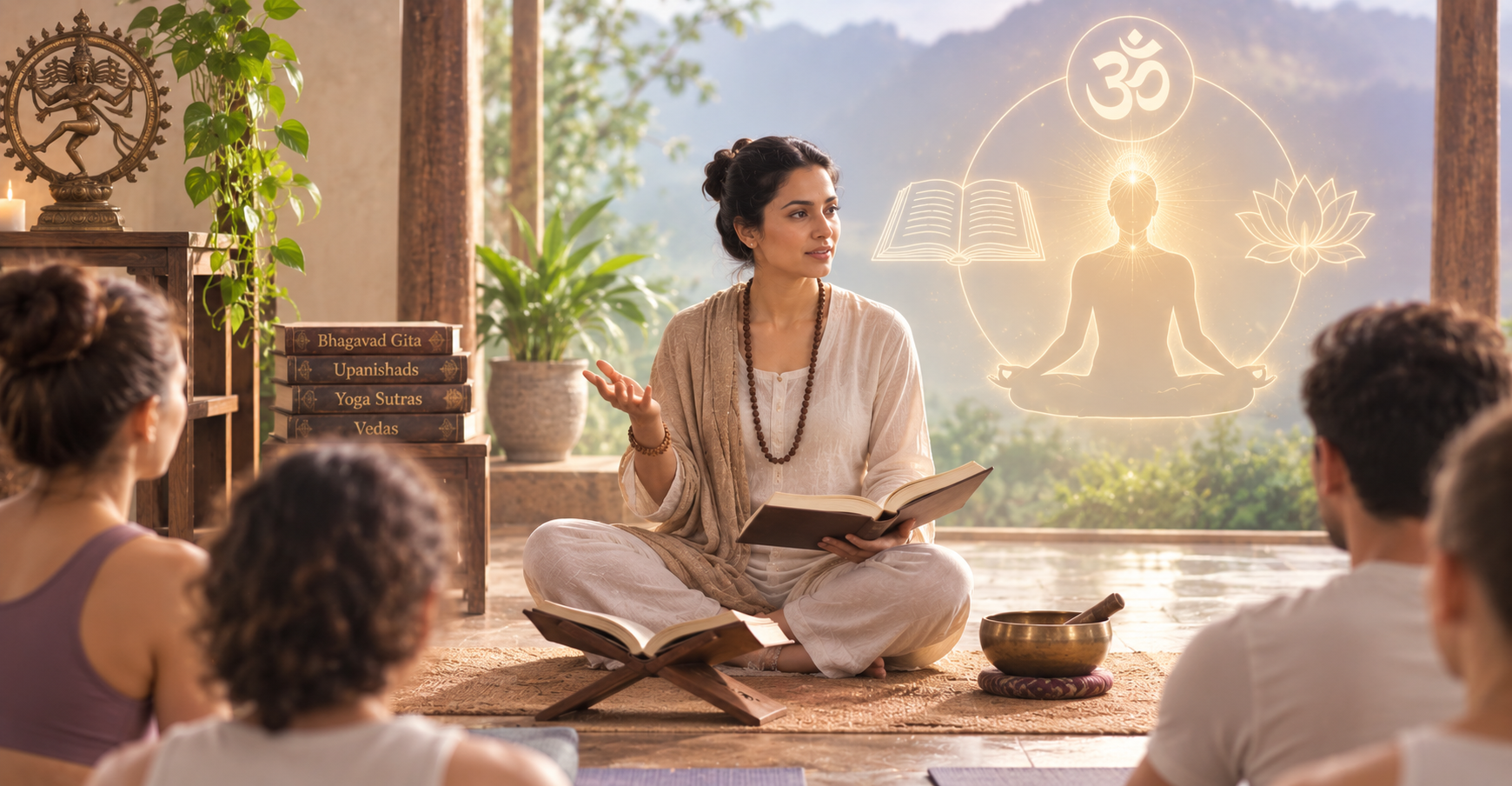
- What Jnana Yoga Actually Is
- The Three Core Practices
- Why This Path Is Demanding
- What Jnana Yoga Offers Yoga Teachers Specifically
- Jnana Yoga and the Bhagavad Gita
- Jnana Yoga in the Context of a Broader Practice
- How to Begin Engaging with Jnana Yoga
- A Note on Depth in Yoga Education
- FAQs
Most yoga teachers reach a point where the poses stop being the question. A student arrives carrying grief, or confusion, or a restlessness that no sequence can touch. You feel the limits of what your hands and cues can offer. That moment, quiet and a little unsettling, is often the first real invitation into Jnana Yoga.
Jnana (pronounced gyaan) means knowledge, but not the kind you collect from books. It is the direct, experiential knowing of your own nature, what the Vedic tradition calls Atma-jnana, or self-knowledge. Jnana Yoga uses the mind as its primary instrument, turning inquiry, discernment, and contemplation into a form of practice as rigorous as any asana.
For yoga teachers, understanding this path is not an academic exercise. It changes how you hold space, how you speak to students, and how you understand the purpose of everything you teach.
What Jnana Yoga Actually Is
The four classical paths of yoga are Karma Yoga (the path of action), Bhakti Yoga (the path of devotion), Raja Yoga (the path of meditation and discipline), and Jnana Yoga (the path of knowledge). These are not competing systems. They are different entry points into the same destination.
Jnana Yoga works through the intellect, specifically through a practice called viveka, or discernment. The practitioner learns to distinguish between what is real and what is temporary, between the unchanging Self (Atman) and the constantly shifting contents of the mind, body, and world.
The classical text most associated with this path is the Bhagavad Gita, particularly the chapters where Lord Krishna instructs Arjuna on the nature of the Self, the body, and action. The Upanishads, especially the Mandukya and Kena, are equally foundational. These are not dry philosophical texts. They are precise maps of inner experience.
The Three Core Practices
Traditional Jnana Yoga is structured around three practices that build on each other.
Shravana: Listening
The first stage is deep, receptive listening to the teachings from a qualified teacher or guru. This is not passive hearing. Shravana requires you to set aside your existing conclusions and receive the teaching with full attention. For yoga teachers, it is a reminder that learning never ends, and that the quality of your listening directly shapes the quality of what you transmit.
Manana: Reflection
The second stage is sustained contemplation. You take what you have heard and turn it over, testing it against your experience, examining it from different angles, letting it settle. Manana is where intellectual understanding begins to deepen into genuine inquiry.
Nididhyasana: Meditation and Absorption
The third stage is continuous, uninterrupted meditation on the truth of what has been heard and reflected upon. This is where knowledge stops being a concept and becomes lived experience. The Vedantic term for this arrival is Samadhi, the state where the knower, the known, and the act of knowing merge.
Why This Path Is Demanding
Jnana Yoga is sometimes described as both the most direct path and the most demanding. The reason is straightforward: it requires you to question everything you think you are.
The central practice is neti, neti, a Sanskrit phrase meaning "not this, not this." You systematically inquire into each layer of your identity, your body, your emotions, your thoughts, your roles, and recognise that none of these is the unchanging Self. What remains after all the "not this" is the awareness that witnesses all of it. That awareness is what Jnana Yoga points toward.
For most practitioners, this is not comfortable. The mind resists losing its sense of a fixed, separate self. This is why traditional teachers insisted that Jnana Yoga requires a prepared foundation, specifically the qualities cultivated through Karma, Bhakti, and Raja Yoga first.
What Jnana Yoga Offers Yoga Teachers Specifically
Teaching yoga is an act of transmission. What you understand at depth, your students receive at depth. What you hold only at the surface, they receive at the surface.
When you have genuinely engaged with Jnana Yoga, several things shift in how you teach.
Your language becomes more precise. You stop using words like "energy" and "consciousness" as decorative additions and start using them with intention, because you have actually inquired into what they mean.
You hold uncertainty more gracefully. A student's existential question no longer sends you scrambling for a neat answer. You can sit with the question alongside them, which is often more valuable than any answer you could offer.
You understand the purpose of the body in practice. Jnana Yoga teaches that the body is not the obstacle to spiritual experience; it is the instrument through which awareness comes to know itself. That reframes every physical adjustment you make.
You become a better student. Teachers who walk the Jnana path tend to remain genuinely curious. They read, they question, they seek out lineages and teachers who challenge them. That curiosity is what keeps a teaching practice alive over decades.
If you are drawn to the deeper philosophical side of yoga, the 5 must-read books for yoga lovers curated on the hellomyyoga blog is a useful place to start building your Jnana library.
Jnana Yoga and the Bhagavad Gita
No discussion of Jnana Yoga is complete without the Bhagavad Gita. Lord Krishna's instruction to Arjuna is, among other things, a sustained teaching on the nature of the Self and the difference between the body that perishes and the consciousness that does not.
Chapter Two is a direct exposition of Jnana. Krishna tells Arjuna that the wise grieve neither for the living nor the dead, because the Self is eternal, unborn, and unchanging. This is not consolation. It is a precise philosophical claim that the Jnana tradition asks you to verify through your own inquiry.
For yoga teachers who want to understand why ancient texts remain so central to serious practice, the Journey Home on the hellomyyoga blog reflects on exactly that kind of return to foundational wisdom.
Jnana Yoga in the Context of a Broader Practice
It would be a mistake to treat Jnana Yoga as purely intellectual. The tradition is clear that knowledge without devotion becomes arrogance, and devotion without knowledge becomes sentiment. The paths are meant to inform each other.
Many teachers find that chanting serves as a bridge between Bhakti and Jnana. The act of chanting Sanskrit mantras engages the intellect through meaning, the heart through sound, and the body through breath, all at once. The chanting explained: benefits and the science behind it piece on the hellomyyoga blog explores this in depth.
Some of the most powerful examples of Jnana in practice come from teachers who have spent decades integrating philosophical study with direct service. The story of Masterji's unique yoga project is a reminder that deep knowledge, when it is genuine, always finds its way into action.
How to Begin Engaging with Jnana Yoga
You do not need to abandon your asana practice or your teaching schedule. Jnana Yoga integrates into whatever you are already doing. Here are practical starting points:
-
Read primary texts, not just commentaries. The Bhagavad Gita, the Upanishads, and Adi Shankaracharya's works are available in good translations. Read slowly. One verse contemplated deeply is worth more than a chapter skimmed.
-
Ask the question before the class. Before you teach, sit for five minutes and ask: who is teaching? Not your name or your credentials. Who is the awareness behind the role? This is Jnana practice in miniature.
-
Notice the witness. During your own practice, periodically shift attention from the object of awareness, the breath, the sensation, the thought, to the awareness itself. This is the central inquiry of Jnana Yoga.
-
Find a teacher who has walked the path. Shravana, the first stage, requires a qualified voice. Seek out lineages, texts, and teachers with genuine depth, not just charisma.
-
Journal your inquiry. Manana benefits from writing. When you write about what you are discovering, you slow the mind down enough to actually examine it.
A Note on Depth in Yoga Education
Jnana Yoga is a reminder that yoga education at its best is not a collection of techniques. It is a systematic inquiry into the nature of the human being. That inquiry is what separates a teacher who instructs from a teacher who guides.
At hellomyyoga, every program is built around this kind of depth. The curriculum is designed by doctors, vaidyas, and yoga chikitsa acharyas who understand that real yoga education includes the philosophical and clinical layers that mainstream training routinely skips. If you are a teacher who feels that gap, explore what is available at hellomyyoga.com.
FAQs
What is Jnana Yoga in simple terms?
Jnana Yoga is the path of self-knowledge within the broader tradition of yoga. It uses inquiry, discernment, and contemplation to help a practitioner recognise the unchanging awareness that underlies all experience. The word jnana means knowledge in Sanskrit, specifically the direct knowing of one's own nature.
Is Jnana Yoga suitable for beginners?
Traditional teachers considered Jnana Yoga the most demanding of the four paths and recommended that practitioners first build a foundation through Karma Yoga, Bhakti Yoga, or Raja Yoga. That said, the spirit of inquiry it cultivates can begin at any stage. Even a beginner can start asking deeper questions about why they practice.
What is the difference between Jnana Yoga and Raja Yoga?
Raja Yoga works primarily through the discipline of the mind using practices such as meditation, pranayama, and ethical observances, the eight limbs of Patanjali. Jnana Yoga works through the intellect and inquiry, specifically the practice of discerning what is real from what is temporary. The two paths complement each other and are often practiced together.
What texts are central to Jnana Yoga?
The Bhagavad Gita, the principal Upanishads (especially the Mandukya, Kena, and Aitareya), and the works of Adi Shankaracharya, particularly the Vivekachudamani (Crest Jewel of Discrimination), are the foundational texts. These are studied through the three stages of shravana, manana, and nididhyasana.
How does Jnana Yoga apply to teaching yoga professionally?
Engaging with Jnana Yoga deepens a teacher's philosophical understanding, sharpens their use of language, and builds the capacity to hold space for students' existential questions. It also keeps a teaching practice intellectually alive over the long term, preventing the mechanical repetition that can set in after years of teaching the same sequences.
What is the practice of neti, neti?
Neti, neti means "not this, not this." It is a central inquiry method in Jnana Yoga where the practitioner systematically examines each layer of identity, body, emotions, thoughts, roles, and recognises that none of these is the permanent Self. What remains after this process of elimination is the pure awareness that the tradition identifies as the true Self.
Can Jnana Yoga be practiced alongside asana and pranayama?
Yes, and the tradition encourages it. Jnana Yoga is not a replacement for physical and energetic practices; it is a complementary layer that gives those practices deeper meaning. Many practitioners find that a strong asana and pranayama foundation makes the philosophical inquiry of Jnana Yoga more grounded and experiential rather than purely conceptual.
The path of knowledge is not a detour from yoga. It is yoga at its most complete. When you begin to ask who is practicing, who is teaching, and what awareness underlies every breath, you are already walking it.