

- What Is Bhramari Pranayama?
- The Nervous System: Why Humming Works
- Effects on the Mind and Hormones
- How to Practise Bhramari Pranayama
- Bhramari and Sound: The Deeper Connection
- Contraindications and Cautions
- For Yoga Teachers: Moving Beyond the Basics
- Frequently Asked Questions
There is something almost immediate about bhramari pranayama. Within a few rounds, the mental noise that follows you through the day begins to quiet. The jaw softens. The breath slows. That response is not accidental, and it is not purely psychological — there is a clear physiological explanation for why this practice works so quickly on the nervous system.
This article covers what bhramari pranayama is, how it works at a physiological level, how to practise it correctly, and who should approach it with care.
What Is Bhramari Pranayama?
Bhramari takes its name from the Sanskrit word bhramari, meaning the Indian black bee. The practice involves producing a soft, continuous humming sound on the exhale — a low drone that resembles the sound of a bee in flight. It is one of the pranayamas described in the Hatha Yoga Pradipika and remains among the most accessible breath practices in the classical tradition.
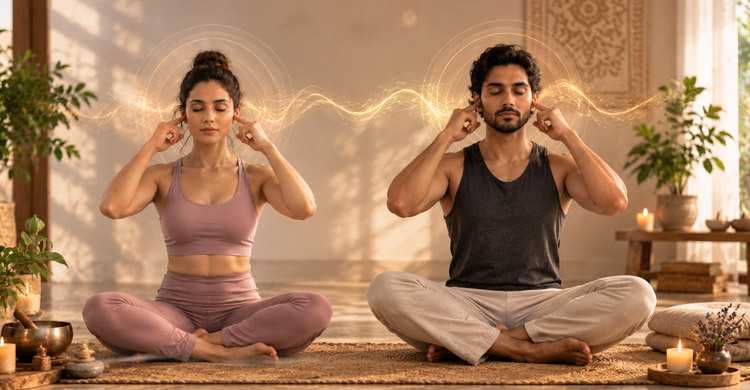
The mechanics are straightforward: inhale through both nostrils, then exhale slowly with the lips gently closed, producing a nasal hum. Many practitioners also use shanmukhi mudra — closing the ears, eyes, and mouth with the fingers — to deepen inward focus. The vibration travels through the skull, sinuses, and chest in a way that is immediately perceptible.
The Nervous System: Why Humming Works
To understand why bhramari produces calm so efficiently, it helps to understand the vagus nerve. The longest cranial nerve in the body, it runs from the brainstem down through the throat, heart, lungs, and abdomen. It is the primary channel of the parasympathetic nervous system — the branch responsible for the rest-and-digest state that counteracts chronic stress.
Humming stimulates the vagus nerve directly through vibration in the throat and larynx. This sends a signal to the brainstem that the body is safe, which slows the heart rate, reduces cortisol output, and shifts the nervous system away from sympathetic activation.
A second mechanism is the extended exhale. In bhramari, the hum naturally lengthens the exhalation beyond the inhalation. A longer exhale increases vagal tone and lowers heart rate more effectively than equal-ratio breathing. The body reads a slow, extended exhale as a signal of safety — and bhramari builds that signal directly into the structure of the practice.
A third factor is nitric oxide. Research has shown that humming increases nasal nitric oxide production significantly compared to quiet breathing. Nitric oxide is a vasodilator: it relaxes and widens blood vessels, improving circulation and reducing blood pressure. The sinuses are the body's primary site of nitric oxide production, and the vibration of humming activates that production in a way that silent breathing simply does not.
Effects on the Mind and Hormones
The calming effect of bhramari extends well beyond the breath session itself. Regular practice has been associated with reduced anxiety, improved sleep quality, and a general lowering of baseline stress reactivity — all of which connect to how the practice influences hormonal balance.
Chronic stress keeps cortisol elevated, which over time disrupts sleep, digestion, immune function, and mood. By consistently activating the parasympathetic nervous system, bhramari helps interrupt that cycle. The relationship between breath practices and hormonal regulation is well documented in the yogic clinical literature, and bhramari is frequently cited as one of the most direct tools available.
The practice also has a measurable effect on mental focus. The internal vibration draws attention inward, away from external stimuli — which is partly why bhramari is used as a preparation for meditation. It narrows the field of awareness in a way that is difficult to achieve through silent sitting alone, particularly for practitioners with a busy or anxious mind.
How to Practise Bhramari Pranayama
Basic Technique
- Sit in a comfortable upright position — cross-legged on the floor or in a chair with the spine tall.
- Close your eyes and take one or two natural breaths to settle.
- Inhale slowly and fully through both nostrils.
- On the exhale, close your lips gently and produce a steady hum from the throat. The sound should be smooth and continuous, not forced.
- Feel the vibration in the skull, the face, and the chest.
- When the exhale is complete, inhale again without rushing.
- Begin with five to seven rounds and gradually extend to ten to fifteen over weeks of regular practice.
With Shanmukhi Mudra
For a deeper inward experience, use the fingers to close the sensory gates. Place your thumbs lightly over the ear flaps (tragus), index fingers over your closed eyelids, middle fingers beside the nostrils without blocking them, ring fingers above the upper lip, and little fingers below the lower lip. This mudra amplifies the internal resonance of the hum and significantly reduces external distraction.
Timing and Frequency
Bhramari is most effective on an empty or light stomach — either early morning or in the evening before sleep. Daily practice of ten to fifteen minutes produces more consistent results than occasional longer sessions. It fits naturally after asana practice or before meditation.
Bhramari and Sound: The Deeper Connection
The humming in bhramari is not simply a mechanical tool. In the yogic framework, sound and vibration are understood to have direct effects on consciousness. The practice shares structural similarities with mantra and chanting, both of which use sustained vocalisation to influence the nervous system and the mind.
The science behind chanting and its physiological effects overlaps significantly with what happens during bhramari. In both cases, the extended exhale, laryngeal vibration, and internal focus work together to produce a state that is simultaneously alert and calm. Bhramari can be understood as a form of internal chanting — one that requires no specific mantra and is accessible regardless of devotional orientation.
Contraindications and Cautions
Bhramari is one of the gentler pranayamas, but there are situations where it should be modified or avoided.
- Ear infections or middle ear conditions: The vibration and pressure change can aggravate active infections. Wait until the infection has fully cleared.
- Severe anxiety or panic disorder: Some practitioners find that closing the sensory gates with shanmukhi mudra intensifies anxiety initially. Begin without the mudra and introduce it gradually as comfort with the inward focus builds.
- Pregnancy: Bhramari is generally considered safe during pregnancy, but the breath should remain comfortable and unforced. Avoid breath retention (kumbhaka) in any form.
- Epilepsy: Consult a qualified yoga therapist before practising any pranayama if you have a seizure disorder.
For yoga teachers working with clients who have chronic conditions, neurological concerns, or are in a prenatal or postnatal phase, understanding the clinical nuances of breath practices matters considerably. Generic training rarely covers these distinctions in adequate depth.
For Yoga Teachers: Moving Beyond the Basics
Knowing how to practise bhramari is one thing. Knowing how to teach it safely and adaptively to a client with hypertension, anxiety disorder, or a history of trauma is a different level of understanding entirely.
This is the gap that clinical specialisation addresses. At hellomyyoga.com, programs designed by doctors, vaidyas, and yoga chikitsa acharyas go into the physiological and therapeutic dimensions of practices like bhramari in ways that a standard 200-hour certification does not reach. The teacher training specialisations in Geriatric Yoga Care, Prenatal and Postnatal Yoga, and Cancer Survivor Rehabilitation Yoga are built precisely for instructors who have moved past foundational training and need genuine clinical grounding.
Frequently Asked Questions
What does bhramari pranayama mean?
Bhramari comes from the Sanskrit word for the Indian black bee. The name refers to the humming sound produced during the practice, which resembles the drone of a bee. It is one of the classical pranayamas described in the Hatha Yoga Pradipika.
How does bhramari pranayama calm the nervous system?
Bhramari activates the parasympathetic nervous system through three main mechanisms: vagus nerve stimulation via laryngeal vibration, an extended exhale that lowers heart rate, and increased nasal nitric oxide production from the humming vibration. Together, these shift the body away from the stress response.
How many rounds of bhramari should I practise daily?
Beginners can start with five to seven rounds and gradually build to ten to fifteen over several weeks. Daily practice of ten to fifteen minutes tends to produce more consistent effects than occasional longer sessions.
Can I practise bhramari if I have anxiety?
Yes — bhramari is often recommended specifically for anxiety because of its direct effect on the vagus nerve. If closing the sensory gates with shanmukhi mudra increases rather than reduces anxiety, practise without the mudra until you are more comfortable with the inward focus.
Is bhramari pranayama safe during pregnancy?
Bhramari is generally considered safe during pregnancy when practised gently and without breath retention. The humming breath and extended exhale can be calming for both the mother and the nervous system. Consult a qualified yoga therapist or your healthcare provider if you are unsure.
What is the difference between bhramari and other calming pranayamas like nadi shodhana?
Both practices activate the parasympathetic nervous system, but through different mechanisms. Nadi shodhana works primarily through breath ratio and nasal alternation. Bhramari works through vibration, extended exhale, and internal sound. Many practitioners find bhramari faster to produce a calming effect, particularly when the mind is very active.
Can bhramari help with sleep problems?
Regular bhramari practice may support better sleep by reducing cortisol levels and increasing parasympathetic tone. Ten to fifteen rounds before bed can help settle the nervous system after a stimulating day. It is not a substitute for addressing underlying sleep disorders, but it is a well-regarded preparatory practice.
The humming breath is deceptively simple. A few minutes of steady practice and the nervous system responds in ways that years of trying to think your way to calm rarely achieve. Start with five rounds tonight and notice what shifts.