

- What Is Yoga Nidra?
- Why Yoga Nidra Works for Sleep
- Setting Up the Practice
- The Eight-Stage Yoga Nidra Sequence
- Teaching Yoga Nidra to Different Populations
- Common Mistakes When Teaching Yoga Nidra for Sleep
- Integrating Yoga Nidra into Your Teaching Practice
- Frequently Asked Questions
Yoga nidra for sleep is one of the most practical applications of an ancient practice — and one that yoga teachers often overlook until a student asks for it directly. If you have ever guided a class through savasana and watched someone drift off completely, you have already seen the edge of what yoga nidra can do. This guide walks you through the full sequence, stage by stage, so you can teach it with confidence and adapt it for whoever is in the room.
What Is Yoga Nidra?
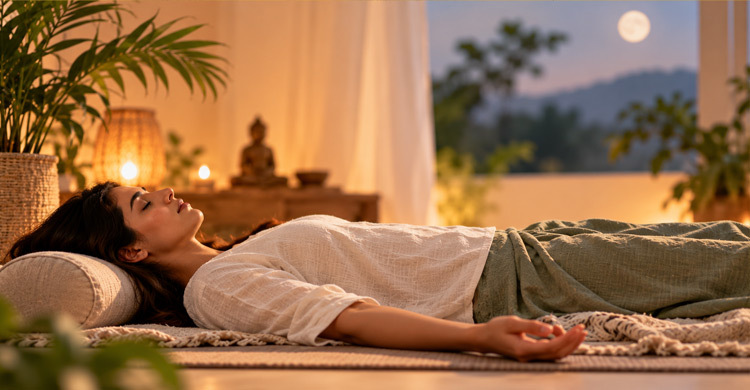
Yoga nidra, often translated as "yogic sleep," is a systematic form of guided relaxation that brings the practitioner to the threshold between waking and sleeping consciousness. Unlike savasana, which is a passive resting posture, yoga nidra is an active inner journey. The body rests completely while awareness remains gently alert.
The practice draws from the Tantric tradition and was systematised in the modern era by Swami Satyananda Saraswati. It moves through eight distinct stages, each designed to progressively withdraw attention from the external world and guide it inward. For sleep-related applications, this sequence is particularly effective because it shifts the nervous system from sympathetic (alert, reactive) to parasympathetic (calm, restorative) function.
As a yoga teacher, that distinction matters. You are not simply helping someone fall asleep. You are teaching them to consciously release the grip of waking awareness — a skill with lasting benefit well beyond the session itself.
Why Yoga Nidra Works for Sleep
Chronic poor sleep is rarely just a body problem. The mind replays the day, anticipates tomorrow, or simply refuses to settle. Yoga nidra addresses this directly by giving the mind a structured object of attention, drawing it away from habitual thinking patterns without forcing suppression.
The rotation of consciousness through body parts, the pairing of opposite sensations, and the use of a sankalpa (a short personal resolve or intention) all work together to occupy the thinking mind just enough that it stops generating its usual noise. By the time the practice reaches the visualisation stage, many practitioners find themselves in a hypnagogic state — the borderland where sleep arrives naturally.
For teachers working with students whose sleep difficulties are rooted in anxiety, chronic pain, or hormonal changes, yoga nidra offers a non-pharmacological tool that sits comfortably within a broader therapeutic framework. If you want a deeper grounding in the philosophy behind yoga as a therapeutic system, the conversation with Dr. Deepak Sachdeva on decoding yoga is a useful place to start.
Setting Up the Practice
Before you guide anyone through yoga nidra, environment and posture need to be right. This is not a small detail. A student who is physically uncomfortable or cold will not reach the deeper stages.
Posture: Savasana (lying flat on the back) is standard. Offer a blanket under the knees for students with lower back sensitivity, and a light blanket over the body. The room should be warm enough that the student does not need to move once settled.
Lighting: Dim or dark. Even soft light through closed eyelids can keep the nervous system slightly alert.
Sound: Silence or very soft, neutral ambient sound. Avoid music with melody or rhythm during the rotation of consciousness stages — it competes for attention.
Duration: A full yoga nidra session for sleep runs between 30 and 45 minutes. Shorter versions of 20 minutes are possible but tend to truncate the visualisation stage, which is where the deepest rest occurs.
Ask students to set their sankalpa before you begin. A sankalpa is a short, positive statement in the present tense — something like "I sleep deeply and wake restored." It is planted at the start and revisited near the end, when the mind is most receptive.
The Eight-Stage Yoga Nidra Sequence
Stage 1: Internalization (Pratyahara)
Begin by guiding the student to become aware of external sounds without reacting to them. Name sounds in the environment one by one, moving from far away to close, then to the sound of their own breath. This stage withdraws attention from the outside world without forcing it.
Speak slowly. Leave pauses. Your voice is the anchor here, and rushing this stage means the student carries external awareness into the rest of the practice.
Stage 2: Sankalpa
Invite the student to recall their sankalpa and repeat it mentally three times with full feeling and attention. Keep this brief. The sankalpa is a seed, not a meditation object. Plant it and move on.
Stage 3: Rotation of Consciousness
This is the technical heart of yoga nidra. You move awareness systematically through every part of the body in a fixed sequence, naming each part briefly and moving on before the mind can settle into sensation.
A standard rotation moves through the right hand (thumb, index finger, middle finger, ring finger, little finger, palm, back of hand, wrist, forearm, elbow, upper arm, shoulder, armpit), then the right side of the torso, the right leg, and repeats the same sequence on the left. It then moves to the back of the body, the front of the torso, the face, and the top of the head.
Name each part clearly and move at a pace that keeps awareness just slightly ahead of where the mind wants to linger. Too slow and the student falls asleep before completing the rotation. Too fast and the mind cannot follow. Aim for roughly one body part every two to three seconds.
The rotation works because it occupies the sensory cortex systematically, gradually withdrawing energy from the thinking mind. By the end, the body feels heavy, distant, and deeply still.
Stage 4: Breath Awareness
After the rotation, guide attention to the natural breath without asking the student to change it. Count the breaths backward from 27 to zero, asking the student to count internally. If they lose count, they return to 27 without judgment.
This stage deepens the inward turn and begins to slow the breath naturally. For students whose sleep difficulties are rooted in anxiety, this is often where the first real release happens.
Stage 5: Opposite Sensations
Pairs of opposite physical sensations are introduced in quick succession: heaviness and lightness, warmth and coolness, pain and pleasure, stillness and movement. You name each sensation and invite the student to feel it in the body, then its opposite.
This works by briefly activating the nervous system and then releasing it, producing a deeper relaxation than simply remaining still. It also develops interoceptive awareness — the ability to notice internal physical states — which has broad therapeutic applications.
For teachers interested in how yoga therapeutics approaches the body's internal experience, the Dharana and Dhyana discussion on hellomyyoga explores the relationship between concentration and meditative absorption in useful depth.
Stage 6: Visualization
Guide the student through a series of rapid mental images. Present each one clearly and move to the next before the mind can analyse it. Common sequences include natural scenes (a mountain lake, a candle flame, a full moon), then symbolic images (a key, a doorway, a lotus), then emotionally neutral scenes from daily life.
The purpose is not to create a story but to stimulate the unconscious mind while the conscious mind remains passive. This stage often produces the hypnagogic state mentioned earlier. Many students will drift into sleep here — and for a sleep-focused practice, that is entirely appropriate.
Keep your voice steady and unhurried. Pauses between images should be long enough for the image to form, but short enough that the mind does not wander.
Stage 7: Sankalpa
Return to the sankalpa. Invite the student to repeat it three times with full attention. At this point in the practice, the mind is at its most receptive, and the sankalpa lands at a deeper level than it did at the opening.
Stage 8: Externalization
In a general yoga nidra session, you would guide the student back to full waking awareness. For a sleep-specific practice, this stage is modified or omitted entirely. Rather than calling the student back, you simply allow the practice to dissolve naturally into sleep.
If you are teaching in a group setting where students need to return to activity afterward, guide a gentle externalization: awareness of breath, then of the body's weight, then of sounds in the room, then a slow movement of the fingers and toes before opening the eyes.
Teaching Yoga Nidra to Different Populations
The sequence above is the classical structure. In practice, you will adapt it depending on who is in the room.
Older students: Extend the rotation of consciousness stage and slow the pace throughout. Students with joint pain or reduced body awareness may need more time to locate and feel each body part. The healing approach to yoga explored in the context of Dr. Deepak Sachdeva's work offers useful perspective on adapting classical practices for bodies that carry chronic conditions.
Students with anxiety: The breath-counting stage is especially valuable here. Consider extending it and softening the opposite sensations stage, particularly if pain-pleasure pairs feel activating rather than releasing.
Pregnant students: Modify posture to a supported side-lying position after the first trimester. The rotation of consciousness and visualisation stages work well without further modification.
Students in recovery from illness or treatment: Move gently through the opposite sensations stage and keep visualisation imagery neutral and nature-based rather than symbolic.
Working regularly with clinical populations asks more of a teacher than any single sequence guide can offer. hellomyyoga's specialised teacher training programs — designed by doctors, vaidyas (Ayurvedic practitioners), and yoga chikitsa acharyas (yoga therapy specialists) — cover clinical applications of yoga in structured hybrid formats, including dedicated programs in Geriatric Yoga Care and Prenatal and Postnatal Yoga. You can explore the full range at hellomyyoga.com.
Common Mistakes When Teaching Yoga Nidra for Sleep
Speaking too fast. The pace of your voice sets the pace of the student's nervous system. Rush it, and they stay alert.
Skipping the rotation of consciousness. Some teachers abbreviate or remove this stage because it feels mechanical. It is the most physiologically active part of the practice. Do not skip it.
Using music throughout. Background music during the rotation competes with the body-part instructions. Use it for the transition into the practice if you like, then fade it out.
Forgetting the sankalpa. Students who practice regularly with a consistent sankalpa often find that the intention begins to shape their experience outside of sessions. It is a small step that compounds over time.
Ending abruptly. Whether you are externalizing or allowing the student to drift into sleep, the ending of yoga nidra should always be gradual. An abrupt ending pulls the student out of a vulnerable state and can leave them feeling disoriented or anxious.
Integrating Yoga Nidra into Your Teaching Practice
Yoga nidra does not require a dedicated class to be useful. A 20-minute version fits naturally at the end of a restorative session or as a standalone evening offering. Many teachers find that introducing it as a short free session builds trust with students who are hesitant about longer commitments.
If you are curious about how other teachers have built practices around integrative and therapeutic approaches, the Masterji's Unique Yoga Project on the hellomyyoga blog offers a grounded example of bringing classical practice into contemporary teaching contexts.
One thing worth noting: the more you teach yoga nidra, the more you will notice its effects in your own practice as well. It is one of those rare techniques that benefits the guide as much as the student.
Frequently Asked Questions
What is the difference between yoga nidra and meditation?
Yoga nidra is a guided practice that brings awareness to the threshold between waking and sleeping. Traditional meditation — including dharana (concentration) and dhyana (sustained meditative absorption) — involves maintaining alert, directed awareness. Yoga nidra intentionally allows consciousness to soften and descend, which is why it is particularly well suited to sleep applications.
How long should a yoga nidra session be for sleep purposes?
A full session runs between 30 and 45 minutes. For sleep-specific use, 35 to 40 minutes is a practical target — long enough for the rotation of consciousness and visualisation stages to complete before the student drifts off. Shorter sessions of 20 minutes can work but tend to produce lighter relaxation.
Can yoga nidra replace sleep?
Yoga nidra produces a state of deep rest that many practitioners find genuinely restorative, but it is not a direct substitute for a full sleep cycle. It is most useful as a tool to help the body and mind transition into sleep more easily, particularly for students who struggle with the falling-asleep phase.
Is it normal for students to fall asleep during yoga nidra?
Yes, especially in sleep-focused sessions. In a general yoga nidra practice, the aim is to remain at the threshold without fully crossing into sleep. For sleep-specific sequences, falling asleep is the intended outcome — and the practice is considered successful when it happens.
How do I adapt yoga nidra for older students with chronic pain?
Slow the rotation of consciousness stage significantly, and offer a supported posture with blankets under the knees and a bolster under the head. Avoid dwelling on pain-related sensations in the opposite sensations stage, and keep visualisation imagery gentle and nature-based rather than symbolic or emotionally charged.
What is a sankalpa and how should I guide students to choose one?
A sankalpa is a short, positive intention stated in the present tense — such as "I am at peace" or "I sleep deeply and wake restored." Guide students toward something that feels genuinely meaningful rather than aspirational. It should reflect a quality they are cultivating, not a goal they are chasing. One sankalpa, used consistently over weeks or months, is more effective than changing it each session.
Can yoga nidra be taught online effectively?
Yes. The practice relies entirely on voice guidance and the student's internal experience, which means it translates well to both live video sessions and recorded formats. The main adjustment is ensuring students have prepared their space in advance, since you cannot modify their environment during the session the way you might in a studio.
Yoga nidra for sleep is a practice worth teaching well. The sequence is structured enough to learn systematically and flexible enough to serve a wide range of students. Start with the classical eight-stage format, teach it consistently, and adapt as you come to know your students' needs. The results tend to speak clearly enough that students come back to it on their own.