

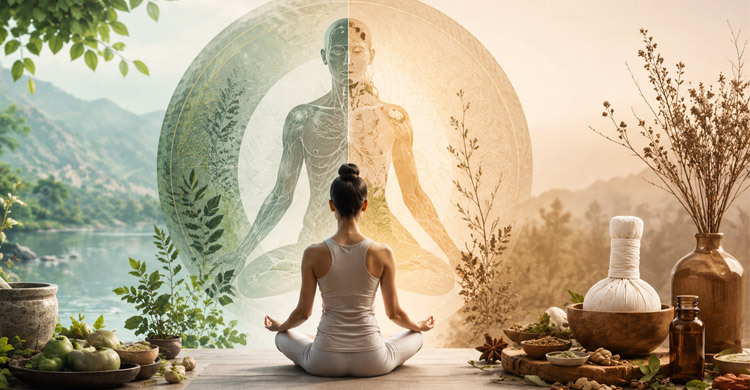
- The Shared Root: Samkhya Philosophy
- What Ayurveda Brings to Yoga Practice
- What Yoga Brings to Ayurvedic Healing
- The Classical Texts Make This Explicit
- Why Modern Yoga Education Separated Them
- Ayurveda and Yoga in Clinical Practice
- The Dosha-Asana Connection in Practice
- Immunity, Ojas, and the Integrated Body
- What This Means for Yoga Teachers
- Bringing the Systems Back Together
- Frequently Asked Questions
There is a quiet frustration many yoga teachers carry. You have your 200-hour certification. You understand asana, pranayama, maybe some philosophy. But when a student walks in with a chronic condition, a hormonal imbalance, or a body worn down by decades of stress, you sense that something is missing. The postures help — but they do not fully address what is happening beneath the surface.
That gap has a name. It is the absence of Ayurveda.
Yoga and Ayurveda are sister sciences. They share the same roots, the same worldview, and the same understanding of what a human being actually is. Separating them was never part of the original design. And for a yoga teacher working with real people carrying real health challenges, understanding why they belong together is not just philosophically satisfying — it is practically essential.
The Shared Root: Samkhya Philosophy
Both systems draw from Samkhya, one of the oldest philosophical frameworks in the Vedic tradition. Samkhya describes reality as the interplay between Purusha (pure consciousness) and Prakriti (matter, or nature). Everything in the physical world — including the human body — is an expression of Prakriti in its various forms.
From this shared foundation, the two systems developed with distinct but complementary purposes.
Ayurveda became the science of life and longevity: maintaining health, preventing disease, and restoring balance when the body moves out of its natural state. Yoga became the science of consciousness: steadying the mind, purifying the subtle body, and moving toward liberation.
Neither system treats the body and mind as separate. Neither treats the individual as separate from their environment. This is not a modern wellness talking point. It is the original architecture.
What Ayurveda Brings to Yoga Practice
Ayurveda introduces the concept of Prakriti — your individual constitutional type, shaped by the balance of the three doshas: Vata, Pitta, and Kapha. Each dosha is a combination of the five elements, and every person carries a unique ratio of all three.
This matters enormously in practice. A person with a predominantly Vata constitution — characterised by qualities of air and space — tends toward anxiety, dryness, and irregular energy. Vigorous, fast-paced vinyasa may aggravate rather than settle them. Grounding, slow, warming practices serve them far better.
A Pitta-dominant practitioner, driven by fire and water, may push too hard, overheat, and turn competitive in ways that create injury rather than integration. Cooling, surrendering practices bring them back into balance.
A Kapha-dominant body, heavier and more stable, often needs the energising quality of dynamic movement to shift stagnation.
Without Ayurvedic understanding, a yoga teacher applies the same sequence to every body in the room. With it, you begin to see each student as a unique constitutional being whose practice needs to be shaped accordingly.
What Yoga Brings to Ayurvedic Healing
The relationship runs in both directions. Ayurveda recognises that disease does not begin in the physical body — it begins in the mind, in the subtle body, in the disruption of prana. The Charaka Samhita, one of Ayurveda's foundational texts, describes yoga practices as essential tools for managing the mental and pranic dimensions of illness.
Pranayama regulates the nervous system in ways that no herb or dietary adjustment alone can achieve. Meditation addresses the manomaya kosha, the mental sheath, where many chronic conditions take root. Specific asana sequences support organ function, the flow of apana vayu (the downward-moving energy), and the health of the digestive fire — agni.
Classical Ayurvedic physicians did not prescribe only herbs and diet. They prescribed yoga as part of the treatment protocol. The two systems were always meant to work together as a complete clinical approach.
The Classical Texts Make This Explicit
The Yoga Sutras of Patanjali, the Hatha Yoga Pradipika, and the Charaka Samhita do not exist in isolation from one another. Scholars of traditional lineage have always read them as part of the same conversation.
The Hatha Yoga Pradipika describes the body in terms that align closely with Ayurvedic anatomy — the nadis (subtle energy channels), the chakras, and the role of prana in maintaining health. These are not metaphors. They are a map of the subtle body that Ayurveda also recognises and works with.
When you study Ayurveda alongside yoga, you are not adding a new subject. You are reading the second half of a text you already started.
Why Modern Yoga Education Separated Them
The separation happened gradually, and largely through globalisation. As yoga moved westward through the twentieth century, it was filtered through a fitness framework. Asana became the primary focus. The philosophical and medical dimensions were simplified or stripped out entirely.
Ayurveda — harder to standardise, less visually demonstrable — was left behind. The result is a generation of yoga teachers who are skilled in movement but lack the constitutional and clinical framework needed to work safely with people whose bodies are under real stress.
This is not a criticism of individual teachers. It is a structural gap in how yoga education has been designed. And it is precisely the gap that a clinically grounded approach to teacher training is built to address.
Ayurveda and Yoga in Clinical Practice
When Ayurvedic understanding enters your teaching, the questions you ask change. Instead of asking which sequence fits this class, you begin asking: what is this person's constitution, what is their current state of imbalance, which dosha needs to be pacified or stimulated, and what practices will support their body's own healing intelligence?
This becomes especially important when working with populations that carry specific health vulnerabilities. An elderly student with Vata aggravation needs a different approach than a postmenopausal woman managing Pitta-related inflammation. A prenatal student in her third trimester requires an understanding of how apana vayu functions during pregnancy and how certain pranayama practices support — or contraindicate — that process.
These are clinical questions. They require clinical training. And that training, done properly, is rooted in both Ayurveda and yoga as a unified system.
The Dosha-Asana Connection in Practice
Here is a simple illustration of how Ayurvedic principles shape a yoga practice:
Vata imbalance (anxiety, dryness, restlessness, poor sleep): Favour slow, grounded, warming sequences. Long holds in seated and supine postures. Nadi Shodhana pranayama. Avoid rapid, irregular movement.
Pitta imbalance (inflammation, irritability, overheating, perfectionism): Favour cooling, surrendering practices. Moon salutations over sun salutations. Sitali pranayama. Avoid competitive or overheating environments.
Kapha imbalance (lethargy, congestion, heaviness, low motivation): Favour dynamic, stimulating sequences. Kapalabhati pranayama. Backbends and inversions. Avoid slow, sedentary practices that reinforce stagnation.
This is not a rigid prescription — constitutions are complex, and current imbalance often differs from baseline constitution. But even this basic framework gives a teacher a far more nuanced and effective approach than a one-size-fits-all sequence ever could.
Immunity, Ojas, and the Integrated Body
Ayurveda describes ojas as the finest product of digestion and the foundation of immunity, vitality, and mental clarity. When ojas is strong, the body resists disease and the mind stays clear. When it is depleted, both deteriorate.
Yoga practices — particularly pranayama, meditation, and restorative asana — are understood in Ayurveda as practices that build and protect ojas. This is why the two systems reinforce each other so naturally. A yoga practice designed with Ayurvedic awareness does not just improve flexibility or strength. It actively supports the body's immune intelligence.
If you are exploring how to take healthy steps towards holistic health, understanding the relationship between ojas, Ayurveda, and yoga practice is a meaningful place to begin.
What This Means for Yoga Teachers
If you want to work with people carrying chronic conditions, hormonal changes, age-related limitations, or recovery from serious illness, the integrated understanding of Ayurveda and yoga is not optional. It is the foundation.
The question is not whether to learn Ayurveda. It is where to learn it in a way that is clinically grounded, taught by practitioners with genuine medical and Ayurvedic authority, and structured so that it translates into safe, effective teaching.
At hellomyyoga.com, every teacher training program is built on this integrated foundation. The faculty includes doctors, vaidyas, and yoga chikitsa acharyas who have spent decades working at the intersection of these two systems. The curriculum is not theoretical — it is designed for teachers who need to apply this knowledge in real clinical contexts, whether with geriatric students, prenatal clients, or cancer survivors in rehabilitation.
You can also explore the platform's recommended reading for yoga practitioners to deepen your philosophical and Ayurvedic understanding alongside formal training.
Bringing the Systems Back Together
The separation of Ayurveda and yoga was never a philosophical decision. It was a practical consequence of globalisation and standardisation. The knowledge was never lost — it was preserved in the texts, in the lineages, and in the teachers who continued to practice both systems as one.
When you study Ayurveda alongside yoga, you do not add a second subject to your training. You complete the picture that was always there. You begin to see your students as whole constitutional beings, not just bodies moving through sequences. And you begin to offer something most yoga teachers simply cannot: a practice that meets each person where their body actually is.
That is the missing link mainstream yoga education leaves behind. And it is exactly where the most meaningful teaching begins.
For those interested in how this integrated approach supports the immune system specifically, the article on how to balance and empower immunity offers a practical entry point into Ayurvedic thinking applied to everyday health.
Frequently Asked Questions
What is the relationship between Ayurveda and Yoga? Ayurveda and Yoga are sister sciences sharing the same philosophical foundation in Samkhya philosophy and the Vedic tradition. Ayurveda focuses on health, longevity, and constitutional balance; Yoga focuses on consciousness, mental steadiness, and spiritual development. Traditionally, they were practiced together as a complete system for human wellbeing — not as separate disciplines.
Can I practice yoga without knowing Ayurveda? Yes, but your practice will be less precise. Without Ayurvedic understanding, you apply the same approach to every body. With it, you can tailor practice to constitution, current state of balance or imbalance, and the specific needs of the individual. For yoga teachers especially, Ayurvedic knowledge significantly improves both the quality and safety of what you offer students.
What are the three doshas in Ayurveda and how do they affect yoga? The three doshas are Vata (air and space), Pitta (fire and water), and Kapha (earth and water). Each person carries a unique combination of all three, and your dominant dosha influences how your body responds to different practices. Vata types benefit from grounding, warming practices; Pitta types from cooling, surrendering practices; Kapha types from dynamic, energising movement.
Why did Ayurveda and Yoga become separated in modern times? Largely through yoga's globalisation in the twentieth century. As yoga entered Western fitness culture, asana became the primary focus and the medical and philosophical dimensions — including Ayurveda — were simplified or removed. This created a structural gap in yoga education that many teachers are now working to address through specialised, clinically grounded training.
How does Ayurveda explain the connection between yoga and immunity? Ayurveda describes ojas as the foundation of immunity and vitality, produced through healthy digestion and balanced living. Yoga practices — particularly pranayama, restorative asana, and meditation — are understood in Ayurveda as practices that build and protect ojas. This is why an integrated Ayurveda and yoga practice supports immune health more effectively than either system practiced in isolation.
Is Ayurvedic knowledge important for yoga teachers who work with clinical populations? Yes, it is essential. When working with elderly students, prenatal clients, or people recovering from serious illness, Ayurvedic constitutional understanding helps a teacher identify what practices are appropriate, what to avoid, and how to adapt their approach to the individual. Clinical yoga training programs that integrate Ayurveda prepare teachers to work safely in these contexts.
Where can I learn Ayurveda and Yoga together in a clinically grounded format? hellomyyoga offers teacher training programs designed by doctors, vaidyas, and yoga chikitsa acharyas that integrate Ayurvedic principles with clinical yoga specialisations. Programs in Geriatric Yoga Care, Prenatal and Postnatal Yoga, and Cancer Survivor Rehabilitation Yoga all draw on this integrated foundation. You can explore the full range of programs at hellomyyoga.com.