

The hot flushes arrive without warning. Sleep thins out. The skin feels drier, the joints stiffer, the mind quicker to worry than it used to be. And somewhere along the way, a doctor or a well-meaning friend says, “It’s just menopause. Learn to live with it.”
Menopause is natural, yes. But “natural” does not have to mean depleted. Ayurveda has spent centuries asking a different question: not how to fight this stage of life, but how to nourish the body through it.
WHAT AYURVEDA CALLS THIS STAGE
Ayurveda calls menopause Rajonivritti – the natural settling of the menstrual cycle. It is not listed as a disease in the classical texts. It is a transition, and like every transition in the body, it has a pattern.
- With age, Vata dosha naturally rises. Vata is dry, light, cold and mobile – and when it rises unchecked, it shows up exactly the way menopause often feels: dryness, poor sleep, restlessness, anxiety, cracking joints.
- The texts also describe Jara, the process of ageing, and Dhatu Kshaya, the gradual thinning of the body’s tissues – bone, muscle, skin, the deeper reserves that once felt abundant.
Put the three together and menopause stops looking like a hormone problem alone. It becomes a nourishment problem: a body whose reserves need rebuilding at the very time its digestion and rhythms are changing.
THE RASAYANA IDEA
This is where Rasayana Chikitsa comes in – Ayurveda’s science of rejuvenation. The word rasayana means “the path of rasa”, the nourishment that feeds every tissue of the body. For Rajonivritti, the classical approach has one primary principle: counter Jara and Dhatu Kshaya while supporting Vata balance. Not aggressive treatment. Not fighting the body. Steady, deep, daily nourishment.
Rasayana works through three doors – food, herbs and conduct – with Panchakarma as gentle support. Each deserves a closer look.
AHARA RASAYANA: FOOD AS DAILY MEDICINE
The first rasayana is the kitchen. For a Vata-rising stage of life, Ayurveda’s guidance is remarkably consistent:
- Warm, cooked, nourishing foods over raw, cold and dry ones
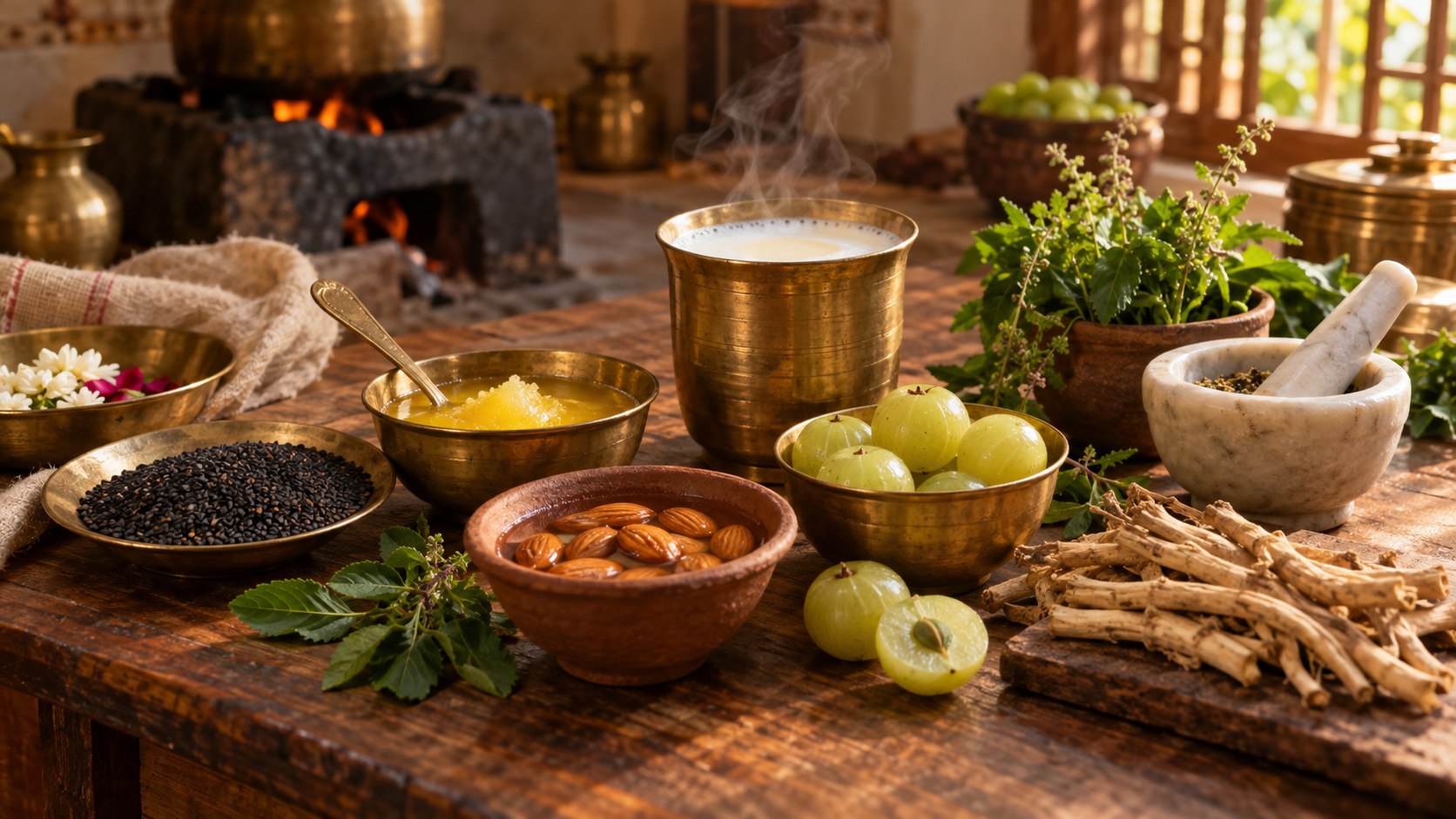
- Ghee, milk, sesame and soaked nuts – the classic building foods
- Phytoestrogen sources such as flax and soy, in moderation
- No excessive dry or cold food, and no irregular eating – regularity itself is a therapy for Vata
Nothing here is exotic. That is the point. Rasayana begins with what is on the plate every single day.
AUSHADHI RASAYANA: THE HERBAL TRADITION
Ayurveda’s classical texts name herbs long associated with this stage of a woman’s life – Shatavari, Ashwagandha and Bala among them. A second group, the Medhya rasayanas – Mandukaparni, Yashtimadhu, Guduchi, Shankhapushpi – is traditionally linked to the mind: memory, calm, clarity. Amla and Gokshura complete the classical picture.
These names belong to a tradition, and that is exactly how they should be read. The texts are equally clear that herbal support is always individualized – chosen for one woman’s constitution, digestion and symptoms by a qualified Ayurvedic physician, not picked off a list. This blog names the tradition; it does not prescribe it.
ACHARA RASAYANA: THE RASAYANA OF CONDUCT
The least known rasayana needs no kitchen and no pharmacy. Achara Rasayana is rejuvenation through the way one lives:
- Truthfulness, a calm mind, and a spirit of service
- A regular daily routine and adequate rest
- Avoiding excess alcohol and chronic stress
Ayurveda observed something modern research keeps confirming: the psychological symptoms of menopause – anxiety, irritability, low mood – respond not only to what a woman takes, but to how she lives. Conduct is medicine.
PANCHAKARMA SUPPORT: GENTLE, NOT AGGRESSIVE
Where deeper support is needed, Ayurveda turns to Panchakarma – but for this stage of life, the keyword is gentle. The classical choices are nourishing rather than purging:
- Matra Basti or Yapana Basti, the oil-based enema therapies considered the foremost support for Vata
- Abhyanga, warm oil massage, and Shirodhara, the steady stream of oil on the forehead that so many women describe as the deepest rest they have had in years
- Nasya, nasal therapy, traditionally used to support sleep and mood
These are therapies done under a qualified physician’s care, as support – never as aggressive purification, and never self-prescribed.
WHERE TO LEARN MORE
Menopause does not have to be a stage of depletion. Understood through Rajonivritti and Rasayana, it can become a stage of deliberate nourishment – food that rebuilds, a routine that steadies Vata, a mind trained toward calm, and therapies that restore rather than strip away.
This is the understanding hellomyyoga’s programs are built on. hellomyyoga offers programs on its website that bring Ayurveda and yoga together for women’s health – including its Ayurveda for Menopause work with Ayurvedic physician Dr Sharon Samuel, and specialised training for yoga teachers who want to support women through menopause and healthy ageing with real knowledge instead of guesswork.
Because “learn to live with it” was never the whole answer. Learning itself is.