

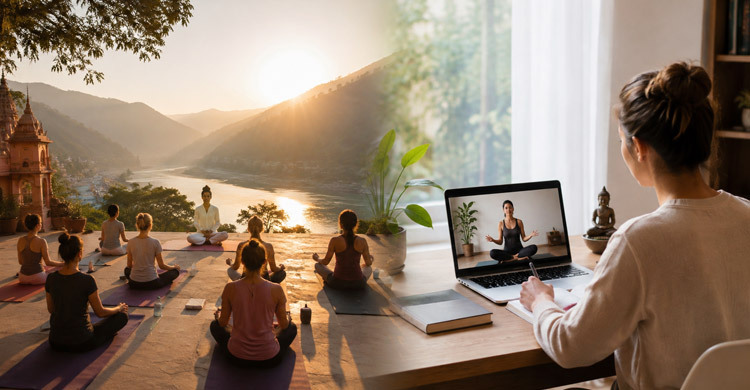
- What a Yoga Retreat in India Actually Offers
- What an Online Specialisation Actually Offers
- Comparing the Two Paths Directly
- When a Retreat Makes More Sense
- When an Online Specialisation Makes More Sense
- The Rasayana Principle Applied to Career Growth
- The Practical Answer
- FAQs
You've done your 200-hour training. You're teaching regularly. And then a student walks in with osteoporosis, or a pregnant woman joins your class, or someone in cancer recovery asks whether yoga can help them.
That moment shifts something. Suddenly the question isn't whether to keep learning — it's how.
Two paths come up most often: attend a yoga retreat in India, or pursue a structured online specialisation. Both have genuine value. But they serve very different purposes, and treating one as a substitute for the other can cost you time, money, and career momentum.
Here's what each path actually delivers, where each falls short, and how to decide which one fits where you want to go.
What a Yoga Retreat in India Actually Offers
India remains the most meaningful destination for yoga immersion. Rishikesh, Mysore, Pune, Kerala, Varanasi — each carries a different lineage, a different pace, a different quality of silence. Spending two weeks or a month in an ashram or retreat centre gives you something no online program can fully replicate: physical presence in the tradition.
You absorb the rhythm of daily sadhana. You sit with teachers whose knowledge was passed down directly, not filtered through a curriculum document. You practise in the environment where the practice was shaped. For many teachers, this kind of immersion is spiritually and personally essential.
The journey home that draws yoga teachers back to India is real. It reconnects you to the source.
But here's what a retreat typically doesn't give you.
What Retreats Usually Don’t Include
Most yoga retreats in India are not structured professional development programs. They're immersive experiences built around a specific style, a specific teacher, or a specific theme. The learning runs deep but tends to be informal. There's no clinical framework for working with elderly students. No module on contraindications in pregnancy. No protocol for adapting practice for someone in cancer rehabilitation.
You may leave more grounded, more inspired, more connected to the tradition. But you rarely leave with a credential that a physiotherapist, an oncologist, or a hospital wellness program will recognise.
There's also a practical cost. A retreat requires you to stop teaching for the duration. If you have a regular class schedule or private clients, that's weeks of income paused and students left without continuity.
What an Online Specialisation Actually Offers
A structured online specialisation is built around a different question entirely: what do you need to know to teach a specific population safely and effectively?
This isn't a general yoga course. A genuine specialisation in geriatric yoga care or prenatal yoga goes into anatomy, physiology, contraindications, therapeutic sequencing, and clinical communication. It's designed by people who understand both yoga and the medical context of the population being served.
The credential matters here in a way it doesn't at a retreat. A hospital, a physiotherapy clinic, a palliative care team, or a prenatal health centre will ask what you're qualified to do. A certificate from a well-designed specialisation program — built by doctors and yoga chikitsa acharyas — answers that question directly.
The hybrid format that better online programs use, combining self-study with live sessions, also preserves real-time learning and community. You're not watching videos in isolation. You're in conversation with faculty and peers working through the same clinical questions.
And you can keep teaching while you train.
The Credential Gap in Generic Programs
A standard 200-hour Yoga Alliance program doesn't prepare you to work with elderly students who have osteoporosis, pregnant women in their third trimester, or people managing the physical aftermath of chemotherapy. These aren't edge cases — they're common situations in any active teaching career.
Generic programs weren't designed to address them. Clinical specialisations are.
Comparing the Two Paths Directly
| Factor | Yoga Retreat India | Online Specialisation |
|---|---|---|
| Depth of immersion | High | Moderate to high (hybrid) |
| Clinical credential | Rarely | Yes, if program is clinically designed |
| Continuity of teaching | Interrupted | Maintained |
| Cost | Variable, often high with travel | 40,000 to 50,000 INR (one-time) |
| Time away from students | Weeks to months | None |
| Ayurvedic and medical grounding | Depends on retreat | Built into curriculum |
| Peer community | Present during retreat | Ongoing (forum-based) |
| Applicable to specific populations | Generally not | Directly |
Neither path is wrong. They serve different needs at different stages of a career.
When a Retreat Makes More Sense
Go to a yoga retreat in India when you need to reconnect. When the practice feels mechanical. When you want to sit with a lineage holder and absorb something that can't be written into a course module. When personal deepening matters more than professional credentialing right now.
A retreat is also worth considering as a reset after years of intensive teaching. Burnout is real in this profession. A month in an ashram can restore what daily studio life gradually depletes.
When an Online Specialisation Makes More Sense
Pursue a clinical specialisation when a student's needs have exceeded your current training. When you want to expand into prenatal classes, senior yoga, or therapeutic yoga for people managing illness. When you want a credential that opens doors to clinical referrals, hospital wellness programs, or specialised private clients.
The three populations most underserved by generic yoga education are elderly students with age-related conditions, pregnant and postpartum women, and people in cancer recovery. These are also the three populations where a qualified specialist commands meaningfully higher fees and earns a different level of professional trust.
A program designed by doctors, vaidyas, and yoga chikitsa acharyas — with clinical frameworks built in from the start — is structurally different from a retreat. It's professional development in the most direct sense.
The Rasayana Principle Applied to Career Growth
There's a concept in Ayurveda worth thinking about here. Rasayana — the practice of deep nourishment and renewal — isn't about quick fixes. It's about building the kind of vitality that sustains you over time. As explored in this reflection on rejuvenation and rebuilding, true renewal requires both inward restoration and outward capacity.
A retreat can be rasayana for the spirit. A specialisation can be rasayana for the career. The teachers who advance fastest tend to be the ones who understand they need both — and sequence them intentionally.
The Practical Answer
If you're asking which path advances your career faster, the honest answer is an online specialisation — specifically a clinically grounded one in a population you're already encountering or want to serve.
A retreat enriches you. A specialisation qualifies you. Both matter. But if the question is career velocity, the credential wins.
For many experienced teachers, the most effective approach is to use a specialisation to build professional credibility and clinical confidence, then use a retreat to deepen the personal practice that sustains the work long-term. These paths aren't competing. They're sequential.
hellomyyoga offers clinically specialised teacher training programs in Geriatric Yoga Care, Prenatal and Postnatal Yoga, and Cancer Survivor Rehabilitation Yoga — each designed by doctors, vaidyas, and yoga chikitsa acharyas. Programs are priced between 40,000 and 50,000 INR on a one-time purchase basis, with no subscription. Explore all programs at hellomyyoga.com.
FAQs
Can a yoga retreat in India count as professional development for a yoga teacher? It depends on the format. An immersive retreat with a recognised lineage teacher can deepen your practice and personal understanding significantly. That said, most retreats don't provide structured clinical training or credentials applicable to specific student populations. For formal professional development, a structured specialisation program is more directly relevant.
Is an online yoga specialisation as credible as an in-person training? Credibility depends on who designed the program, not how it's delivered. A hybrid online program built by doctors, vaidyas, and yoga chikitsa acharyas carries more clinical authority than many in-person retreats that lack medical or therapeutic grounding. The faculty and curriculum matter far more than the format.
How long does a yoga teacher training specialisation typically take? Clinically specialised programs vary, but hybrid formats combining self-study modules with live Zoom sessions are designed to be completed while continuing to teach. The structure is built for working teachers — not those who can step away from their practice for months at a time.
What populations are most underserved by standard 200-hour yoga teacher training? Elderly students with age-related conditions, pregnant and postpartum women, and people in cancer recovery are the three groups most commonly encountered by experienced teachers — and least addressed by generic 200-hour programs. Working with these students requires specific anatomical knowledge, contraindication awareness, and adapted sequencing that standard training simply doesn't cover.
Can I do both a retreat and an online specialisation? Yes, and for many teachers this is the most effective combination. A specialisation builds the clinical credential and professional capacity. A retreat deepens the personal practice and spiritual grounding that sustains long-term teaching. They serve different purposes and work well in sequence.
What should I look for when choosing a yoga specialisation program? Start with who designed the curriculum. Programs built by doctors, vaidyas, and yoga chikitsa acharyas carry a different level of authority than those created by generalist yoga teachers. Also consider whether the program includes live interaction with faculty — not just recorded content — and whether it directly addresses the population you want to serve.
Does a yoga retreat in India improve earning potential for teachers? A retreat can deepen your practice and personal authority, which may attract more serious students over time. But a clinical specialisation has a more direct effect on earning potential — qualifying you for higher-fee private clients, clinical referral networks, and specialised class formats that command premium pricing.