

- What Hatha Yoga Actually Means
- The Classical Framework: Four Pillars of Hatha Practice
- Foundational Hatha Poses for Beginners
- How the Classical Framework Shapes Your Practice
- Common Beginner Mistakes in Hatha Practice
- Building a Sustainable Beginner Practice
- The Living Tradition Behind the Poses
- Frequently Asked Questions
You've probably heard the word "Hatha" dozens of times — on studio schedules, course descriptions, book covers. But most beginners step onto the mat without really knowing what it means, or why it matters for how they practice.
Hatha yoga is not a gentle style invented for newcomers. It is the root system from which nearly every physical yoga tradition you know today has grown. Understanding it changes how you approach every pose, every breath, every moment of stillness.
This article walks you through the classical framework behind Hatha yoga and the foundational poses that embody it — so your practice has roots, not just shapes.
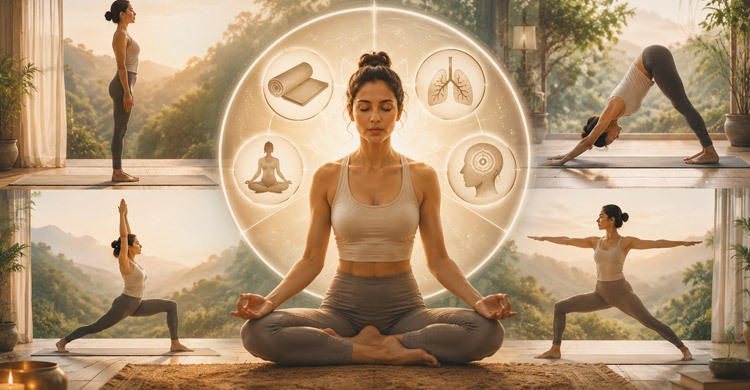
What Hatha Yoga Actually Means
The word Hatha comes from two Sanskrit syllables: ha (sun) and tha (moon). Together, they point to the central purpose of the practice — balancing opposing forces within the body and mind. Effort and ease. Strength and surrender. Solar and lunar rhythms.
This is not metaphor for its own sake. The classical texts that define Hatha yoga, including the Hatha Yoga Pradipika (composed in the 15th century), describe a systematic method for purifying the body so that prana (life force) can move freely through the nadis (energy channels). The physical postures, or asanas, are one part of that method. Breathwork, shatkarmas (cleansing practices), and mudras (energetic seals) are the others.
When you practice Hatha yoga as a beginner, you are not just learning poses. You are entering a classical system designed to prepare the body and nervous system for deeper states of awareness.
The Classical Framework: Four Pillars of Hatha Practice
Before you learn a single pose, it helps to understand what the practice is actually built on.
1. Asana: The Posture as a Foundation
In the Hatha Yoga Pradipika, asana is described as the first rung of practice — and its purpose is not flexibility or fitness. It is sthirata (steadiness) and sukha (ease). Patanjali's Yoga Sutras put it simply: sthira sukham asanam — a posture should be both stable and comfortable.
This framing matters enormously for beginners. You are not trying to achieve a shape. You are trying to find stillness inside one.
2. Pranayama: Breath as the Bridge
Once the body is steady, attention turns to breath. Pranayama is the regulation of prana through conscious breathing. In classical Hatha practice, it follows asana — because a prepared body holds the breath differently than a tense one.
For beginners, even simple breath awareness during poses counts. Noticing whether your breath shortens in a forward fold, or deepens in a twist, is where this practice begins.
3. Pratyahara: Withdrawing the Senses Inward
Pratyahara means turning attention away from external stimulation and toward internal experience. In a Hatha class, this happens when you close your eyes in a standing pose, or stop scanning the room and start feeling what is actually happening inside your body.
Most beginners skip this entirely because no one names it. Knowing it exists gives you something to practice beyond the physical.
4. Dharana: Single-Pointed Focus
Dharana is concentration. In asana practice, it might mean keeping your gaze on a fixed point — a drishti — or holding attention on a single sensation without drifting. It is the quality that separates mechanical movement from genuine practice.
Foundational Hatha Poses for Beginners
These poses appear across classical and contemporary Hatha traditions. They are foundational not because they are easy, but because they teach the principles of the practice most directly.
Tadasana (Mountain Pose)
Tadasana is standing still. That description undersells it completely.
Feet together or hip-width apart, spine long, arms relaxed at the sides, gaze forward. The work is internal: grounding through the feet, lifting through the crown, breathing without collapsing the chest. This is the template for every standing pose you will ever learn. The alignment principles here — rooting down to rise up, engaging without gripping, breathing into the full length of the spine — repeat in every other posture.
Adho Mukha Svanasana (Downward-Facing Dog)
One of the most recognised poses in modern yoga, Adho Mukha Svanasana is an inversion, a forward fold, and a full-body strengthener all at once.
From hands and feet on the floor, hips lift toward the ceiling into an inverted V-shape. The spine lengthens, the hamstrings open, and the shoulders broaden. For beginners, bent knees are not a compromise — they are often the correct starting point, allowing the spine to lengthen before the hamstrings are ready to release. Classically, this pose reverses the flow of energy in the body, bringing fresh circulation to the brain and calming the nervous system.
Virabhadrasana I (Warrior I)
Virabhadrasana I is named after Virabhadra, a fierce warrior figure from Hindu mythology. The pose reflects that quality: one foot forward, one foot back, hips squared toward the front, arms raised overhead.
For beginners, the challenge lives in the hips. The back hip wants to open outward. The practice is to draw it forward without forcing it — finding the balance between effort and structural honesty. This is Hatha yoga's core teaching made physical.
Virabhadrasana II (Warrior II)
Where Warrior I faces forward, Virabhadrasana II opens to the side. Arms extend parallel to the floor, gaze follows the front hand, and the front knee tracks over the front ankle.
This pose builds stamina and teaches you to hold a strong position without gripping in the face and jaw. Watch where you carry unnecessary effort. That is the real practice.
Balasana (Child’s Pose)
Balasana is a resting pose, but it is not passive. Kneeling with hips toward heels and forehead toward the floor, you are in a mild inversion with the spine in gentle flexion.
In classical understanding, rest is not the absence of practice — it is practice with a different quality of attention. Child's Pose teaches you to breathe into the back body, release the effort of holding yourself upright, and stay present even when nothing is happening.
Setu Bandhasana (Bridge Pose)
Setu Bandhasana, or Bridge Pose, is a backbend accessible to most beginners. Lying on the back with knees bent and feet flat on the floor, you press down through the feet and lift the hips toward the ceiling.
This pose opens the chest and hip flexors, strengthens the posterior chain, and introduces the experience of a backbend without the compression risk of deeper poses. The classical texts associate backbends with activating prana vayu — the upward-moving energy associated with vitality and breath.
Savasana (Corpse Pose)
Savasana is the most misunderstood pose in yoga. Lying flat on the back, arms slightly away from the body, eyes closed, doing nothing. It looks like rest. It is actually the hardest pose in the sequence.
The Hatha Yoga Pradipika calls Savasana the remover of fatigue and the calmer of the mind. The challenge is staying present without falling asleep, and releasing muscular effort without losing awareness. Everything you practised in the session integrates here. It is not optional.
How the Classical Framework Shapes Your Practice
Understanding the framework behind these poses changes what you notice on the mat.
When you know that asana prepares the body for pranayama, you stop rushing through poses to get to the next one. When you understand pratyahara, you start catching the moment your attention drifts outward — and you can bring it back. When you know that Savasana is not a reward for finishing class, you stop rolling up your mat before it ends.
This is why starting a yoga practice at any stage of life is more than a physical decision. The classical system meets you wherever you are and gives you a direction to move in.
Common Beginner Mistakes in Hatha Practice
Chasing the Shape Instead of Finding the Sensation
The pose is not the goal. The quality of attention inside the pose is. A shallow Warrior II where you are fully present is more valuable than a deep one where you are thinking about lunch.
Holding the Breath
Many beginners unconsciously hold their breath in challenging poses — which is the opposite of what Hatha practice intends. If you cannot breathe freely in a pose, it is too intense for your current state. Back off until the breath flows again.
Skipping Savasana
This happens constantly. Savasana is the integration period where the nervous system processes everything that happened in the session. Leaving early is like closing a book mid-chapter.
Comparing Progress to Others
Hatha yoga is not a performance. The classical texts describe the body as an instrument for inner exploration, not a vehicle for external display. Your practice is entirely your own.
Building a Sustainable Beginner Practice
A consistent short practice outperforms an occasional long one. Twenty minutes every day builds more than ninety minutes once a week. Start with the foundational poses above, hold each for five to ten breaths, and always close with Savasana.
Add pranayama gradually. Begin with nadi shodhana (alternate nostril breathing), which directly addresses the ha-tha balance the tradition is named for. After your asana practice, sit comfortably, close your eyes, and alternate the breath between nostrils for five minutes. Simple, and quietly powerful.
For practitioners who want to go deeper into the philosophy behind the practice, the hellomyyoga blog explores the intersection of yogic science and everyday wellbeing in depth. The books recommended for yoga lovers also offer a strong starting point for understanding the classical texts.
The Living Tradition Behind the Poses
Hatha yoga did not emerge from a studio. It came from a lineage of practitioners who tested these methods on themselves over centuries and passed them down through direct transmission. The poses you learn today carry that history.
This is also why the quality of teaching matters so much. A teacher who understands the classical framework gives you something a pose-by-pose tutorial cannot — context. And context is what turns a physical practice into a genuine path.
If you are curious about how dedicated teachers continue to develop within this tradition, the work happening through innovative yoga education projects shows what it looks like when classical knowledge meets contemporary commitment.
Frequently Asked Questions
What is the difference between Hatha yoga and other styles like Vinyasa or Ashtanga?
Hatha yoga is the classical root system. Vinyasa and Ashtanga are both derived from it. Hatha classes typically hold poses longer and move more slowly, giving beginners time to find alignment and breathwork inside each shape. Vinyasa links poses with breath in a flowing sequence. Ashtanga follows a fixed series with a specific order and pace. All three share the same foundational poses and principles.
How long should a beginner hold each pose?
Five to ten full breaths is a practical starting point — roughly thirty to sixty seconds depending on your breath pace. Holding longer builds both physical stability and the quality of inner attention that classical Hatha practice is designed to develop.
Do I need to know Sanskrit to practise Hatha yoga?
No, but learning the Sanskrit names gradually adds depth. Sanskrit terms carry precise meaning that English translations often simplify. Knowing that Tadasana means Mountain Pose, for example, tells you something about the quality the pose is reaching for.
Is Hatha yoga suitable for people with injuries or physical limitations?
Many Hatha poses can be adapted for different bodies and conditions. That said, if you have a specific injury or chronic condition, working with a teacher who has clinical training — not just a general yoga certification — makes a meaningful difference. Specialist training in areas like geriatric care or rehabilitation yoga exists precisely for this reason.
How often should a beginner practise Hatha yoga?
Three to four sessions per week is a strong foundation. Daily short sessions of fifteen to twenty minutes are also effective and often more sustainable than longer infrequent ones. Consistency matters more than duration.
Can I learn Hatha yoga from online resources?
You can learn the poses and build a basic practice through online guidance. For deeper understanding of the classical framework, pranayama techniques, and safe alignment, live instruction with an experienced teacher adds significant value. The combination of self-study and live interaction tends to produce the most durable learning.
What should I do if a pose feels painful?
Stop immediately. Pain is not part of the practice. Discomfort from stretching or muscular effort is normal. Sharp, joint, or radiating pain is not. Modify the pose, reduce your range of motion, or rest in Balasana until you can continue comfortably.
Every pose in Hatha yoga is an invitation to pay attention. The classical framework gives that attention a direction. Start with the foundational poses, learn the principles behind them, and let the practice grow from there.
For practitioners ready to explore deeper learning rooted in traditional and clinical knowledge, hellomyyoga offers courses and programs designed by doctors, vaidyas, and yoga chikitsa acharyas. Explore what is available at hellomyyoga.com.